RBI Proposed Kill Switch for Digital Payments Security
Source:Indian Express ↗
Why It Matters
Digital financial inclusion is a key pillar of India's economic growth, but it brings massive cybersecurity challenges. The RBI's regulatory interventions to secure digital payments are highly relevant for GS3 (Indian Economy, Cyber Security) and Prelims (understanding of payment systems like UPI, NEFT, and RBI's mandates).
Summary
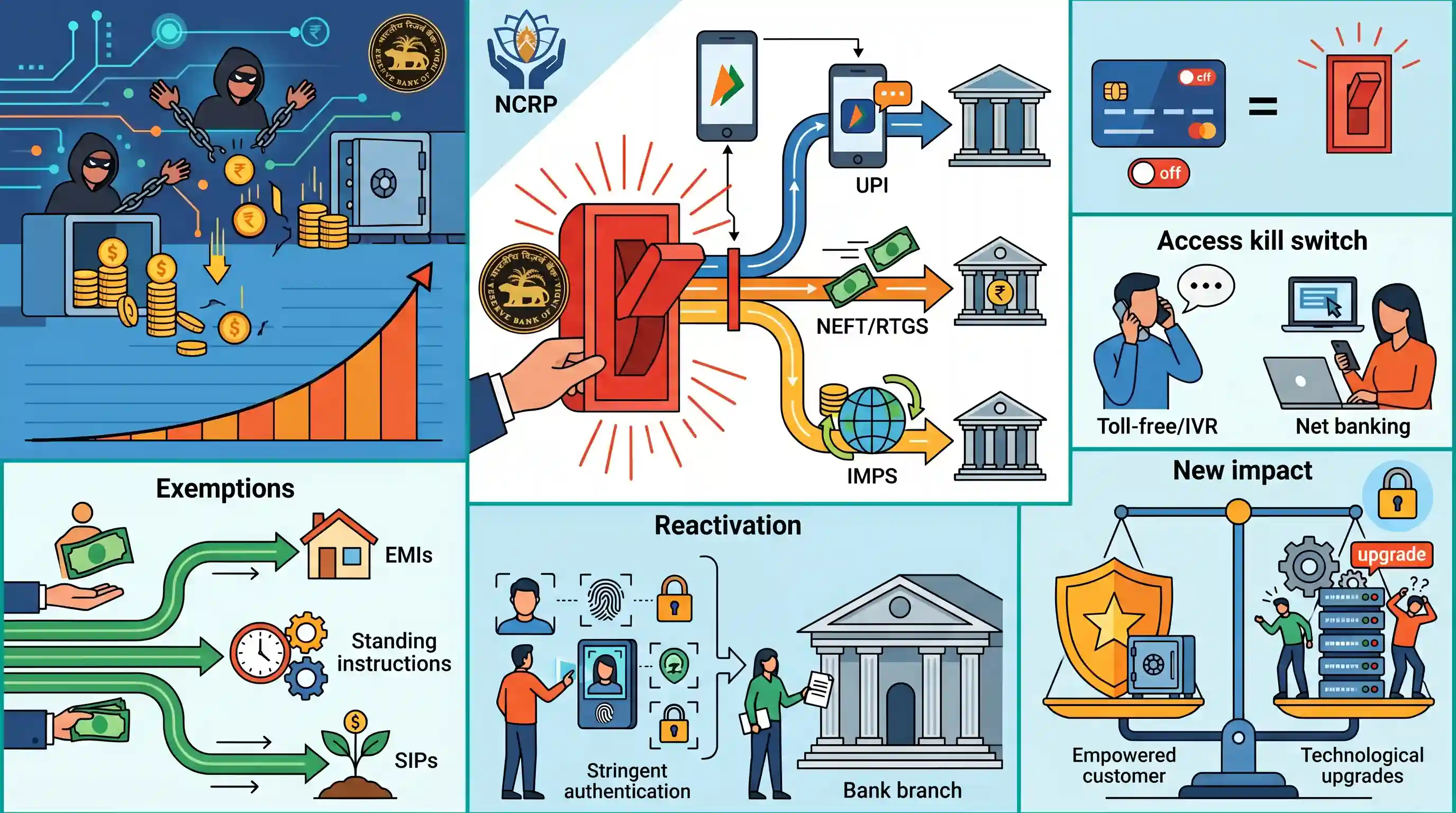
The Reserve Bank of India (RBI) has released a discussion paper proposing a 'Kill Switch' mechanism for digital payments to curb the rising menace of online financial frauds. According to the National Cybercrime Reporting Portal (NCRP), 2025 saw nearly 28 lakh digital fraud incidents amounting to ₹22,931 crore. The proposed Kill Switch will act as an emergency brake, allowing customers to disable all digital payment channels (like UPI, NEFT, RTGS, IMPS) linked to their account in one stroke. While card-based payments currently have switch on/off features, there is no uniform standard across other digital modes. The facility will be easily accessible via toll-free numbers, IVR, or net banking, and its reactivation will require stringent digital authentication or a physical branch visit. Existing payment mandates and standing instructions would be exempt to avoid defaults on EMIs or SIPs. The RBI is also considering whether new accounts should have digital payments disabled by default to further enhance security. While the move empowers customers and bolsters the security ecosystem, it may require significant technological upgrades from banks and poses a risk of inadvertent activation causing payment disruptions.
Key Points
- The Reserve Bank of India (RBI) has proposed a 'Kill Switch' facility to help customers immediately disable all digital transactions from their account in case of a suspected fraud.
- Data from the National Cybercrime Reporting Portal (NCRP) reveals roughly 28 lakh digital payment fraud incidents totaling ₹22,931 crore in 2025.
- The 'Kill Switch' would provide a single-stroke mechanism to halt all digital channels (UPI, IMPS, NEFT, RTGS) uniformly, unlike the current piecemeal facility available mainly for card payments.
- Exemptions to the Kill Switch would include existing mandates and standing instructions (like SIPs and EMIs) to prevent unintended defaults.
- The RBI is also exploring if new bank accounts should have digital payments disabled by default, requiring explicit customer consent to activate.
Important Terms
Kill Switch (Digital Payments)

A proposed RBI mechanism allowing customers to instantly disable all digital payment channels (UPI, NEFT, RTGS, IMPS) linked to their account to prevent further unauthorized transactions during suspected fraud.
UPSC context
GS Paper 3: Economy and Cyber Security. Tests understanding of consumer protection measures in the digital financial ecosystem.
Unified Payments Interface (UPI)
A real-time payment system developed by the National Payments Corporation of India (NPCI) that enables instant inter-bank money transfers through mobile devices using a Virtual Payment Address (VPA).
UPSC context
GS Paper 3: Digital Public Infrastructure (DPI). Essential for questions on financial inclusion and the digital economy.
National Cybercrime Reporting Portal (NCRP)
A citizen-centric online platform under the Ministry of Home Affairs (MHA) that enables victims to report cybercrimes, including financial frauds and crimes against women or children, for law enforcement action.
UPSC context
GS Paper 3: Internal Security. Relevant for strategies to tackle cyber-financial crimes and institutional reporting frameworks.
Indian Cyber Crime Coordination Centre (I4C)
An attached office of the Ministry of Home Affairs (MHA) that serves as the nodal point for law enforcement agencies to coordinate and comprehensively deal with cybercrime across India.
UPSC context
GS Paper 3: Cyber Security. Focuses on the institutional architecture for internal security and inter-agency coordination.
Real-Time Gross Settlement (RTGS)
A continuous, real-time fund transfer system for high-value transactions (typically above ₹2 lakh) where each transaction is settled individually and immediately on a gross basis without netting.
UPSC context
GS Paper 3: Indian Economy. Tests knowledge of core banking systems and payment settlement mechanisms.
National Electronic Funds Transfer (NEFT)
A nationwide electronic fund transfer system that processes transactions in half-hourly batches using a deferred net settlement (DNS) mechanism, suitable for smaller and medium-value transfers.
UPSC context
GS Paper 3: Economy. Frequently appears in comparisons of digital payment infrastructures in Prelims and Mains.
Prelims Trap
"Activating the Kill Switch freezes the entire bank account, stopping all debits including standing instructions for EMIs."
The Kill Switch disables new digital transactions across channels (UPI/RTGS), but deliberately exempts existing mandates and standing instructions to prevent loan defaults.
Static Concepts Connected
What is the institutional framework for cybercrime reporting in India?
- NCRP: A portal under the Ministry of Home Affairs (MHA) allowing citizens to report financial and other cybercrimes online.
- I4C: The Indian Cyber Crime Coordination Centre is the MHA's nodal agency established to provide a coordinated and comprehensive response to cybercrime.
How does the RBI legally regulate digital payment systems?
- PSS Act 2007: The Payment and Settlement Systems Act, 2007 designates the RBI as the sole authority to regulate and supervise all payment systems in India.
- BPSS: The Board for Regulation and Supervision of Payment and Settlement Systems (BPSS) exercises RBI's statutory powers regarding digital payments.
Cross-Topic Patterns
Cybersecurity vs. Financial Inclusion
Transitioning from an 'opt-out' to an 'opt-in' model for digital payments balances consumer protection against the seamless onboarding needed for rural financial inclusion.
Behavioral Economics in Banking Policy
RBI's proposal to keep digital payments disabled by default on new accounts leverages 'Nudge theory' to create positive friction, reducing vulnerability to cyber-fraud.

Expect a mixed Prelims question linking digital payment features (UPI/RTGS), the PSS Act, and MHA's I4C/NCRP framework in 2026.
Linked PYQs · 5
Linked PYQs · 5
- 2023MainsGS3
What is the status of digitalization in the Indian economy? Examine the problems faced in this regard and suggest improvements.
- 2020MainsGS3
Discuss different types of cyber crimes and measures required to be taken to fight the menace.
- 2017PrelimsGS1
Which of the following is a most likely consequence of implementing the 'Unified Payments Interface (UPI)'?
- 2018PrelimsGS1
With reference to digital payments, consider the following statements: 1. BHIM app allows the user to transfer money to anyone with a UPI-enabled bank account. 2. While a chip-pin debit card has four factors of authentication, BHIM app has only two factors of authentication. Which of the statements given above is/are correct?
- 2017PrelimsGS1
Consider the following statements: 1. National Payments Corporation of India (NPCI) helps in promoting the financial inclusion in the country. 2. NPCI has launched RuPay, a card payment scheme. Which of the statements given above is/are correct?
