RBI Monetary Policy Committee Repo Rate Outlook
Source:Indian Express ↗
Why It Matters
Monetary policy is a core pillar of macroeconomic management. The decisions of the MPC directly influence inflation, interest rates, and economic growth. The structure, mandate, and tools of the RBI are fundamental topics in the UPSC syllabus, frequently tested in Prelims (conceptual MCQs) and Mains (evaluating the effectiveness of RBI's policies on inflation and growth).
Summary
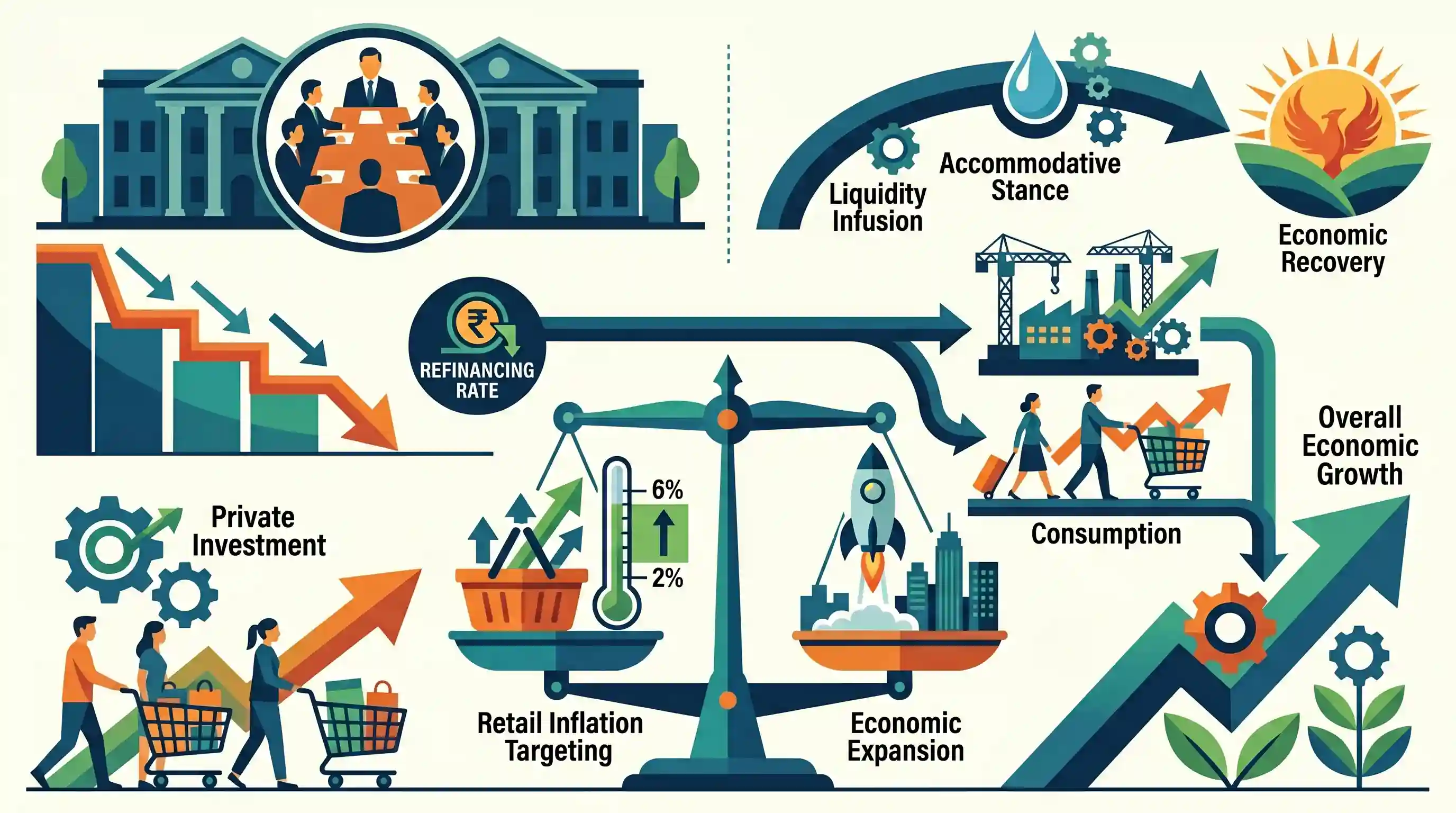
The Reserve Bank of India's Monetary Policy Committee (MPC) is anticipated to reduce the benchmark repo rate for the third consecutive time during its June meeting. This expected rate cut underscores the central bank's focus on lowering borrowing costs to stimulate consumption, encourage private investment, and bolster overall economic growth. The MPC, a six-member body chaired by the RBI Governor, balances the dual mandate of maintaining retail inflation within the target band of 2-6% while fostering economic expansion. An extended accommodative monetary policy stance indicates that the RBI is prioritizing economic recovery and liquidity infusion.
Key Points
- The Reserve Bank of India's (RBI) Monetary Policy Committee (MPC) is expected to cut the repo rate for the third consecutive time in its upcoming June meeting.
- A reduction in the repo rate lowers borrowing costs for commercial banks, which in turn reduces interest rates on loans for consumers and businesses, stimulating economic growth.
- The MPC's decision to cut rates reflects an accommodative monetary policy stance, prioritizing growth while keeping an eye on the statutory inflation target of 4% (+/- 2%).
- Repeated rate cuts are typically deployed to counter economic slowdowns and boost consumption and investment.
Important Terms
Monetary Policy Committee (MPC)

A statutory six-member body chaired by the RBI Governor. It fixes the benchmark repo rate to achieve the inflation target while supporting economic growth through a majority vote.
UPSC context
GS Paper 3 (Economy); crucial for understanding institutional frameworks of monetary policy and the decision-making process.
Repo Rate
The interest rate at which the RBI lends money to commercial banks against government securities. It is the primary tool for controlling liquidity and influencing retail inflation.
UPSC context
GS Paper 3 (Economy); tested in Prelims (definition/impact) and Mains (monetary transmission and its effect on growth).
Inflation Targeting
A framework (since 2016) where the RBI maintains retail inflation (CPI) within a 2-6% band, aiming for a 4% target to ensure price stability for sustainable growth.
UPSC context
GS Paper 3 (Economy); central to discussions on the RBI's mandate, accountability, and macroeconomic stability.
Accommodative Stance
A policy outlook indicating the central bank's willingness to expand the money supply and reduce interest rates to stimulate consumption and investment during slowdowns.
UPSC context
GS Paper 3 (Economy); tests knowledge of policy cycles and the RBI’s response to economic fluctuations.
Reserve Bank of India Act, 1934
The 1934 legislation establishing the RBI; amended in 2016 to provide a statutory basis for the MPC and the flexible inflation targeting framework (Section 45ZB).
UPSC context
GS Paper 2/3; tests the legal and institutional evolution of India's central bank and monetary governance.
Reserve Bank of India (RBI)
India's central bank and regulatory body. It manages currency, supervises the financial system, and ensures monetary stability through tools like the Repo Rate.
UPSC context
GS Paper 3 (Economy); foundational for banking topics, focusing on regulatory powers, autonomy, and the central bank's role.
Prelims Trap
The MPC is responsible for setting the flexible inflation target band of 2-6% for the economy.
The inflation target (4% +/- 2%) is set by the Central Government in consultation with the RBI, not by the MPC itself. The MPC only determines the policy rate.
Static Concepts Connected
What is the composition and voting structure of the Monetary Policy Committee (MPC)?
- Six Members: It comprises 3 members from the RBI (including the Governor as ex-officio Chair) and 3 external members appointed by the Central Government.
- Voting Mechanism: Decisions are taken by a majority vote. The RBI Governor has no veto power, but holds a casting vote in the event of a tie.
What does an 'Accommodative' monetary policy stance mean in UPSC context?
- Growth Focus: The central bank is prepared to lower interest rates to expand the money supply and boost growth, signaling rates will not increase in the near term.
- Versus Other Stances: It contrasts with a 'Neutral' stance (flexibility to move rates either way) and a 'Hawkish' stance (prepared to raise rates to curb inflation).
Cross-Topic Patterns
Monetary Easing vs. Capital Flight
Lowering domestic rates while US Fed rates remain stable or high widens the interest rate differential, risking FPI outflows and downward pressure on the Indian Rupee.
Supply-Side Inflation Constraints
Repo rate cuts primarily manage demand-side liquidity. They remain largely ineffective against persistent headline inflation driven by supply shocks, such as erratic monsoons impacting food prices.

Expect a 2026 Prelims question linking sequential repo rate cuts to their macroeconomic impact on sovereign bond yields and exchange rates.
Linked PYQs · 2
Linked PYQs · 2
- 2017PrelimsGS1
Which of the following statements is/are correct regarding the Monetary Policy Committee (MPC)? 1. It decides the RBI's benchmark interest rates. 2. It is a 12-member body including the Governor of RBI and is reconstituted every year. 3. It functions under the chairmanship of the Union Finance Minister. Select the correct answer using the code given below:
- 2024MainsGS3
What are the causes of persistent high food inflation in India? Comment on the effectiveness of the monetary policy of the RBI to control this type of inflation.
