RBI keeps repo rate unchanged with neutral stance
Source:Indian Express ↗
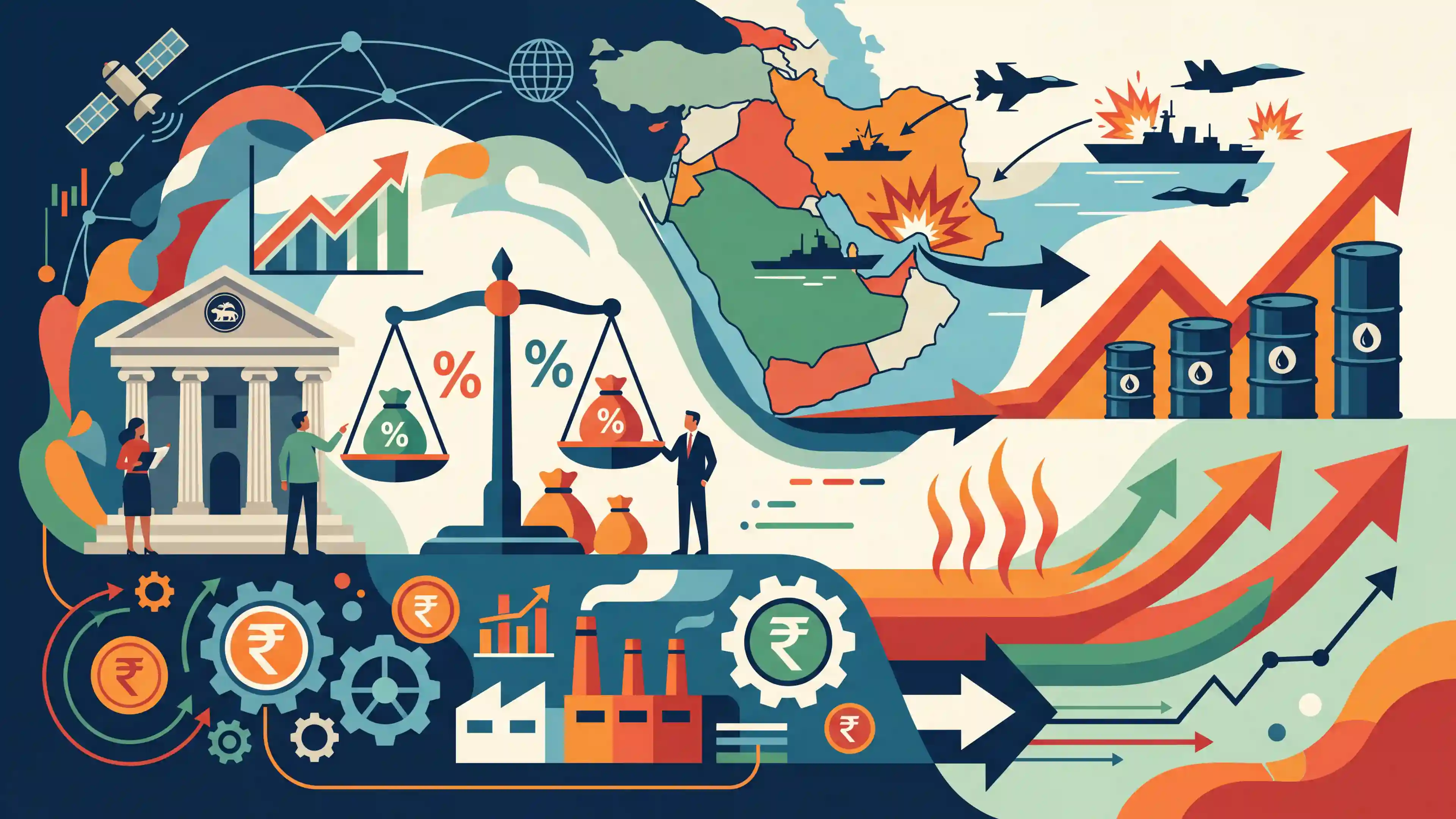
Why It Matters
Understanding the linkage between global geopolitical events (like the West Asia conflict) and domestic monetary policy is crucial for UPSC aspirants. It highlights how external energy supply shocks impact India's inflation and economic growth, influencing the RBI's Monetary Policy Committee decisions on key policy rates.
Summary
The Reserve Bank of India's Monetary Policy Committee (MPC) maintained the policy repo rate at 5.25% with a 'neutral' stance during its April 2026 meeting. RBI Governor Sanjay Malhotra projected India's GDP growth at 6.9% for FY26-27 amidst global uncertainties. Escalating geopolitical tensions in West Asia, particularly the US-Iran conflict and disruptions in the critical Strait of Hormuz, have led to a sharp spike in global crude oil prices. Although a temporary ceasefire has offered some relief, these external supply shocks have influenced the RBI's cautious monetary approach to mitigate imported inflation risks and ensure macroeconomic stability.
Key Points
- The RBI's Monetary Policy Committee maintained the policy repo rate at 5.25% in its April 2026 meeting, retaining a 'neutral' stance.
- India's GDP growth projection for the fiscal year 2026-27 is estimated at 6.9%.
- Heightened US-Iran tensions in West Asia and disruptions in the Strait of Hormuz have caused a sharp spike in global crude oil prices.
- The RBI maintains a cautious approach to manage potential imported inflation risks stemming from global energy supply shocks.
Important Terms
Monetary Policy Committee (MPC)

A six-member statutory body under the RBI Act, 1934, chaired by the Governor. It determines the benchmark repo rate to achieve a specific inflation target while supporting economic growth.
UPSC context
GS-III Indian Economy; tests knowledge of statutory bodies, inflation targeting (4% +/- 2%), and committee-based decision-making.
Standing Deposit Facility (SDF)
A collateral-free liquidity absorption tool introduced in 2022. It allows banks to park excess funds with the RBI at a rate lower than the repo rate, forming the LAF corridor's floor.
UPSC context
GS-III Economy; tests understanding of modern liquidity management tools and the evolution of the Liquidity Adjustment Facility (LAF) framework.
Marginal Standing Facility (MSF)
A penal rate at which scheduled commercial banks can borrow additional overnight funds from the RBI by dipping into their SLR portfolio. It acts as an emergency liquidity safety valve.
UPSC context
GS-III Economy; tests distinction between Repo and MSF, focusing on borrowing limits and the 'ceiling' of the interest rate corridor.
Reserve Bank of India (RBI)
India's central bank and regulatory body responsible for issuing currency, managing payments systems, and ensuring macroeconomic stability through its role as the 'lender of last resort'.
UPSC context
GS-III Economy; fundamental for understanding the institutional framework of India’s financial system and monetary policy transmission.
Prelims Trap
"A neutral stance implies the RBI is bound to keep interest rates unchanged in the next cycle."
A neutral stance actually gives the RBI flexibility to either hike or cut rates based on incoming data. It indicates a data-dependent approach, not a rigid pause or freeze.
Static Concepts Connected
What is the composition and mandate of the Monetary Policy Committee (MPC)?
- Composition: Consists of 6 members: 3 from the RBI (including the Governor) and 3 external experts appointed by the Central Government.
- Primary Mandate: Fixing the benchmark policy interest rate (repo rate) to contain inflation within the statutory target (4% with a +/- 2% tolerance band).
- Decision Making: Decisions are taken by majority vote. The RBI Governor does not have a veto but holds a casting vote in the event of a tie.
Where is the Strait of Hormuz located and what is its strategic significance?
- Connecting Waterways: A vital maritime chokepoint linking the Persian Gulf in the west to the Gulf of Oman and the Arabian Sea in the southeast.
- Bordering Nations: It is bordered by Iran to the north, and the United Arab Emirates and Oman (Musandam peninsula) to the south.
- Energy Chokepoint: Handles a massive share of global seaborne crude oil exports. Any disruption here causes immediate global supply shocks and price spikes.
Cross-Topic Patterns
Geopolitics driving domestic monetary policy
Supply-side shocks from Middle East chokepoints directly dictate RBI’s rate decisions by threatening 'imported inflation,' linking international relations directly to domestic macroeconomic stability.
Maritime chokepoints & strategic reserves
Vulnerabilities in the Strait of Hormuz directly test India's energy security, shifting policy focus toward expanding Strategic Petroleum Reserves (ISPRL) and accelerating domestic renewable energy transitions.

Expect a 2026 Prelims question linking West Asian maritime chokepoints (like Hormuz) directly to macroeconomic impacts like imported inflation.
Linked PYQs · 5
Linked PYQs · 5
- 2014PrelimsGS1
The terms 'Marginal Standing Facility Rate' and 'Net Demand and Time Liabilities', sometimes appearing in news, are used in relation to
- 2017PrelimsGS1
Which of the following statements is/are correct regarding the Monetary Policy Committee (MPC)? 1. It decides the RBI's benchmark interest rates. 2. It is a 12-member body including the Governor of RBI and is reconstituted every year. 3. It functions under the chairmanship of the Union Finance Minister. Select the correct answer using the code given below:
- 2020PrelimsGS1
If the RBI decides to adopt an expansionist monetary policy, which of the following would it not do ? 1. Cut and optimize the Statutory Liquidity Ratio 2. Increase the Marginal Standing Facility Rate 3. Cut the Bank Rate and Repo Rate Select the correct answer using the code given below:
- 2024MainsGS3
What are the causes of persistent high food inflation in India? Comment on the effectiveness of the monetary policy of the RBI to control this type of inflation.
- 2025MainsGS2
"Energy security constitutes the dominant kingpin of India's foreign policy, and is linked with India's overarching influence in Middle Eastern countries.” How would you integrate energy security with India's foreign policy trajectories in the coming years?
