RBI Maintains Repo Rate Unchanged Amid Global Geopolitical Risks
Source:Indian Express ↗
Why It Matters
Illustrates the direct impact of global geopolitical flashpoints (West Asia, Strait of Hormuz) on India's macroeconomic stability and energy security. Aspirants must understand the mechanics of the RBI's Monetary Policy Committee, policy rate tools (Repo, MSF, SDF), and how imported inflation dictates central bank actions.
Summary
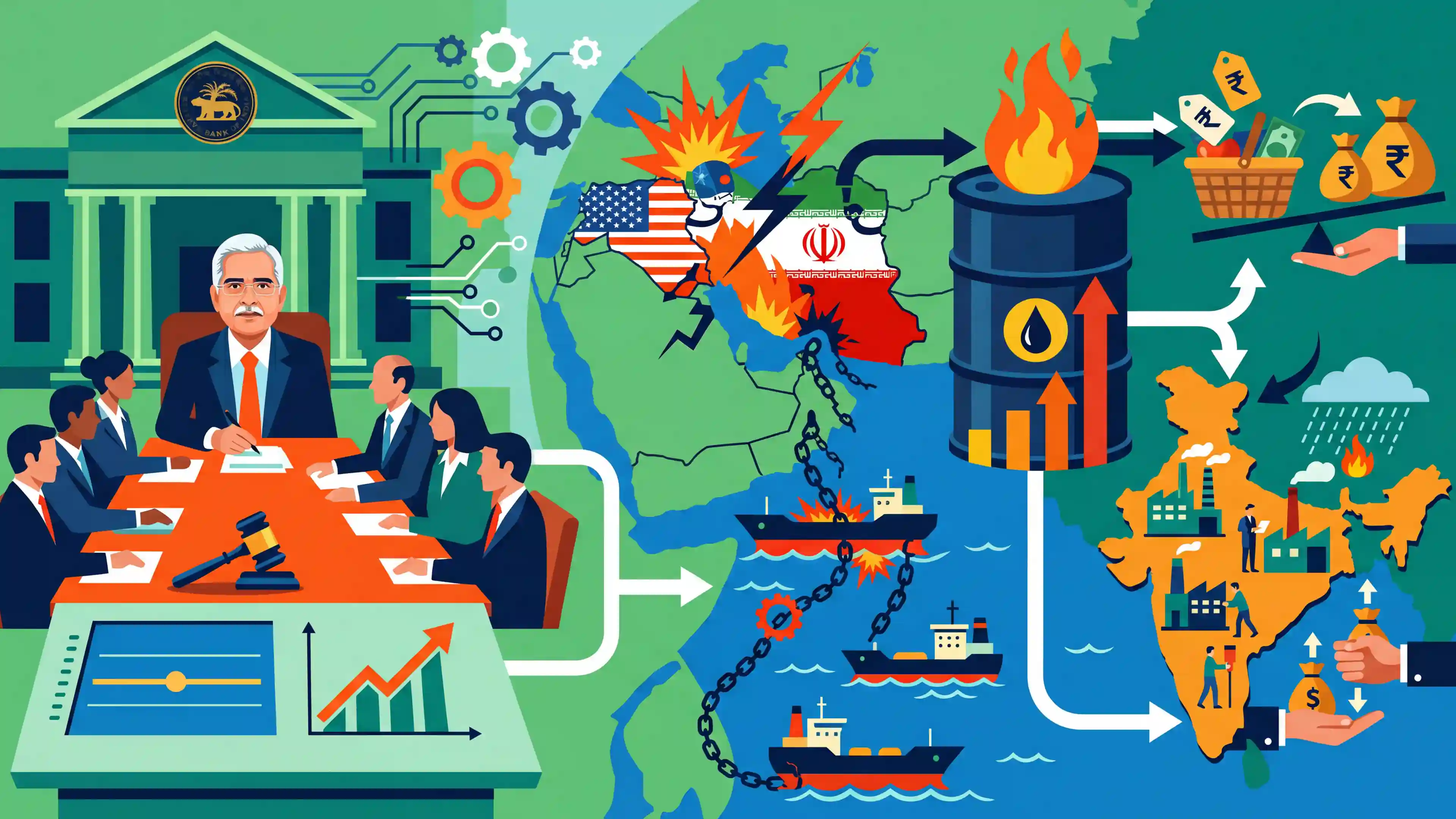
In its April 2026 meeting, the Reserve Bank of India's Monetary Policy Committee (MPC), led by Governor Sanjay Malhotra, kept the benchmark repo rate unchanged at 5.25% and retained a 'neutral' stance. The central bank projected a GDP growth rate of 6.9% for the year. A significant focus of the policy announcement was the heightened global uncertainty stemming from the US-Iran conflict in West Asia. Disruptions in the strategic Strait of Hormuz have caused crude oil prices to spike, raising concerns about imported inflation and its ripple effects on the Indian economy, despite a temporary ceasefire easing some immediate pressure.
Key Points
- The RBI Monetary Policy Committee (MPC) maintained the policy repo rate at 5.25% with a 'neutral' stance during its April 2026 meeting.
- The Standing Deposit Facility (SDF) rate remains at 5.0%, while the Marginal Standing Facility (MSF) rate and Bank Rate stand at 5.5%.
- India's GDP growth for the financial year is projected at 6.9%.
- Global macroeconomic stability faces headwinds from escalating geopolitical tensions, specifically the US-Iran conflict in West Asia.
- Disruptions in the Strait of Hormuz have triggered sharp spikes in crude oil prices, presenting imported inflation risks and supply chain challenges for the Indian economy.
Important Terms
Monetary Policy Committee (MPC)

A statutory six-member body (3 RBI officials, 3 Government nominees) mandated to maintain price stability (target 4% ± 2%) while supporting growth by determining the benchmark repo rate.
UPSC context
GS Paper III (Economy). Tests understanding of institutional frameworks for inflation targeting and consensus-based monetary decision-making.
Repo Rate
The interest rate at which the Reserve Bank of India lends overnight money to commercial banks against government securities to manage liquidity and signal policy stance.
UPSC context
GS Paper III (Economy). Fundamental tool for liquidity management; key to understanding how RBI influences inflation and growth.
Strait of Hormuz
A critical maritime chokepoint between the Persian Gulf and Gulf of Oman; it handles approximately 21% of global oil trade and significant LNG exports.
UPSC context
GS Paper II (IR) & III (Security). Tests knowledge of global trade arteries and risks to India's energy security.
Imported Inflation
A rise in domestic prices caused by the increased cost of imported essential commodities (like crude oil) or significant depreciation of the domestic currency.
UPSC context
GS Paper III (Economy). Crucial for analyzing external shocks to domestic price stability and Balance of Payments.
Standing Deposit Facility (SDF)
A collateral-free liquidity absorption window where banks park surplus funds with the RBI; it currently serves as the "floor" of the interest rate corridor.
UPSC context
GS Paper III (Economy). Tests technical knowledge of modern liquidity tools and the RBI’s interest rate corridor framework.
Marginal Standing Facility (MSF)
An emergency window for scheduled banks to borrow overnight funds from the RBI by dipping into their SLR quota at a higher rate than repo.
UPSC context
GS Paper III (Economy). Represents the "ceiling" of the policy corridor and emergency liquidity measures for financial stability.
Neutral Stance
A policy position indicating the central bank is open to moving interest rates in either direction (up or down) based on future economic data.
UPSC context
GS Paper III (Economy). Tests ability to interpret central bank communication and signaling in different economic cycles.
Prelims Trap
"The SDF allows commercial banks to park excess funds with the RBI by receiving government securities as collateral."
SDF is strictly uncollateralized. The RBI absorbs surplus liquidity from banks without providing government securities, which distinguishes it from the traditional Reverse Repo rate.
Static Concepts Connected
How does the Standing Deposit Facility (SDF) differ from the traditional Reverse Repo window?
- Collateral free: SDF allows the RBI to absorb surplus liquidity without providing government securities as collateral to commercial banks.
- LAF corridor floor: SDF replaced the fixed reverse repo rate as the primary tool to establish the floor of the Liquidity Adjustment Facility (LAF) corridor.
How do global crude oil shocks trigger imported inflation in the Indian economy?
- Direct price effect: High global crude prices directly inflate domestic fuel and transport costs, creating a cascading effect that raises the retail prices of manufactured goods and food.
- Exchange rate pressure: A soaring import bill widens the Current Account Deficit, depreciating the Rupee and subsequently making all other imports more expensive.
Cross-Topic Patterns
Monetary Policy + Chokepoint Geopolitics
Domestic inflation targeting is increasingly hostage to maritime geography. Expect questions linking Strait of Hormuz transit to India's macroeconomic stability and CAD.
Imported Inflation + Strategic Reserves
Crude oil spikes from West Asian conflicts push the urgency for expanding India's Strategic Petroleum Reserves and accelerating green transition targets.

Expect a multi-statement question in 2026 linking Strait of Hormuz geography to India's CAD widening and the RBI's liquidity management.
Linked PYQs · 5
Linked PYQs · 5
- 2020PrelimsGS1
If the RBI decides to adopt an expansionist monetary policy, which of the following would it not do ? 1. Cut and optimize the Statutory Liquidity Ratio 2. Increase the Marginal Standing Facility Rate 3. Cut the Bank Rate and Repo Rate Select the correct answer using the code given below:
- 2022PrelimsGS1
In India, which one of the following is responsible for maintaining price stability by controlling inflation?
- 2017PrelimsGS1
Which of the following statements is/are correct regarding the Monetary Policy Committee (MPC)? 1. It decides the RBI's benchmark interest rates. 2. It is a 12-member body including the Governor of RBI and is reconstituted every year. 3. It functions under the chairmanship of the Union Finance Minister. Select the correct answer using the code given below:
- 2020PrelimsGS1
The term 'West Texas Intermediate', sometimes found in news, refers to a grade of
- 2025MainsGS2
"Energy security constitutes the dominant kingpin of India's foreign policy, and is linked with India's overarching influence in Middle Eastern countries.” How would you integrate energy security with India's foreign policy trajectories in the coming years?
