Monetary Policy Committee Repo Rate Decision and Inflation Management
Source:Indian Express ↗
Why It Matters
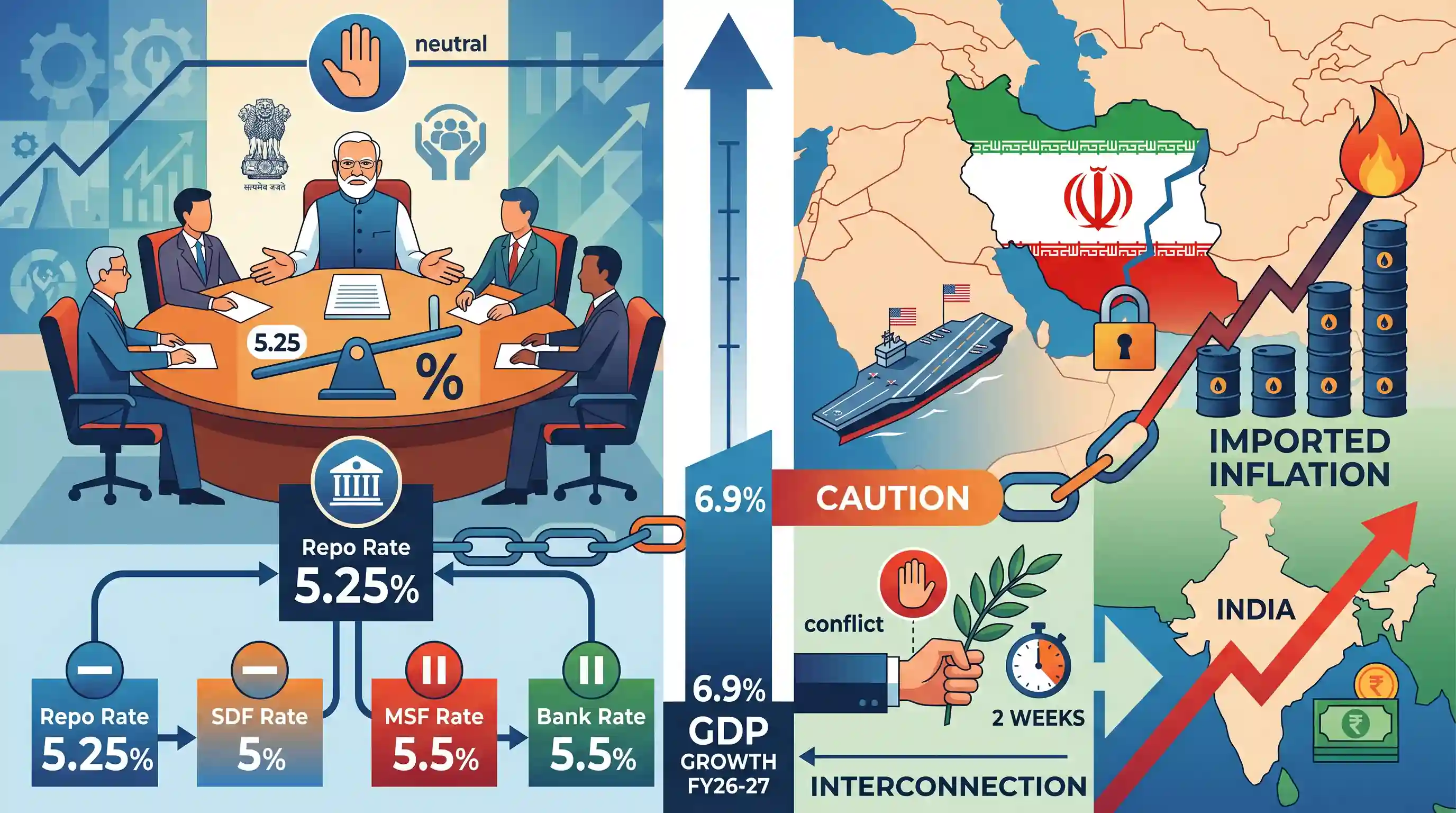
The RBI's monetary policy determines the cost of borrowing in the economy, directly affecting inflation and growth. This update demonstrates the strong interconnection between international relations (West Asian conflicts, Strait of Hormuz blockades) and India's domestic macroeconomic stability, as India imports a vast majority of its crude oil and is highly sensitive to global energy shocks.
Summary
In its April 2026 meeting, the Monetary Policy Committee (MPC) of the Reserve Bank of India, chaired by Governor Sanjay Malhotra, elected to keep the repo rate unchanged at 5.25% and maintained a "neutral" stance. Key liquidity management rates also remained steady, with the Standing Deposit Facility (SDF) rate at 5% and the Marginal Standing Facility (MSF) and Bank rates at 5.5%. GDP growth for FY26-27 was projected at a robust 6.9%. The RBI's cautious approach was heavily influenced by significant geopolitical tensions in West Asia—specifically the US-Iran conflict—which threatened maritime traffic through the critical Strait of Hormuz. These disruptions caused a sharp spike in crude oil prices, raising concerns about imported inflation, although a temporary two-week ceasefire has offered a brief reprieve.
Key Points
- The RBI's Monetary Policy Committee maintained the repo rate at 5.25% and kept its stance neutral during the April 2026 meeting.
- GDP growth for FY2026-27 is projected at 6.9%, with quarterly variations from 6.7% to 7.2%.
- Other policy rates remained unchanged, with the Standing Deposit Facility (SDF) at 5% and both the Marginal Standing Facility (MSF) and Bank Rate at 5.5%.
- The policy review faced heavy constraints from global uncertainty, especially the US-Iran conflict disrupting the Strait of Hormuz, threatening energy supply routes and causing a spike in crude oil prices.
- A temporary ceasefire eased immediate concerns, but the MPC remains cautious of upside inflation risks from volatile energy markets.
Important Terms
Monetary Policy Committee (MPC)

A six-member body under the RBI Act, 1934, mandated to determine the policy interest rate (repo rate) required to achieve the target inflation rate.
UPSC context
GS Paper III (Economy); tests understanding of institutional frameworks for inflation targeting and price stability.
Repo Rate
The interest rate at which the RBI lends liquidity to commercial banks against the collateral of government and other approved securities.
UPSC context
GS Paper III (Economy); essential for understanding monetary policy transmission and tools for controlling inflation.
Standing Deposit Facility (SDF)
A collateral-free liquidity absorption mechanism that allows banks to park surplus funds with the RBI at a rate below the repo rate.
UPSC context
GS Paper III (Economy); tests knowledge of modern liquidity management tools and the floor of the LAF corridor.
Marginal Standing Facility (MSF)
An emergency window for banks to borrow overnight from the RBI at a higher rate by dipping into their Statutory Liquidity Ratio (SLR) portfolio.
UPSC context
GS Paper III (Economy); tests understanding of emergency liquidity support and the upper ceiling of the interest rate corridor.
Neutral Stance
A policy posture where the central bank remains flexible to either increase or decrease interest rates based on evolving macroeconomic data.
UPSC context
GS Paper III (Economy); tests ability to interpret central bank communication and its future policy trajectory.
Strait of Hormuz
A vital maritime chokepoint between Iran and Oman through which a significant portion of the world's seaborne oil and natural gas passes.
UPSC context
GS Paper II (IR) and III (Energy Security); tests impact of West Asian geopolitics on Indian inflation and energy security.
Reserve Bank of India (RBI)
India's central bank responsible for regulating the banking system, issuing currency, and managing the country's monetary policy and foreign exchange reserves.
UPSC context
GS Paper III (Economy); foundational knowledge of central banking functions and financial sector regulation.
Prelims Trap
A 'neutral' stance implies the RBI is pausing the rate cycle and will not hike rates further.
A neutral stance means the MPC retains flexibility to either cut or hike rates based on incoming data. It is an 'accommodative' stance that signals rate hikes are generally off the table.
Static Concepts Connected
What constitutes the modern Liquidity Adjustment Facility (LAF) corridor?
- Upper Bound: Marginal Standing Facility (MSF) – the penal rate for banks to borrow emergency funds.
- Middle Rate: Repo Rate – the standard policy rate at which the RBI lends short-term funds to banks.
- Lower Bound: Standing Deposit Facility (SDF) – the collateral-free window used by RBI to absorb excess liquidity from the system.
What makes the Strait of Hormuz an economic chokepoint?
- Geographic Link: It is a narrow maritime passage connecting the oil-rich Persian Gulf to the Gulf of Oman and the Arabian Sea.
- Energy Transit: It handles roughly 20-25% of global seaborne oil trade, serving as a critical artery for energy security.
- Vulnerability: Disruptions here directly spike global crude prices, leading to a widened CAD and imported inflation in oil-dependent nations like India.
Cross-Topic Patterns
Geopolitics dictating Monetary Policy
West Asian conflicts threatening the Strait of Hormuz directly widen India's Current Account Deficit (CAD) and trigger imported inflation, forcing the RBI to maintain tight monetary stances despite domestic growth.
SDF vs Reverse Repo in Liquidity Management
UPSC frequently tests monetary tools. Note how the collateral-free Standing Deposit Facility (SDF) has effectively replaced the Reverse Repo rate as the lower floor of the Liquidity Adjustment Facility (LAF) corridor.

A mixed Geography/Economy prelims question mapping Middle-East chokepoints (Hormuz/Red Sea) to macroeconomic effects like imported inflation is highly likely.
Linked PYQs · 5
Linked PYQs · 5
- 2022PrelimsGS1
In India, which one of the following is responsible for maintaining price stability by controlling inflation?
- 2017PrelimsGS1
Which of the following statements is/are correct regarding the Monetary Policy Committee (MPC)? 1. It decides the RBI's benchmark interest rates. 2. It is a 12-member body including the Governor of RBI and is reconstituted every year. 3. It functions under the chairmanship of the Union Finance Minister. Select the correct answer using the code given below:
- 2020PrelimsGS1
If the RBI decides to adopt an expansionist monetary policy, which of the following would it not do ? 1. Cut and optimize the Statutory Liquidity Ratio 2. Increase the Marginal Standing Facility Rate 3. Cut the Bank Rate and Repo Rate Select the correct answer using the code given below:
- 2020PrelimsGS1
The term 'West Texas Intermediate', sometimes found in news, refers to a grade of
- 2024PrelimsGS1
Consider the following statements : Statement-I : Sumed pipeline is a strategic route for Persian Gulf oil and natural gas shipments to Europe. Statement-II : Sumed pipeline connects the Red Sea with the Mediterranean Sea. Which one of the following is correct in respect of the above statements?
