RBI Keeps Repo Rate Steady Amid Global Uncertainties
Source:Indian Express ↗
Why It Matters
RBI monetary policy reviews are crucial for understanding macroeconomic stability, inflation management, and liquidity tools (Repo rate, SDF, MSF). Additionally, the article highlights the direct vulnerability of India's inflation targeting to imported inflation via global geopolitical shocks, such as crude oil supply disruptions in the Strait of Hormuz.
Summary
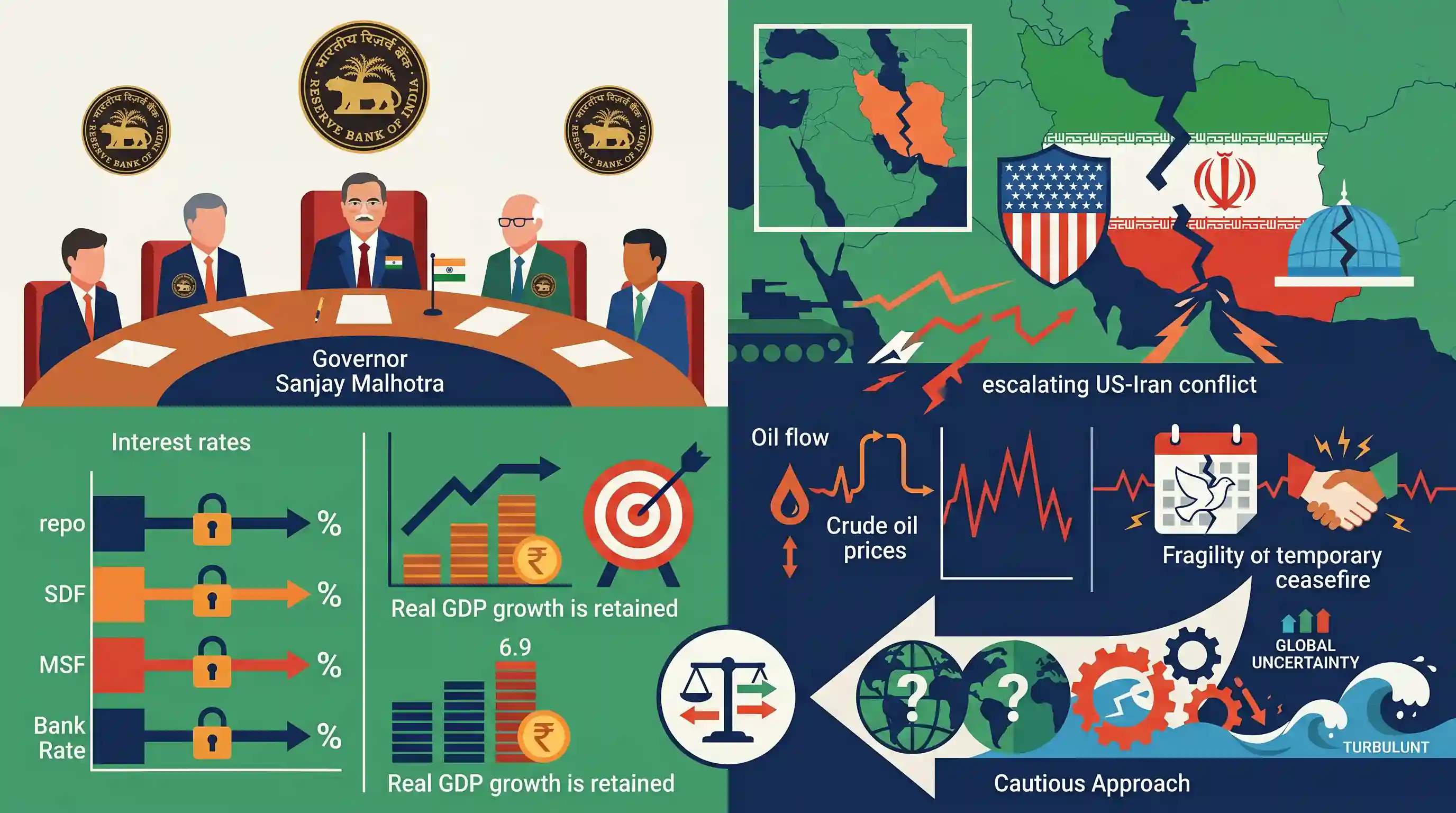
The RBI's Monetary Policy Committee (MPC), led by Governor Sanjay Malhotra, opted to keep the benchmark repo rate unchanged at 5.25% in its April 2026 meeting, maintaining a 'neutral' policy stance. The Standing Deposit Facility (SDF) rate remains at 5%, while the Marginal Standing Facility (MSF) and Bank Rate are steady at 5.5%. The central bank retained its real GDP growth projection at 6.9% for the year. The decision reflects a cautious approach amid heightened global uncertainty, primarily driven by the escalating US-Iran conflict in West Asia. Tensions threatening the Strait of Hormuz have caused fluctuations in crude oil prices, posing potential inflationary risks to the Indian economy despite a temporary ceasefire.
Key Points
- The RBI Monetary Policy Committee kept the repo rate unchanged at 5.25% in April 2026, with a 'neutral' stance.
- Consequently, the Standing Deposit Facility (SDF) rate remains at 5%, and the Marginal Standing Facility (MSF) rate and Bank Rate at 5.5%.
- Real GDP growth projection for the current financial year is retained at 6.9%.
- The RBI's caution is driven by global uncertainties, especially the US-Iran conflict in West Asia threatening energy routes like the Strait of Hormuz and spiking crude oil prices.
Important Terms
Monetary Policy Committee (MPC)

A six-member statutory body under the RBI Act (Section 45ZB) responsible for fixing the benchmark policy rate to achieve the inflation target while supporting growth.
UPSC context
GS Paper III (Economy); tests knowledge of statutory bodies, inflation targeting frameworks, and executive vs. central bank roles.
Standing Deposit Facility (SDF)
A collateral-free liquidity absorption tool that allows the RBI to absorb surplus funds from banks. It serves as the floor of the Liquidity Adjustment Facility (LAF) corridor.
UPSC context
GS Paper III (Economy); tests understanding of modern monetary tools and the evolution of the LAF corridor.
Marginal Standing Facility (MSF)
A window for banks to borrow overnight funds from the RBI against government securities at a higher interest rate, acting as the ceiling of the LAF corridor.
UPSC context
GS Paper III (Economy); tests knowledge of banking liquidity management and emergency funding mechanisms.
Strait of Hormuz
A narrow, strategic waterway between Iran and Oman connecting the Persian Gulf to the open ocean; a critical global chokepoint for crude oil and gas.
UPSC context
GS Paper I (Geography) & II (International Relations); critical for energy security and West Asian geopolitics.
Neutral Policy Stance
A policy outlook where the central bank remains flexible, indicating it may either increase or decrease interest rates based on evolving macroeconomic data without a predetermined bias.
UPSC context
GS Paper III (Economy); tests ability to interpret central bank communication and policy signaling.
Repo Rate
The benchmark interest rate at which the Reserve Bank of India lends money to commercial banks against government securities to control inflation and money supply.
UPSC context
GS Paper III (Economy); foundational concept for banking, inflation control, and cost of credit.
Prelims Trap
"Standing Deposit Facility (SDF) requires the RBI to provide government securities as collateral to commercial banks."
Aspirants confuse SDF with traditional reverse repo. SDF is intentionally collateral-free, allowing the RBI to absorb unlimited excess liquidity without exhausting its G-Sec inventory.
Static Concepts Connected
How is the RBI's Liquidity Adjustment Facility (LAF) corridor structured?
- Corridor Ceiling: Marginal Standing Facility (MSF) rate, serving as the penal rate for emergency overnight borrowing.
- Benchmark Rate: The Repo rate, situated in the middle, acting as the primary policy signaling rate.
- Corridor Floor: Standing Deposit Facility (SDF) rate, which allows the RBI to absorb excess liquidity from banks without providing collateral.
What do different Monetary Policy stances indicate?
- Neutral Stance: The RBI retains complete flexibility to either cut or hike policy rates based on incoming macroeconomic data.
- Accommodative Stance: The central bank aims to expand money supply to boost economic growth; rate hikes are effectively ruled out.
- Hawkish Stance: The primary focus is curbing inflation, making policy rate hikes and a tighter money supply highly likely.
Cross-Topic Patterns
Strait of Hormuz & imported inflation
Geopolitical chokepoints directly impact India's current account deficit and CPI via imported inflation, often forcing the RBI to prioritize price stability over domestic growth mandates.
LAF framework normalization
The introduction of SDF fundamentally shifted the LAF corridor by creating a collateral-free floor, ending the central bank's reliance on the fixed reverse repo rate for liquidity absorption.

LAF corridor mechanics (SDF vs MSF) paired with imported inflation from West Asian maritime chokepoints is a highly probable 2026 Prelims target.
Linked PYQs · 3
Linked PYQs · 3
- 2020PrelimsGS1
If the RBI decides to adopt an expansionist monetary policy, which of the following would it not do ? 1. Cut and optimize the Statutory Liquidity Ratio 2. Increase the Marginal Standing Facility Rate 3. Cut the Bank Rate and Repo Rate Select the correct answer using the code given below:
- 2022PrelimsGS1
In India, which one of the following is responsible for maintaining price stability by controlling inflation?
- 2024MainsGS3
What are the causes of persistent high food inflation in India? Comment on the effectiveness of the monetary policy of the RBI to control this type of inflation.
