RBI monetary policy repo rate and inflation stance decisions
Source:Indian Express ↗
Why It Matters
RBI's monetary policy tools (repo rate, MSF, SDF) and their stances are fundamental concepts in the GS3 Economy syllabus, critical for managing inflation and fostering growth. Additionally, understanding how global events (like conflicts in the Strait of Hormuz) impact India's energy security and inflation imports is a recurring theme in both GS2 International Relations and GS3 Economy.
Summary
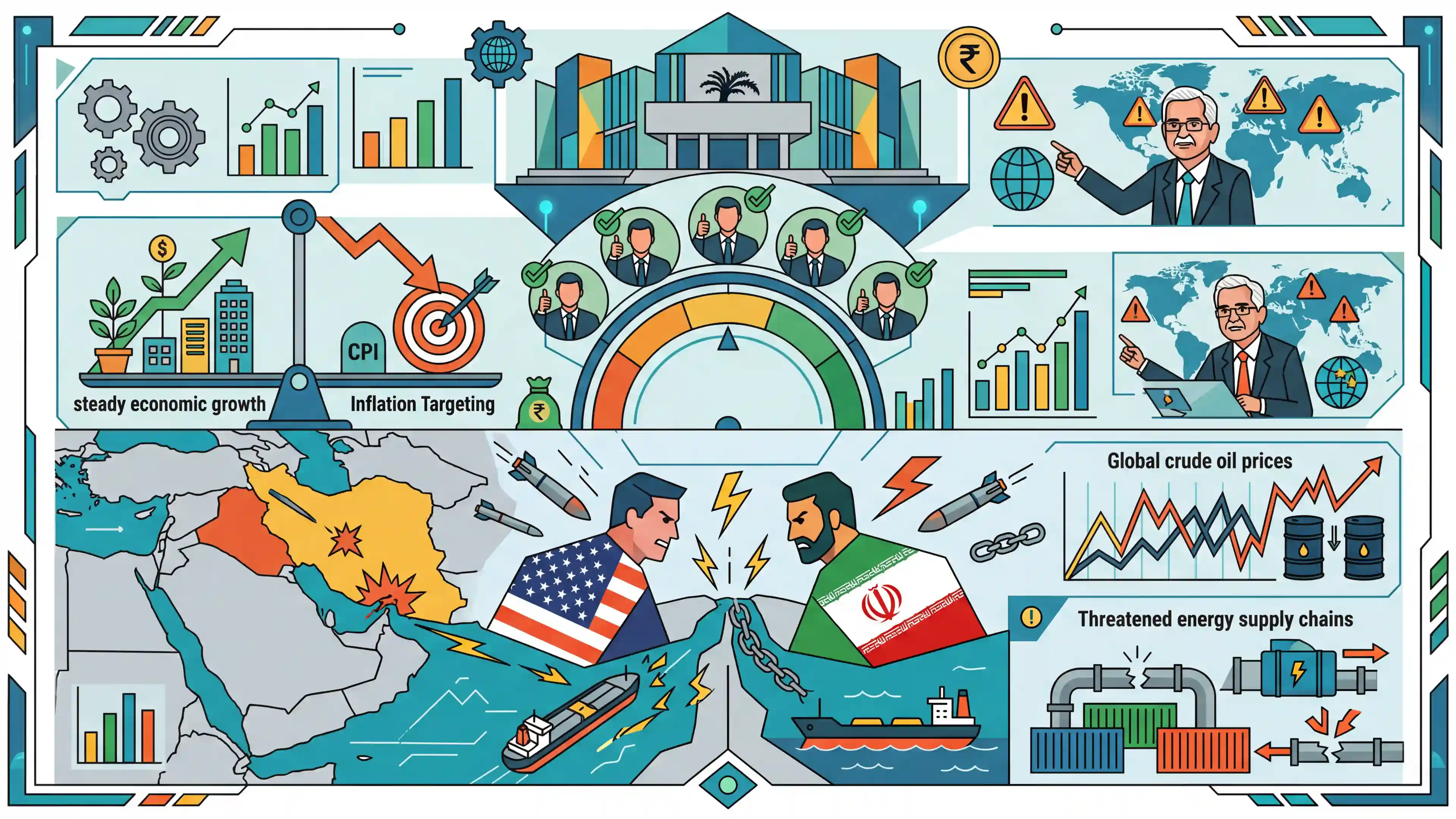
The Reserve Bank of India’s Monetary Policy Committee voted unanimously to keep the repo rate unchanged at 5.25% in its April 2026 meeting, maintaining a 'neutral' stance. The decision balances steady economic growth—projected at 6.9% for FY26-27—with ongoing efforts to align inflation with the 4% target. While domestic economic fundamentals remain resilient, RBI Governor Sanjay Malhotra highlighted significant external macroeconomic risks. Notably, heightened geopolitical tensions in West Asia between the US and Iran, alongside threats to the Strait of Hormuz, have created volatility in global crude oil prices and threatened energy supply chains.
Key Points
- The RBI's Monetary Policy Committee unanimously decided to keep the repo rate unchanged at 5.25% during its April 2026 meeting.
- The monetary policy stance remains 'neutral', giving the RBI flexibility to maneuver depending on the inflation trajectory towards the 4% target.
- The Standing Deposit Facility (SDF) rate was kept at 5.0%, and the Marginal Standing Facility (MSF) rate and Bank Rate at 5.5%.
- India's GDP growth projection for FY 2026-27 is set at 6.9%.
- External risks loom large due to escalating US-Iran tensions and potential disruptions in the Strait of Hormuz, threatening energy supply routes and driving volatility in crude oil prices.
Important Terms
Monetary Policy Committee (MPC)

A statutory 6-member body under the RBI Act, 1934, mandated to determine the policy repo rate required to achieve the inflation target while supporting economic growth.
UPSC context
GS Paper 3 (Economy); tests knowledge of institutional frameworks for price stability and monetary governance.
Standing Deposit Facility (SDF)
A collateral-free liquidity absorption tool introduced in 2022 that allows banks to park excess funds with the RBI; it serves as the floor of the Liquidity Adjustment Facility corridor.
UPSC context
GS Paper 3 (Economy); relevant for understanding modern liquidity management and the shift from reverse repo.
Marginal Standing Facility (MSF)
An emergency window for scheduled commercial banks to borrow overnight funds from the RBI at a rate higher than the repo rate by pledging SLR-quota securities.
UPSC context
GS Paper 3 (Economy); tests understanding of penal rates and emergency liquidity windows in the banking system.
Repo Rate
The benchmark interest rate at which the RBI lends money to commercial banks against government securities to manage liquidity and control inflation in the economy.
UPSC context
GS Paper 3 (Economy); fundamental tool for inflation control and economic stimulus.
Inflation Targeting
A framework where the RBI is mandated to maintain Consumer Price Index (CPI) inflation at 4%, within a tolerance band of +/- 2%.
UPSC context
GS Paper 3 (Economy); core objective of India's monetary policy framework since 2016.
Reserve Bank of India (RBI)
India's central bank and regulatory body established in 1935, responsible for monetary policy, currency issuance, and maintaining the country's financial stability.
UPSC context
GS Paper 3 (Economy); essential for understanding the regulator's role in macroeconomics and banking.
Prelims Trap
The Standing Deposit Facility (SDF) allows banks to park excess liquidity with the RBI backed by government securities.
SDF is explicitly collateral-free. It was introduced to absorb excess liquidity without the RBI needing to provide government securities to banks.
Static Concepts Connected
What constitutes the modern Liquidity Adjustment Facility (LAF) corridor?
- Upper Bound: Marginal Standing Facility (MSF) - penal rate for overnight borrowing using the SLR quota.
- Policy Rate: Repo Rate - standard rate for short-term borrowing against approved government collateral.
- Lower Bound: Standing Deposit Facility (SDF) - collateral-free rate to park surplus funds.
What is the geographical and economic significance of the Strait of Hormuz?
- Location: A narrow maritime chokepoint connecting the Persian Gulf to the Gulf of Oman and Arabian Sea.
- Bordering Nations: Bounded by Iran to the north and Oman and the UAE to the south.
- Economic Impact: Handles ~20% of global oil transit; disruptions cause immediate imported cost-push inflation in import-dependent India.
Cross-Topic Patterns
Monetary Policy meets Map Work
RBI's domestic inflation targeting is increasingly vulnerable to West Asian maritime chokepoints, making integrated Economy-Geography questions highly probable.
Imported Inflation dynamics
Connecting crude oil supply shocks directly to India's Current Account Deficit (CAD) and cost-push inflation, overriding domestic monetary tightening.

Expect a multi-statement prelims question linking the LAF corridor (SDF/MSF) with imported inflation driven by West Asian chokepoints.
Linked PYQs · 4
Linked PYQs · 4
- 2014PrelimsGS1
The terms 'Marginal Standing Facility Rate' and 'Net Demand and Time Liabilities', sometimes appearing in news, are used in relation to
- 2020PrelimsGS1
If the RBI decides to adopt an expansionist monetary policy, which of the following would it not do ? 1. Cut and optimize the Statutory Liquidity Ratio 2. Increase the Marginal Standing Facility Rate 3. Cut the Bank Rate and Repo Rate Select the correct answer using the code given below:
- 2017PrelimsGS1
Which of the following statements is/are correct regarding the Monetary Policy Committee (MPC)? 1. It decides the RBI's benchmark interest rates. 2. It is a 12-member body including the Governor of RBI and is reconstituted every year. 3. It functions under the chairmanship of the Union Finance Minister. Select the correct answer using the code given below:
- 2024MainsGS3
What are the causes of persistent high food inflation in India? Comment on the effectiveness of the monetary policy of the RBI to control this type of inflation.
