RBI Proposes Compensation Framework for Digital Payment Fraud Victims
Source:The Hindu ↗
Why It Matters
The article bridges internal security (cybercrimes and digital fraud) with core macroeconomic policies (MSME credit, banking regulations, and alternative investment funds). It highlights the RBI's proactive measures to protect digitally vulnerable citizens while deepening financial inclusion, which frequently forms the basis for GS3 Mains questions and Prelims concepts on banking frameworks.
Summary
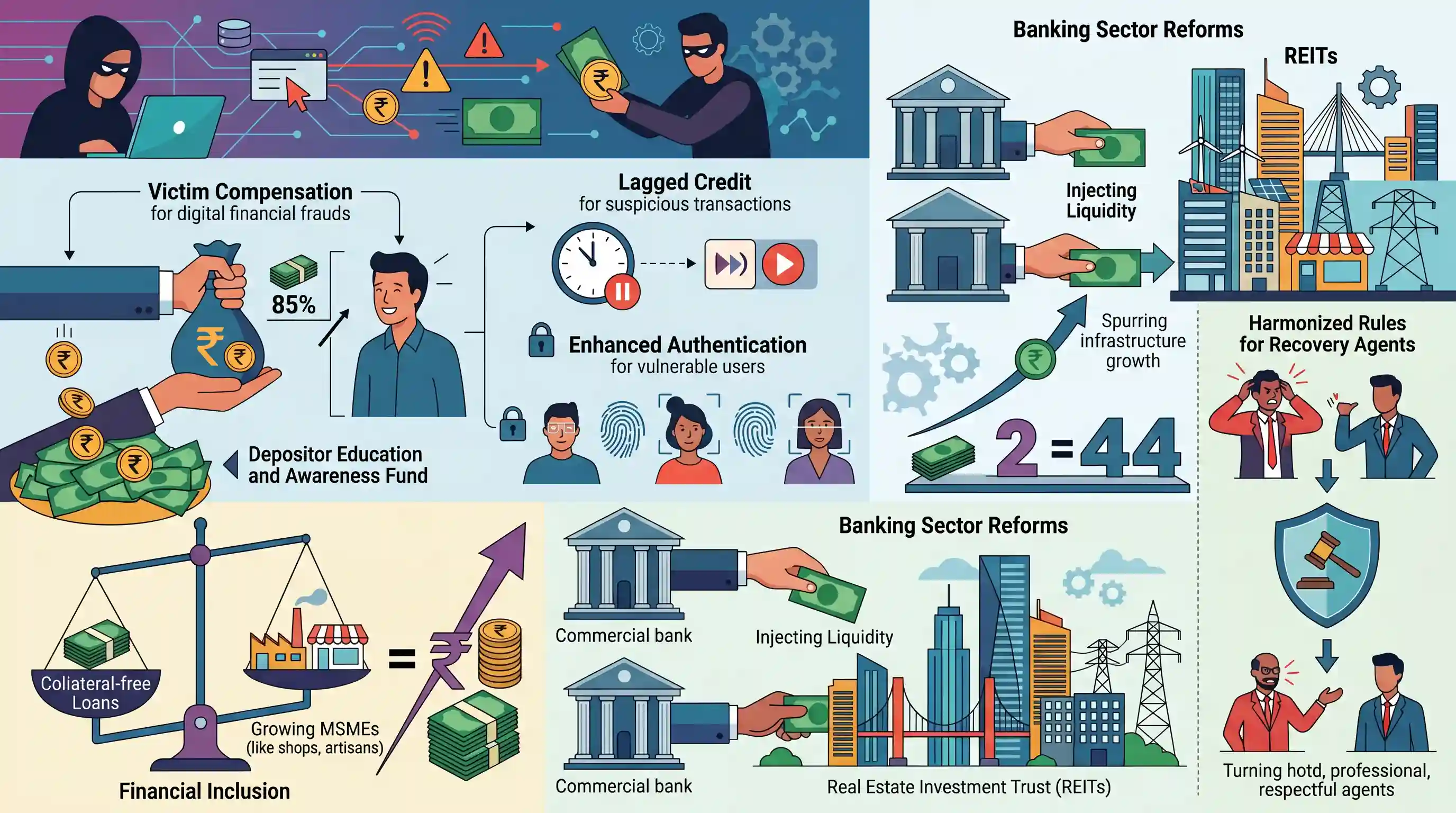
The Reserve Bank of India (RBI) has unveiled a comprehensive suite of measures to address the surge in digital financial frauds and bolster economic inclusion. Central to these proposals is a framework to compensate victims of small-value cyber frauds up to ₹25,000 (or 85% of the loss) using funds from the Depositor Education and Awareness Fund. To mitigate future risks, the RBI aims to implement lagged credit for suspicious transactions and enhanced authentication for vulnerable users. In parallel economic measures, the RBI doubled the collateral-free loan limit for MSMEs to ₹20 lakh to spur enterprise growth and allowed commercial banks to lend to Real Estate Investment Trusts (REITs) to inject liquidity into the infrastructure and real estate sectors. Additionally, harmonized rules for recovery agents across all regulated entities are proposed to curb mis-selling and harassment.
Key Points
- The RBI has proposed a mechanism to compensate victims of small-value online frauds up to ₹25,000 or 85% of the lost amount, whichever is lower.
- The compensation pool will be drawn from the RBI's Depositor Education and Awareness Fund, which contains approximately ₹85,000 crore in unclaimed deposits.
- This framework operates on a "no-questions-asked" basis for the victim and specifically targets low-value frauds, which account for 65% of the total number of online frauds but less than 10% by overall value.
- The central bank is introducing 'lagged credits' for digital payments to create a time window for reversing suspicious transactions.
- Additional security layers (multi-factor authentication) have been proposed for digitally vulnerable users, such as senior citizens.
- The ceiling for collateral-free loans to Micro, Small, and Medium Enterprises (MSMEs) has been raised from ₹10 lakh to ₹20 lakh.
- Commercial banks are now permitted to lend directly to Real Estate Investment Trusts (REITs), enhancing capital availability in the real estate sector.
Important Terms
Depositor Education and Awareness (DEA) Fund

A fund maintained by the RBI under the Banking Regulation Act, 1949, comprising unclaimed deposits dormant for 10+ years. It funds depositor awareness and proposed cyberfraud compensation.
UPSC context
GS Paper 3: Economy/Banking; tests regulatory frameworks and consumer protection mechanisms in the financial sector.
Real Estate Investment Trusts (REITs)
Investment vehicles that own, operate, or finance income-generating real estate. RBI recently allowed commercial banks to lend to REITs, capping exposure at 49% of asset value.
UPSC context
GS Paper 3: Economy/Infrastructure; focuses on investment models and liquidity in the real estate sector.
MSMEs (Micro, Small and Medium Enterprises)
Enterprises categorized by investment and turnover under the MSMED Act, 2006. RBI recently doubled their collateral-free loan limit to ₹20 lakh to improve credit access.
UPSC context
GS Paper 3: Economy; tests policies for industrial growth, employment, and financial inclusion.
Lagged Credit
A proposed security mechanism where digital transactions (e.g., above ₹10,000) are delayed for a specific period to verify authenticity and prevent authorized push-payment (APP) frauds.
UPSC context
GS Paper 3: Security/Economy; addresses digital payment security and internal security challenges from cybercrime.
Recovery Agents
Third-party entities engaged by banks to recover overdue loans. RBI aims to harmonize their conduct rules to prevent unethical practices and customer harassment.
UPSC context
GS Paper 4: Ethics; examines the ethical conduct of financial institutions and consumer rights.
Prelims Trap
"The Depositor Education and Awareness Fund is maintained by the Ministry of Finance for deposits unclaimed for 5 years."
The DEA Fund is maintained by the RBI (not MoF) and specifically targets accounts unclaimed for 10 years or more, per the Banking Regulation Act.
Static Concepts Connected
What is the Depositor Education and Awareness (DEA) Fund?
- Statutory Backing: Established under Section 26A of the Banking Regulation Act, 1949.
- Funding Source: Comprises balances from bank accounts that have remained unclaimed or inoperative for 10 years or more.
- Maintenance: Maintained and administered by the RBI to promote depositor awareness and protect their interests.
How are Real Estate Investment Trusts (REITs) structured and regulated in India?
- Regulatory Authority: Regulated by SEBI, they function like mutual funds that pool capital to invest in rent-yielding real estate assets.
- Income Distribution: Mandated to distribute a major portion (typically 90%) of their net cash flows to investors as dividends.
- Bank Financing: Historically restricted, commercial banks are now permitted by the RBI to lend directly to REITs.
Cross-Topic Patterns
Digital payment systems vs. Cyber resilience
The RBI's 'lagged credit' proposal bridges digital public infrastructure (DPI) with cyber security, acknowledging that instant settlement (like UPI) creates vulnerabilities for fast fraud extraction.
RBI & SEBI synergy on capital instruments
Allowing banks to lend to SEBI-regulated REITs blurs the traditional boundary between commercial banking and capital markets, reflecting a unified push to inject infrastructure liquidity.

Multi-statement question on DEA Fund rules (10-year rule, RBI maintenance) mixed with the new ₹25k cyber-fraud compensation mandate.
Linked PYQs · 5
Linked PYQs · 5
- 2020PrelimsGS1
In India, under cyber insurance for individuals, which of the following benefits are generally covered, in addition to payment for the loss of funds and other benefits? 1. Cost of restoration of the computer system in case of malware disrupting access to one's computer 2. Cost of a new computer if some miscreant wilfully damages it, if proved so 3. Cost of hiring a specialized consultant to minimize the loss in case of cyber extortion 4. Cost of defence in the Court of Law if any third party files a suit Select the correct answer using the code given below:
- 2023PrelimsGS1
Consider the following statements: Statement-I: Interest income from the deposits in Infrastructure Investment Trusts (InvITs) distributed to their investors is exempted from tax, but the dividend is taxable. Statement-II: InvITs are recognized as borrowers under the 'Securitization and Reconstruction of Financial Assets and Enforcement of Security Interest Act, 2002'. Which one of the following is correct in respect of the above statements?
- 2020MainsGS3
Discuss different types of cyber crimes and measures required to be taken to fight the menace.
- 2017MainsGS3
Discuss the potential threats of Cyber attack and the security framework to prevent it.
- 2022MainsGS3
Is inclusive growth possible under market economy ? State the significance of financial inclusion in achieving economic growth in India.
