RBI Rate Cut Signals Growth Focus Amid Global Economic Turbulence
Source:Indian Express ↗
Why It Matters
Monetary policy decisions directly affect interest rates, inflation, exchange rates, and overall growth. UPSC frequently tests candidates on the conceptual underpinnings of the RBI's MPC, the growth-inflation trade-off (Mains), and the impact of global economic crises on India's macroeconomic stability.
Summary
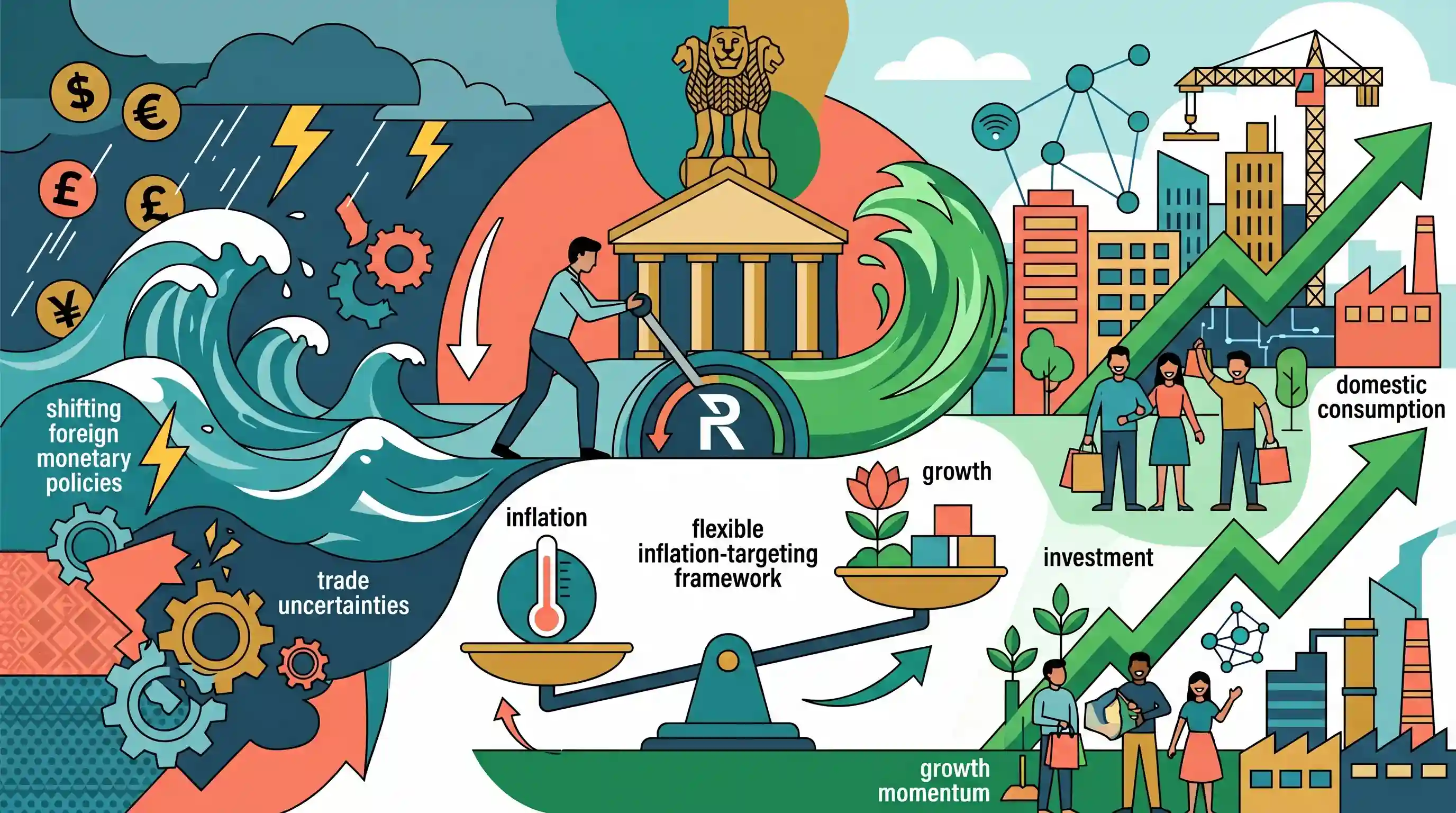
The Reserve Bank of India's Monetary Policy Committee (MPC) has opted for a repo rate cut, signaling a definitive pivot towards supporting economic growth amidst global economic turbulence. As international headwinds—such as shifting foreign monetary policies and trade uncertainties—pose risks to domestic stability, the RBI's easing of monetary policy aims to spur domestic consumption and investment. The move underscores the inherent challenges in the flexible inflation-targeting framework, where the central bank must constantly balance its mandate to control inflation against the imperative to sustain growth momentum during external shocks.
Key Points
- The RBI Monetary Policy Committee's decision to cut the repo rate serves as a policy signal to prioritize economic growth over strict inflation containment.
- The shift in monetary policy stance is a strategic response to global economic turmoil, aimed at buffering the domestic economy against external headwinds and uncertainty.
- Rate cuts are intended to lower the cost of borrowing, thereby stimulating consumption and private investment to sustain the growth momentum.
- The decision highlights the classic macroeconomic tightrope central banks walk: balancing the risk of persistent (often supply-side) inflation with the need to prevent economic deceleration.
Important Terms
Flexible Inflation Targeting Framework

A monetary policy regime where the RBI targets a specific retail inflation rate (4% ±2% band) while retaining the flexibility to support economic growth during external shocks or domestic downturns.
UPSC context
GS Paper 3 (Economy). Tests understanding of RBI's dual mandate to maintain price stability while fostering sustainable economic development.
Monetary Policy Committee (MPC)
A six-member statutory body (3 RBI officials, 3 external experts) responsible for fixing the benchmark repo rate to keep inflation within the government-mandated target range.
UPSC context
GS Paper 3 (Economy). Tests knowledge of monetary governance, decision-making transparency, and the shift from discretionary to rule-based policy.
Repo Rate
The interest rate at which the RBI lends short-term funds to commercial banks against government securities; it serves as the primary tool for regulating liquidity and inflation.
UPSC context
GS Paper 3 (Economy). A core concept for Prelims (monetary tools) and Mains (impact of interest rates on investment and consumption).
Reserve Bank of India (RBI)
Established in 1935, it is India's central bank and regulatory authority for the banking system, responsible for monetary policy, currency issuance, and maintaining macroeconomic stability.
UPSC context
GS Paper 3 (Economy). Fundamental for understanding the institutional framework of India's financial system and its role as the 'lender of last resort.'
Prelims Trap
The primary mandate of the MPC is to ensure balanced economic growth and price stability.
The RBI Act mandates "price stability" as the primary objective, only "keeping in mind" growth. Growth is structurally secondary in statute, even if prioritized in immediate policy.
Static Concepts Connected
What are the core parameters of India's Flexible Inflation Targeting (FIT) framework?
- Statutory basis: Established via the 2016 amendment to the Reserve Bank of India Act, 1934.
- Target metric: Maintain consumer price inflation (Headline CPI) at 4%, with a tolerance band of +/- 2%.
- Failure condition: Triggered if average inflation falls outside the 2% to 6% band for three consecutive quarters, requiring a report to the Central Government.
How is the Monetary Policy Committee (MPC) structured?
- Membership: A 6-member body: 3 from the RBI (including the Governor) and 3 external members appointed by the Central Government.
- Voting structure: Decisions are made by majority vote. The RBI Governor has a casting vote in the event of a tie, but no absolute veto.
Cross-Topic Patterns
Monetary Easing vs. Currency Depreciation
Lowering domestic rates while global rates remain high can trigger foreign portfolio investment (FPI) outflows, putting downward pressure on the Rupee's exchange rate and complicating external stability.
Supply-side inflation and Monetary limits
Rate cuts stimulate demand, but they remain ineffective against structural supply-side issues like climate-induced food inflation, which require fiscal and agricultural interventions rather than monetary tools.

A 2026 Prelims question will likely link RBI's accommodative stance with the resulting risks of FPI capital flight and Rupee depreciation.
Linked PYQs · 4
Linked PYQs · 4
- 2024MainsGS3
What are the causes of persistent high food inflation in India? Comment on the effectiveness of the monetary policy of the RBI to control this type of inflation.
- 2017PrelimsGS1
Which of the following statements is/are correct regarding the Monetary Policy Committee (MPC)? 1. It decides the RBI's benchmark interest rates. 2. It is a 12-member body including the Governor of RBI and is reconstituted every year. 3. It functions under the chairmanship of the Union Finance Minister. Select the correct answer using the code given below:
- 2018MainsGS3
How would the recent phenomena of protectionism and currency manipulations in world trade affect macroeconomic stability of India?
- 2022PrelimsGS1
With reference to the Indian economy, consider the following statements: 1. If the inflation is too high, Reserve Bank of India (RBI) is likely to buy government securities. 2. If the rupee is rapidly depreciating, RBI is likely to sell dollars in the market. 3. If interest rates in the USA or European Union were to fall, that is likely to induce RBI to buy dollars. Which of the statements given above are correct?
