RBI Monetary Policy Stance and Rate Actions Explained
Source:Indian Express ↗
Why It Matters
Understanding monetary policy tools, interest rate adjustments, and policy stances is crucial for aspirants to analyze macroeconomic management, inflation targeting, and the role of the central bank in economic stabilization.
Summary
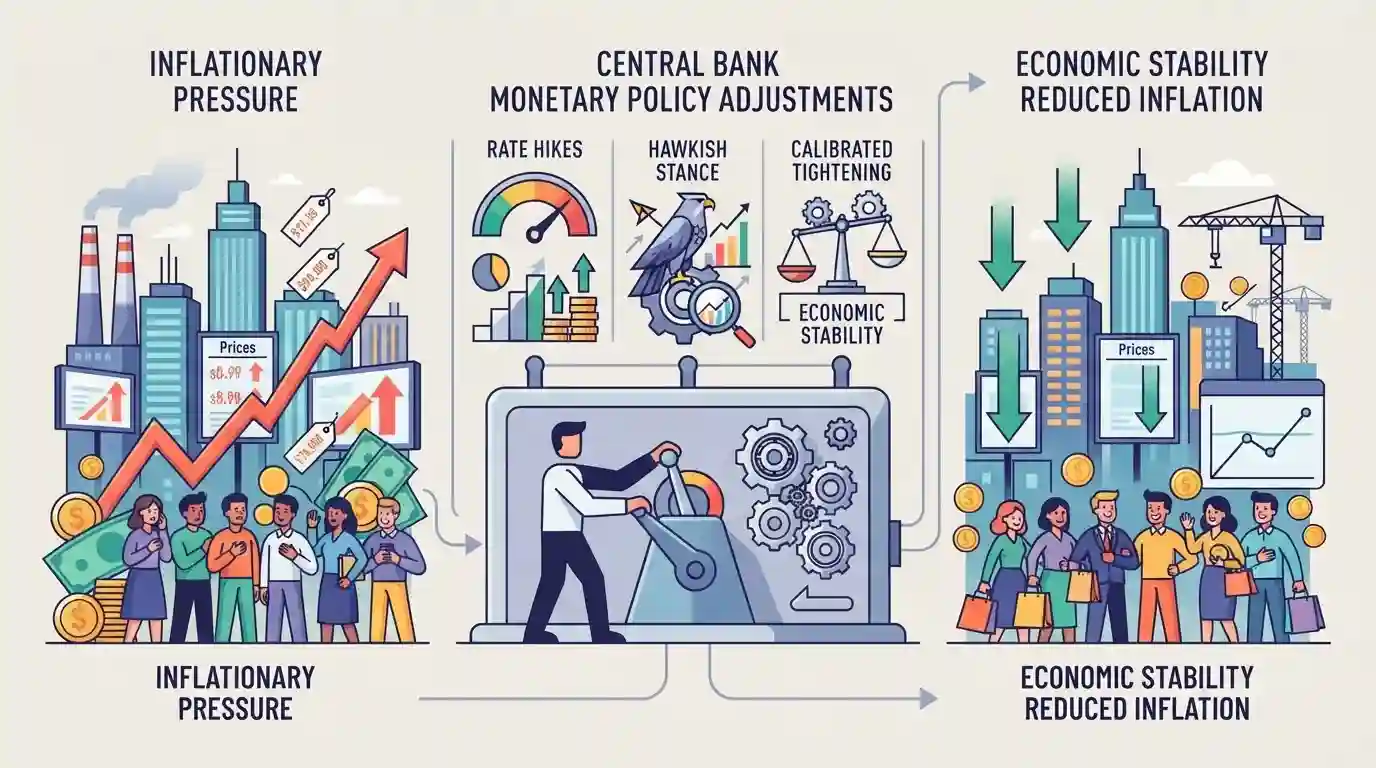
The article details the mechanics of central bank monetary policy adjustments, explaining key economic concepts like rate hikes, hawkish stances, and calibrated monetary tightening used to control inflation and manage economic cycles.
Key Points
- The article explains key concepts related to monetary policy, including rate hikes, a hawkish policy stance, and calibrated tightening by the central bank.
- It highlights how central banks use interest rate adjustments and policy stances to manage economic growth and combat inflationary pressures.
- The Monetary Policy Committee (MPC) evaluates macroeconomic indicators to decide whether to tighten or ease monetary conditions.
Important Terms
Reserve Bank of India

India's central banking institution established under the RBI Act of 1934, responsible for regulating the issue of bank notes, maintaining reserves with a view to securing monetary stability, and operating the currency and credit system of the country.
UPSC context
UPSC CSE Prelims and Mains (GS Paper III - Indian Economy); tests knowledge of institutional framework, monetary policy, and central banking functions.
Monetary Policy Committee
A statutory six-member body constituted under the Reserve Bank of India Act, 1934, tasked with fixing the benchmark interest rate to achieve inflation targeting while supporting growth.
UPSC context
UPSC CSE Prelims and Mains (GS Paper III - Indian Economy); tests structural mechanisms of inflation control, monetary policy management, and macroeconomic governance.
Prelims Trap
The RBI Governor holds a special veto power to override the majority decision of the Monetary Policy Committee.
Aspirants often assume the RBI Governor has veto power in the MPC. In reality, all six members have one vote each, and the Governor only exercises a casting vote in the event of a tie.
Static Concepts Connected
What is the statutory framework of Flexible Inflation Targeting (FIT) in India?
- RBI Act 1934: Statutory Mandate: Amended Section 45ZA of the RBI Act, 1934, mandates the central government, in consultation with the RBI, to determine the inflation target once every five years.
- CPI Target: Target Range: The target is currently set at 4% Consumer Price Index (CPI) inflation, with an upper tolerance limit of 6% and a lower tolerance limit of 2%.
- Accountability Clause: Accountability: If the RBI fails to meet the inflation target for three consecutive quarters, it must submit a formal report to the Central Government explaining the failure and remedial actions.
Cross-Topic Patterns
Monetary Tightening and Fiscal Deficit Pressures
Central bank tightening cycles intersect directly with fiscal deficit management, as higher sovereign borrowing costs increase government debt servicing burdens and impact capital expenditure allocations in the Union Budget.
Inflation Targeting and Agri-Supply Shocks
Supply-side food inflation shocks driven by weather anomalies test the limits of conventional interest rate hikes, forcing coordination between monetary policy and agricultural supply management.

Expect a multi-statement prelims question testing the statutory mandate, voting mechanism, and veto powers under the RBI Act FIT framework.
Linked PYQs · 3
Linked PYQs · 3
- 2024MainsGS3
What are the causes of persistent high food inflation in India? Comment on the effectiveness of the monetary policy of the RBI to control this type of inflation.
- 2022PrelimsGS1
In India, which one of the following is responsible for maintaining price stability by controlling inflation?
- 2022PrelimsGS1
With reference to the Indian economy, consider the following statements: 1. If the inflation is too high, Reserve Bank of India (RBI) is likely to buy government securities. 2. If the rupee is rapidly depreciating, RBI is likely to sell dollars in the market. 3. If interest rates in the USA or European Union were to fall, that is likely to induce RBI to buy dollars. Which of the statements given above are correct?
