Monetary Policy Committee Stance and Inflation Control Measures
Source:Indian Express ↗
આ શા માટે મહત્વનું છે
Understanding monetary policy tools, interest rate cycles, and central bank stances is essential for aspirants to analyze macroeconomic stability, inflation management, and growth tradeoffs in the Indian economy.
સારાંશ
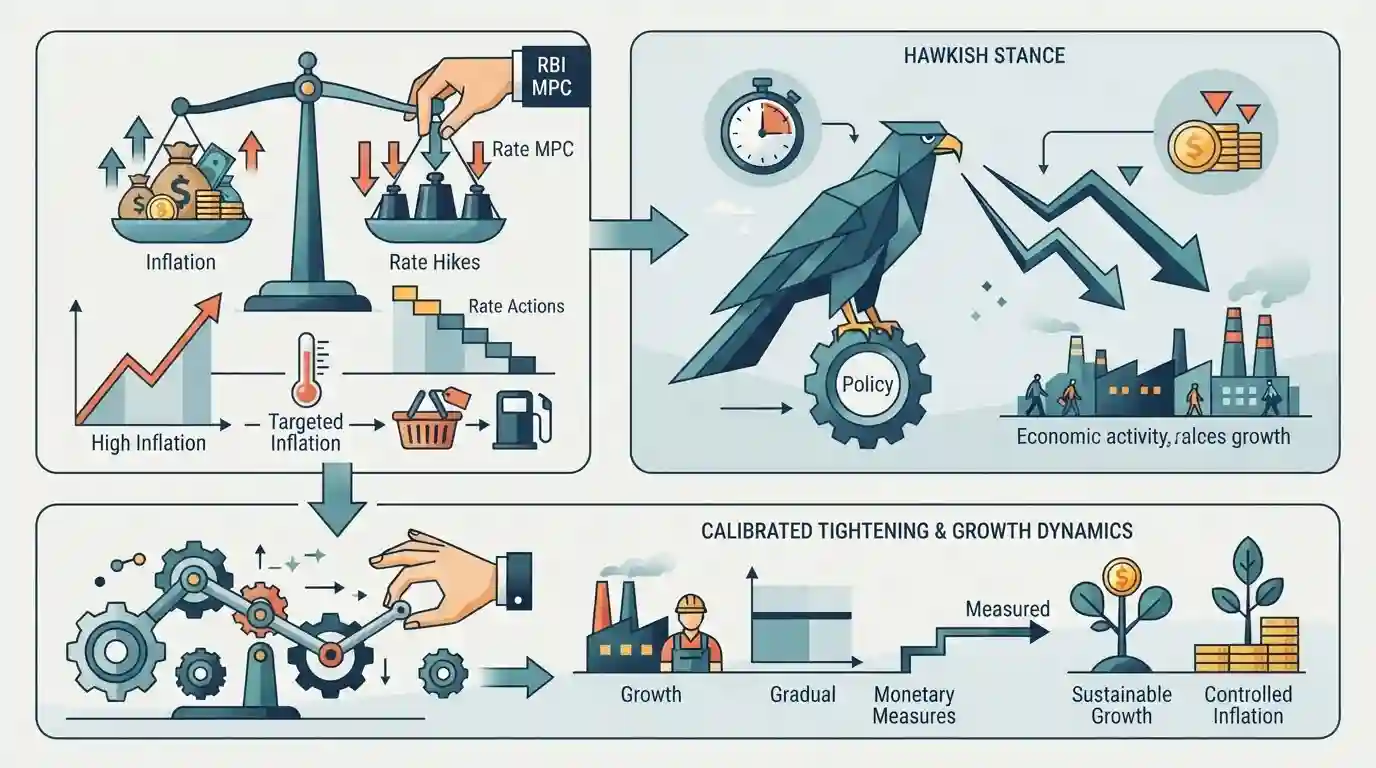
The article explains the concepts of RBI's Monetary Policy Committee (MPC) rate actions, hawkish stances, and calibrated tightening, detailing how central banks utilize these instruments to control inflation while navigating growth dynamics.
મુખ્ય મુદ્દા
- The Reserve Bank of India's Monetary Policy Committee (MPC) utilizes policy tools like the repo rate and a hawkish or calibrated tightening stance to manage inflation and anchor inflationary expectations.
- A hawkish stance indicates a primary focus on checking inflation even at the cost of short-term economic growth, often through higher interest rates or liquidity tightening.
- Calibration of monetary policy helps balance growth concerns with the primary mandate of price stability under the flexible inflation targeting framework.
મહત્વપૂર્ણ શબ્દો
RBI Act, 1934

Statutory framework established by the Indian legislature in 1934 to regulate currency issuance, maintain monetary stability, and oversee the nation's credit and banking system.
UPSC context
GS Paper III (Indian Economy). Tests statutory backing of the central bank and powers governing monetary administration in India.
Reserve Bank of India
India's central banking institution responsible for regulating the monetary system, issuing currency, managing foreign exchange reserves, and acting as banker to banks and the government.
UPSC context
GS Paper III (Indian Economy). Core institution for monetary policy formulation, banking regulation, and macroeconomic stability.
Monetary Policy Committee
A statutory six-member body constituted under the RBI Act, 1934, tasked with fixing the benchmark interest rate to achieve inflation targets while keeping growth in mind.
UPSC context
GS Paper III (Inflation and Monetary Policy). Tests institutional framework of inflation targeting and collective decision-making in monetary governance.
પ્રિલિમ્સ ટ્રેપ
Growth and price stability are given equal statutory weight without any primacy during high-inflation phases.
The RBI Act mandates price stability while having regard to growth, but price stability is explicitly designated as the primary objective under the flexible inflation targeting framework.
સંલગ્ન સ્થિર ખ્યાલો
What are the key statutory features and mandate of the RBI's Monetary Policy Committee (MPC)?
- Statutory Basis:: Established under Section 45ZB of the amended RBI Act, 1934, as a statutory six-member body.
- Composition:: Comprises three officials of the RBI and three external members appointed by the Central Government.
- Core Mandate:: Determines the policy repo rate required to achieve the inflation target set by the government.
- Inflation Target:: Operates under a flexible inflation targeting framework with a target of 4% CPI inflation and a +/- 2% tolerance band.
આંતર-વિષય પેટર્ન
Monetary Policy and Fiscal Deficit Linkages
Monetary tightening raises debt servicing costs for the government, directly linking interest rate decisions to fiscal deficit targets under the FRBM Act.
Interest Rate Hikes and Forex Management
Higher domestic interest rates narrow the inflation differential with trading partners, impacting capital flows, exchange rate volatility, and RBI's forex interventions.

Expect a 3-statement prelims question on the statutory mandate, composition (6 members), and the 4+/-2% CPI band of the RBI MPC.
સંલગ્ન PYQ · 3
સંલગ્ન PYQ · 3
- 2024MainsGS3
What are the causes of persistent high food inflation in India? Comment on the effectiveness of the monetary policy of the RBI to control this type of inflation.
- 2017PrelimsGS1
Which of the following statements is/are correct regarding the Monetary Policy Committee (MPC)? 1. It decides the RBI's benchmark interest rates. 2. It is a 12-member body including the Governor of RBI and is reconstituted every year. 3. It functions under the chairmanship of the Union Finance Minister. Select the correct answer using the code given below:
- 2022PrelimsGS1
In India, which one of the following is responsible for maintaining price stability by controlling inflation?
