RBI Monetary Policy Stance and Calibrated Tightening
Source:Indian Express ↗
Why It Matters
Understanding monetary policy mechanics, interest rate cycles, and central bank stances is essential for aspirants to analyze macroeconomic stability, inflation management, and growth tradeoffs in the Indian economy.
Summary
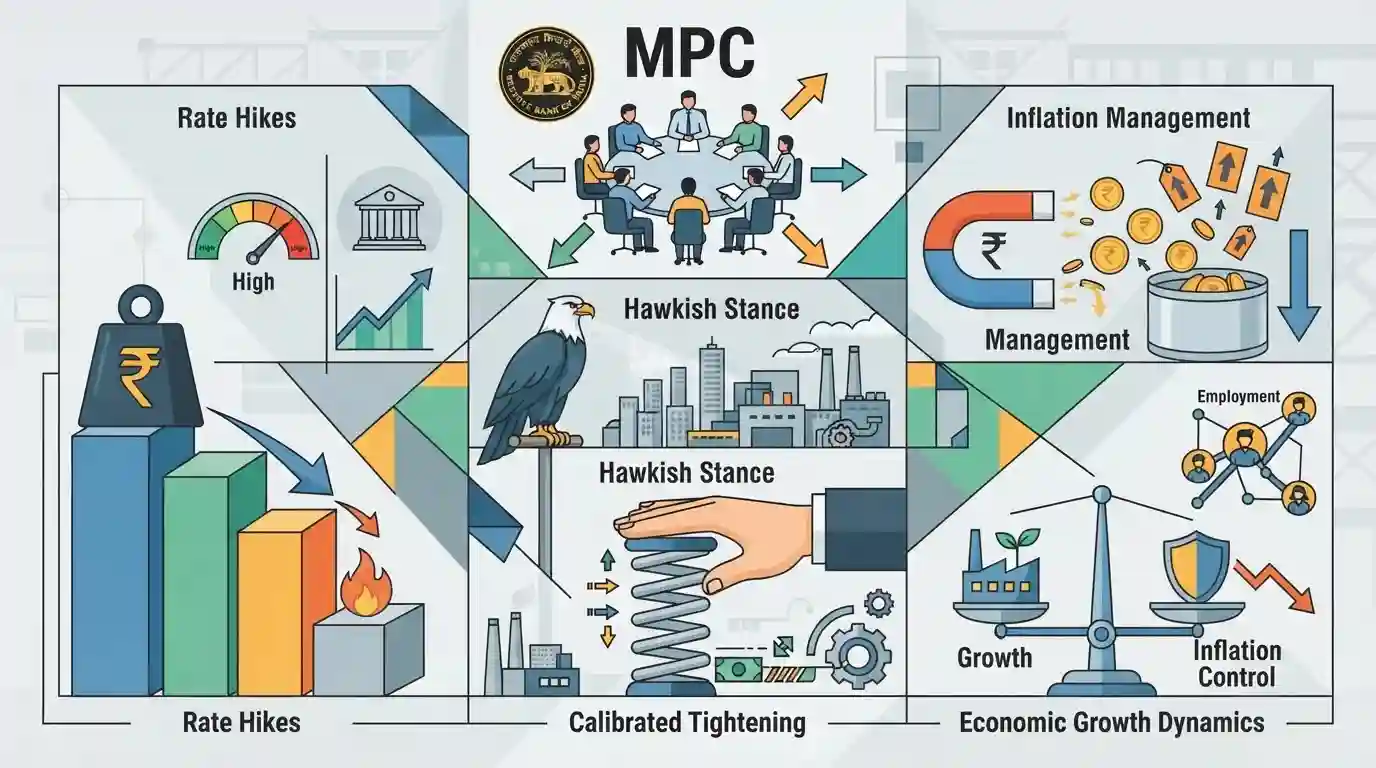
The article explains key concepts associated with the Reserve Bank of India's Monetary Policy Committee (MPC), including rate hikes, hawkish stances, and calibrated tightening, detailing how central banks manage inflation and economic growth dynamics.
Key Points
- The Reserve Bank of India's Monetary Policy Committee (MPC) utilizes monetary tools such as repo rate adjustments and policy stance modifications to manage economic stability and inflation.
- A hawkish stance indicates a focus on tightening money supply to curb inflation, whereas a dovish stance prioritizes growth support through rate cuts or loose liquidity.
- Calibrated tightening refers to measured, step-by-step policy adjustments rather than aggressive, abrupt shifts, allowing the central bank to navigate evolving global and domestic macroeconomic conditions.
Important Terms
Reserve Bank of India

India's central banking institution established under the RBI Act of 1934, responsible for regulating the issue of bank notes, maintaining monetary stability, and managing the country's currency and credit system.
UPSC context
UPSC Prelims/Mains (GS Paper III): Essential for questions on central banking, monetary management, financial inclusion, and macroeconomic stability.
Monetary Policy Committee
A statutory six-member body established under the RBI Act, 1934, tasked with determining the policy repo rate required to achieve the inflation target while keeping growth in mind.
UPSC context
UPSC Prelims/Mains (GS Paper III): Tests knowledge of institutional framework for inflation targeting and monetary policy formulation in India.
Hawkish Stance
A central bank policy stance favoring monetary tightening through interest rate hikes or liquidity withdrawal to curb high inflationary pressures in the economy.
UPSC context
UPSC Prelims/Mains (GS Paper III): Crucial for understanding central bank interventions, inflation control mechanisms, and macroeconomic management.
Calibrated Tightening
A deliberate monetary policy approach where a central bank moves cautiously and gradually toward tightening financial conditions to control inflation without abruptly choking economic growth.
UPSC context
UPSC Prelims/Mains (GS Paper III): Tests understanding of nuanced monetary policy stances and macroeconomic response to inflation shocks.
Prelims Trap
The primary statutory mandate of the RBI MPC is equal balancing of economic growth and inflation targeting.
Aspirants often confuse the statutory mandate of the MPC (to achieve the inflation target) with dual explicit mandates of growth and inflation equality; growth is an objective, but price stability is primary.
Static Concepts Connected
What are the composition, statutory basis, and voting mechanism of the RBI Monetary Policy Committee (MPC)?
- Composition: Six members total: three from RBI (including Governor as chairperson) and three external members appointed by the Central Government.
- Statutory Basis: Statutory backing under Section 45ZB of the amended Reserve Bank of India Act, 1934.
- Voting Mechanism: Governor holds a casting vote in the event of a tie; decisions are taken by a majority vote.
Cross-Topic Patterns
Monetary Policy + Fiscal Consolidation (FRBM)
Fiscal deficit targets under FRBM Act directly interact with RBI's liquidity management; high borrowings can complicate monetary transmission and force prolonged hawkish stances.
Inflation Targeting + Supply-Side Management
RBI's inflation targeting framework (4+/-2%) links macro-stabilisation with structural food inflation management handled by supply-side ministries.

Expect a conceptual match-the-following or statement-based question on RBI's policy stances (hawkish vs dovish) and statutory MPC framework.
Linked PYQs · 3
Linked PYQs · 3
- 2024MainsGS3
What are the causes of persistent high food inflation in India? Comment on the effectiveness of the monetary policy of the RBI to control this type of inflation.
- 2017PrelimsGS1
Which of the following statements is/are correct regarding the Monetary Policy Committee (MPC)? 1. It decides the RBI's benchmark interest rates. 2. It is a 12-member body including the Governor of RBI and is reconstituted every year. 3. It functions under the chairmanship of the Union Finance Minister. Select the correct answer using the code given below:
- 2022PrelimsGS1
With reference to the Indian economy, consider the following statements: 1. If the inflation is too high, Reserve Bank of India (RBI) is likely to buy government securities. 2. If the rupee is rapidly depreciating, RBI is likely to sell dollars in the market. 3. If interest rates in the USA or European Union were to fall, that is likely to induce RBI to buy dollars. Which of the statements given above are correct?
