Understanding RBI Monetary Policy Stances and Rate Actions
Source:Indian Express ↗
ఇది ఎందుకు ముఖ్యం
Understanding monetary policy tools, stances like hawkish/dovish, and calibrated tightening is vital for aspirants tracking macroeconomic management, inflation targeting, and central bank operations in India.
సారాంశం
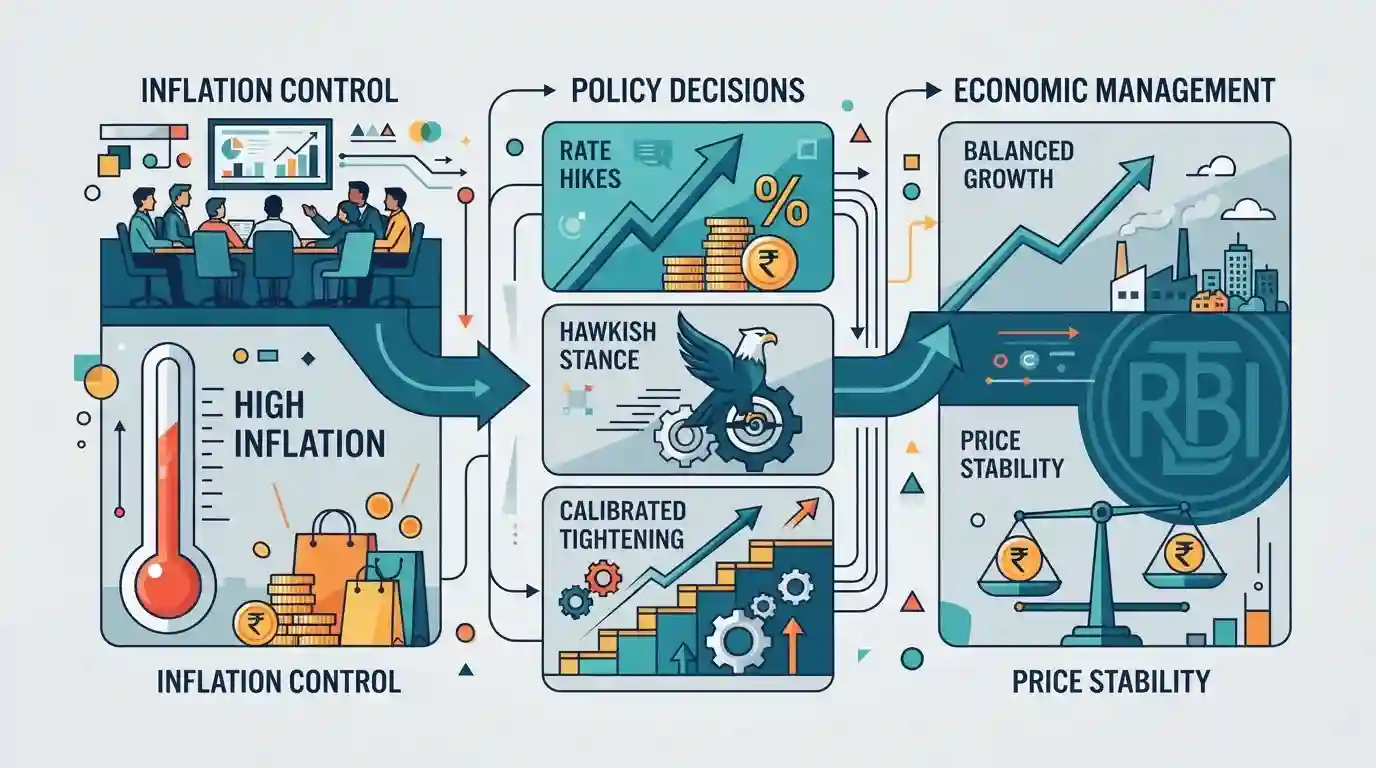
The article explains key concepts associated with the Reserve Bank of India's Monetary Policy Committee (MPC), including rate hikes, a hawkish stance, and calibrated tightening, detailing how central banks manage inflation and economic growth.
ముఖ్య అంశాలు
- The Reserve Bank of India's Monetary Policy Committee (MPC) handles rate hikes, rate cuts, and maintaining stances like 'hawkish' or 'calibrated tightening' to control inflation and guide growth.
- A hawkish stance indicates a primary focus on curbing inflation by keeping interest rates high or raising them, whereas a dovish stance prioritizes economic growth through lower rates.
- Calibrated tightening refers to a measured and step-by-step approach to removing monetary accommodation or raising rates as economic conditions dictate.
- Monetary policy decisions balance domestic inflationary pressures, food inflation, and global macroeconomic trends.
ముఖ్యమైన పదాలు
Reserve Bank of India

India's central banking institution established under the RBI Act of 1934, responsible for regulating the issue of bank notes, maintaining monetary stability, and managing the country's currency and credit system.
UPSC context
UPSC Prelims/Mains (GS Paper III): Core institution in Indian Economy testing monetary management, banking regulation, and macroeconomic stability.
Monetary Policy Committee
A statutory six-member committee constituted under the RBI Act, 1934, entrusted with fixing the benchmark policy repo rate to achieve the inflation-targeting mandate.
UPSC context
UPSC Prelims/Mains (GS Paper III): Frequently tested for its structure, voting mechanism, and inflation targeting framework (4% +/- 2%).
అనుసంధానమైన స్థిర భావనలు
What is the statutory framework and composition of the RBI's Monetary Policy Committee (MPC)?
- Statutory Basis: Statutory backing established under an amendment to the Reserve Bank of India Act, 1934 in 2016 to determine the policy interest rate.
- Composition: Comprises six members: three officials of the RBI and three external members appointed by the Central Government.
- Inflation Target: Mandated to target consumer inflation at 4% with a band of +/- 2% under the flexible inflation targeting framework.
అంతర-అంశ నమూనాలు
Monetary Policy and Foreign Capital Flows
Central bank rate decisions interact with fiscal deficits and capital flows, impacting bond yields and foreign portfolio investments (FPI) into emerging markets.

MPC voting pattern, statutory inflation target band (4+/-2%), and monetary stance shifts are prime targets for Prelims statements.
అనుసంధాన PYQలు · 3
అనుసంధాన PYQలు · 3
- 2024MainsGS3
What are the causes of persistent high food inflation in India? Comment on the effectiveness of the monetary policy of the RBI to control this type of inflation.
- 2022PrelimsGS1
With reference to the Indian economy, consider the following statements: 1. If the inflation is too high, Reserve Bank of India (RBI) is likely to buy government securities. 2. If the rupee is rapidly depreciating, RBI is likely to sell dollars in the market. 3. If interest rates in the USA or European Union were to fall, that is likely to induce RBI to buy dollars. Which of the statements given above are correct?
- 2020PrelimsGS1
Consider the following statements: 1. The weightage of food in Consumer Price Index (CPI) is higher than that in Wholesale Price Index (WPI). 2. The WPI does not capture changes in the prices of services, which CPI does. 3. Reserve Bank of India has now adopted WPI as its key measure of inflation and to decide on changing the key policy rates. Which of the statements given above is/are correct?
