Reserve Bank of India Monetary Policy Stance and Rate Actions
Source:Indian Express ↗
কেন এটি গুরুত্বপূর্ণ
Understanding the nuances of monetary policy stances like 'hawkish' and 'calibrated tightening' is critical for aspirants studying central banking, macroeconomic management, and inflation control in India.
সারসংক্ষেপ
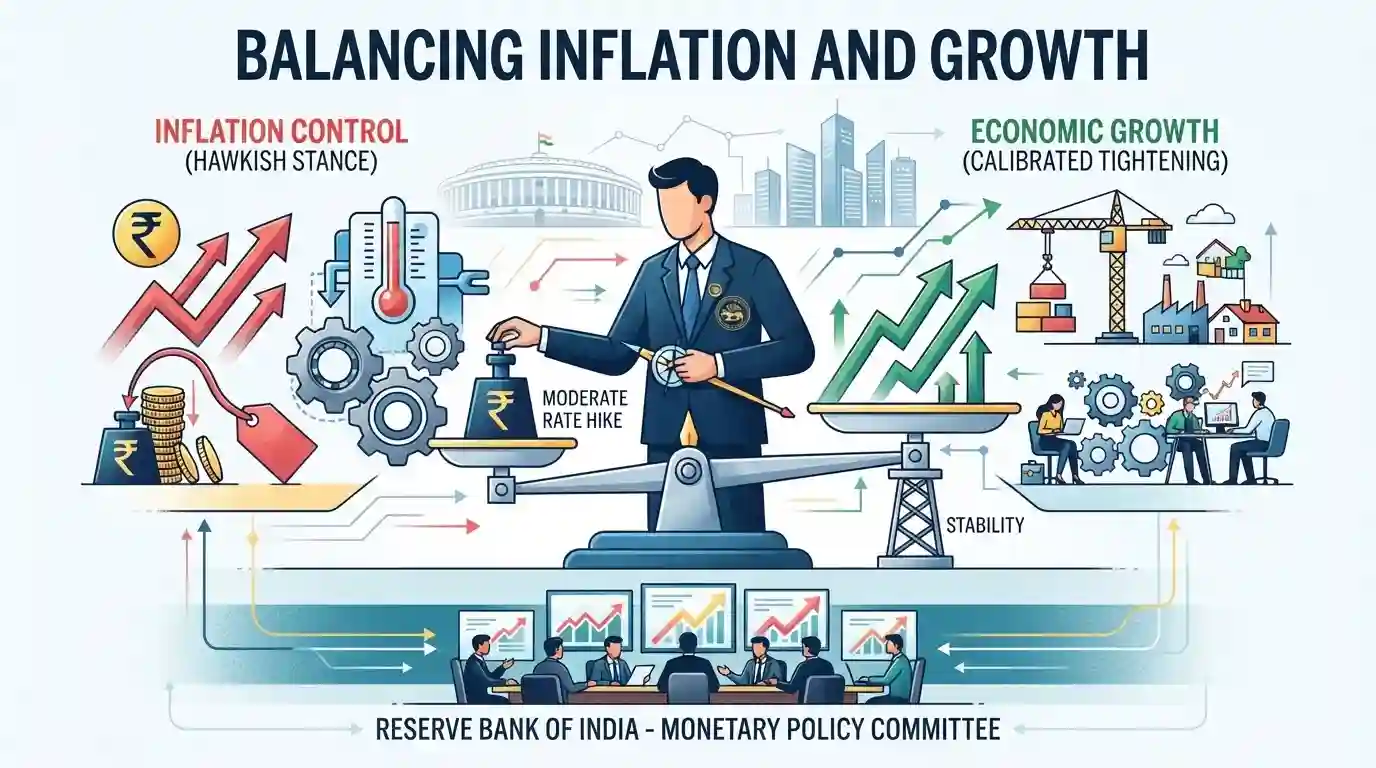
An analysis of the Reserve Bank of India's Monetary Policy Committee (MPC) rate actions, hawkish stances, and calibrated tightening strategies aimed at balancing inflation control and economic growth.
মূল বিষয়
- The Monetary Policy Committee (MPC) is tasked with managing benchmark interest rates to meet inflation-targeting mandates.
- A hawkish stance implies an inclination towards rate hikes or tightening liquidity to curb inflation pressures.
- Calibrated tightening refers to measured, step-by-step policy adjustments rather than aggressive shocks to balance growth and price stability.
গুরুত্বপূর্ণ শব্দ
Reserve Bank of India

India's central banking institution established in 1935 under the RBI Act, 1934, responsible for regulating the monetary system, issuing currency, managing foreign exchange, and maintaining price stability.
UPSC context
UPSC Prelims/Mains (GS Paper III): Core institution for monetary management, inflation targeting, and banking regulation in India.
Monetary Policy Committee
A statutory six-member body established under Section 45ZB of the RBI Act, 1934, tasked with fixing the benchmark policy interest rate to achieve the mandated inflation target.
UPSC context
UPSC Prelims/Mains (GS Paper III): Tests knowledge of inflation targeting, monetary policy framework, and institutional decision-making mechanisms.
Reserve Bank of India Act, 1934
The principal legislation governing the Reserve Bank of India, providing its legal framework for currency management, bank regulation, and statutory monetary policy formulation.
UPSC context
UPSC Prelims: Statutory framework underpinning India's central bank and monetary policy structure.
প্রিলিমস ফাঁদ
The MPC is statutorily mandated to exclusively maximize economic growth rate regardless of headline inflation levels.
Aspirants often confuse the statutory mandate of the MPC with an absolute price-stability goal, ignoring that the RBI Act prioritizes price stability while keeping in mind the objective of growth.
সংযুক্ত স্থির ধারণা
What is the composition and statutory framework of the RBI Monetary Policy Committee (MPC)?
- Statutory Basis: Statutory backing established via an amendment to the Reserve Bank of India Act, 1934 in 2016.
- Composition: Consists of 6 members: 3 from RBI (including the Governor as chairperson) and 3 external members appointed by the Central Government.
- Voting Power: RBI Governor holds a casting vote in the event of a tie; members serve a four-year term and are not eligible for re-appointment.
আন্তঃবিষয় প্যাটার্ন
Monetary Policy vs Fiscal Deficit Management
Monetary tightening cycles directly impact government borrowing costs, affecting fiscal deficit targets and market stabilization schemes (MSS) coordination between RBI and the Ministry of Finance.
Inflation Targeting and Imported Inflation
RBI's inflation targeting framework interacts with global supply chain shocks and imported inflation dynamics studied under balance of payments.

Expect a conceptual statement question on MPC composition, voting ties, and the statutory inflation target band (4% +/- 2%).
সংযুক্ত PYQ · 3
সংযুক্ত PYQ · 3
- 2024MainsGS3
What are the causes of persistent high food inflation in India? Comment on the effectiveness of the monetary policy of the RBI to control this type of inflation.
- 2017PrelimsGS1
Which of the following statements is/are correct regarding the Monetary Policy Committee (MPC)? 1. It decides the RBI's benchmark interest rates. 2. It is a 12-member body including the Governor of RBI and is reconstituted every year. 3. It functions under the chairmanship of the Union Finance Minister. Select the correct answer using the code given below:
- 2026PrelimsGS1
With reference to different Committees in India, consider the following details : | Sl. No. | Committee | Objective | Organization under which it was formed | | :--- | :--- | :--- | :--- | | 1. | R.N. Malhotra Committee | Comprehensive reforms of Insurance sector in India | Insurance Regulatory and Development Authority of India | | 2. | L.C. Gupta Committee | Preparing a roadmap for the introduction of derivatives trading in India | Securities and Exchange Board of India | | 3. | Urjit R. Patel Committee | Preparing a roadmap for reforming bank lending to the Housing sector | Reserve Bank of India | | 4. | Y.H. Malegam Committee | Preparing a roadmap for reforms in Microfinance sector in India | Reserve Bank of India | In which of the above rows are all the details correctly matched ?
