RBI MPC Adopts Hawkish Stance and Calibrated Tightening
Source:Indian Express ↗
આ શા માટે મહત્વનું છે
Understanding monetary policy tools, interest rate cycles, inflation targeting, and central bank stances (hawkish vs. dovish) is essential for aspirants tracking macroeconomic management and GS3 Indian Economy syllabus.
સારાંશ
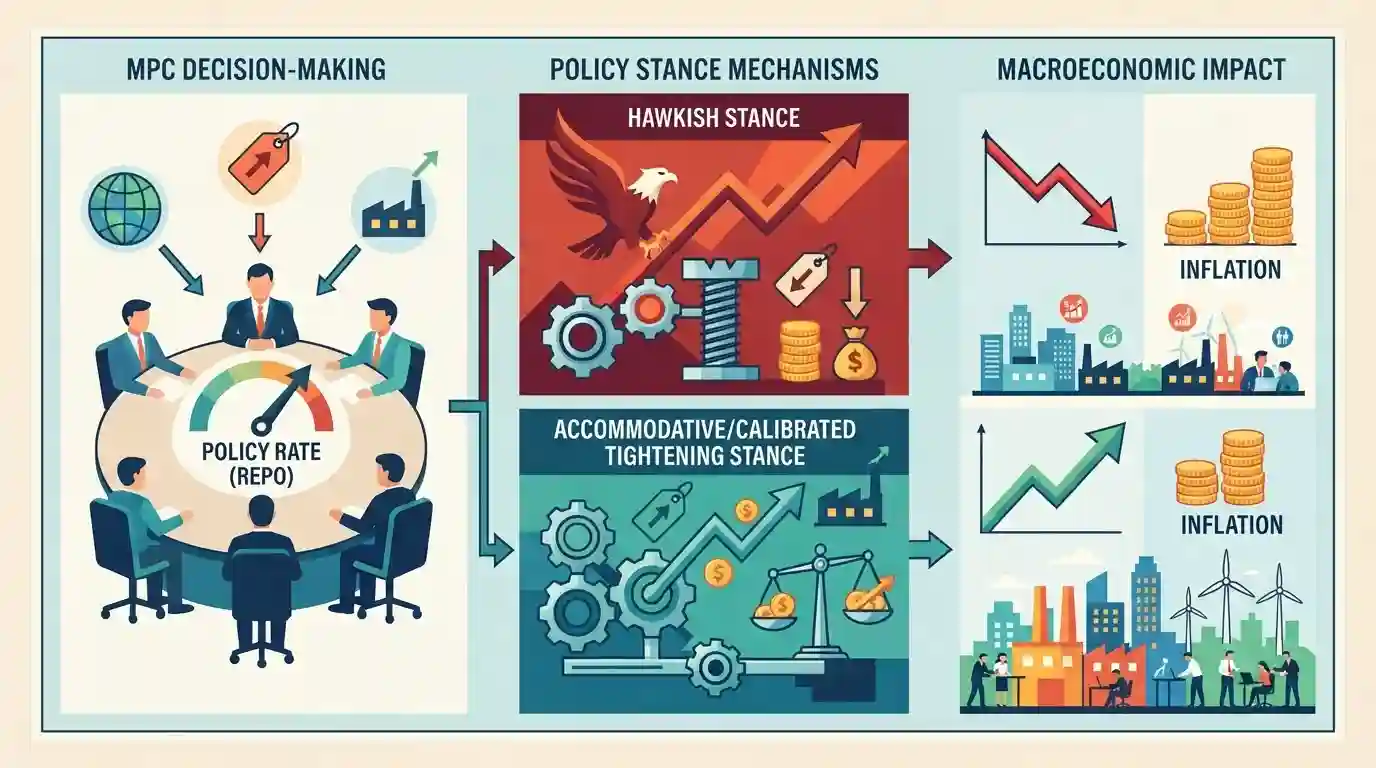
This article explains the mechanics of RBI's Monetary Policy Committee (MPC) rate decisions, explaining terms like hawkish stance, calibrated tightening, and how rate hikes and policy stances are deployed to tackle inflation and manage macroeconomic stability in India.
મુખ્ય મુદ્દા
- The Reserve Bank of India's Monetary Policy Committee (MPC) utilizes policy rate actions and stances to manage inflation and support growth.
- A 'hawkish stance' reflects a policy focus on reigning in inflationary pressures through tighter monetary conditions, whereas a 'dovish stance' prioritizes economic growth through easier liquidity or lower rates.
- Calibrated tightening or policy normalization involves systematic adjustments in repo rates and liquidity management to anchor inflation expectations within the mandated target band.
મહત્વપૂર્ણ શબ્દો
Monetary Policy Committee

A statutory body established under the RBI Act, 1934 to determine the policy interest rate required to achieve the inflation target while keeping growth in mind.
UPSC context
GS Paper III (Indian Economy): Tests understanding of monetary policy, inflation management, and institutional framework of the central bank.
Reserve Bank of India
India's central banking institution established in 1935 under the Reserve Bank of India Act, 1934, responsible for regulating the monetary system, issuing currency, and maintaining macroeconomic stability.
UPSC context
GS Paper III (Indian Economy): Essential for questions on banking sector reforms, central banking functions, and macroeconomic management.
Reserve Bank of India Act, 1934
The foundational legislation enacted in British India that governs the constitution, functions, powers, and regulatory framework of the central banking authority in the country.
UPSC context
GS Paper III (Indian Economy / Polity): Core statute framing financial governance and statutory powers of the central bank.
પ્રિલિમ્સ ટ્રેપ
The RBI Governor holds absolute authority to unilaterally set policy rates and override majority decisions within the Monetary Policy Committee.
The RBI Governor does not have veto power in the MPC; every member has one vote, and ties are resolved by a casting vote by the Governor.
સંલગ્ન સ્થિર ખ્યાલો
What is the composition and mandate of the Monetary Policy Committee (MPC) in India?
- Legal Basis: Statutory body established under Section 45ZB of the Reserve Bank of India Act, 1934.
- Composition: Consists of 6 members: 3 from RBI (including the Governor as chairperson) and 3 external members appointed by the Central Government.
- Core Mandate: Mandated to determine the policy repo rate required to achieve the Consumer Price Index (CPI) inflation target of 4% with a +/- 2% band.
આંતર-વિષય પેટર્ન
Monetary policy and fiscal deficit management
RBI's liquidity withdrawal directly impacts government borrowing costs, linking monetary policy decisions with fiscal deficit management and market borrowing calendars.
Inflation targeting and exchange rate dynamics
Flexible Inflation Targeting performance directly dictates currency stability, creating an intersection between RBI rate actions and forex intervention strategies.

MPC composition, voting patterns, and the statutory FIT framework under the RBI Act are recurrent high-yield UPSC prelims themes.
સંલગ્ન PYQ · 3
સંલગ્ન PYQ · 3
- 2024MainsGS3
What are the causes of persistent high food inflation in India? Comment on the effectiveness of the monetary policy of the RBI to control this type of inflation.
- 2017PrelimsGS1
Which of the following statements is/are correct regarding the Monetary Policy Committee (MPC)? 1. It decides the RBI's benchmark interest rates. 2. It is a 12-member body including the Governor of RBI and is reconstituted every year. 3. It functions under the chairmanship of the Union Finance Minister. Select the correct answer using the code given below:
- 2022PrelimsGS1
With reference to the Indian economy, consider the following statements: 1. If the inflation is too high, Reserve Bank of India (RBI) is likely to buy government securities. 2. If the rupee is rapidly depreciating, RBI is likely to sell dollars in the market. 3. If interest rates in the USA or European Union were to fall, that is likely to induce RBI to buy dollars. Which of the statements given above are correct?
