RBI Monetary Policy Stance and Calibrated Tightening Measures
Source:Indian Express ↗
हे का महत्त्वाचे आहे
Core macroeconomic concept relevant for understanding central bank interventions, inflation targeting frameworks, and monetary policy transmission in India.
सारांश
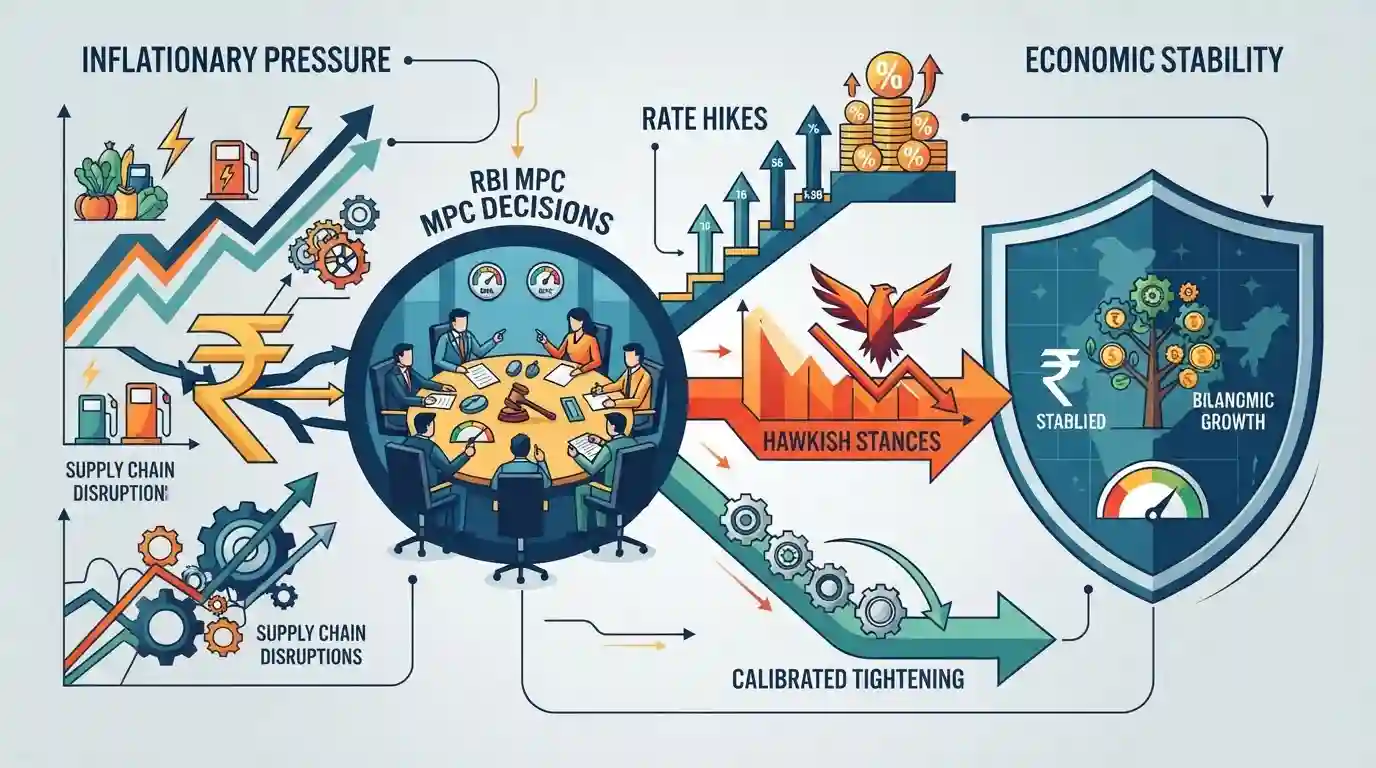
An analytical overview of the RBI Monetary Policy Committee's decisions, detailing concepts like rate hikes, hawkish stances, and calibrated tightening used to control inflation and manage economic stability.
मुख्य मुद्दे
- The Reserve Bank of India's (RBI) Monetary Policy Committee (MPC) uses tools like rate hikes, hawkish stances, and calibrated tightening to manage liquidity and rein in inflation.
- A hawkish stance indicates a primary policy focus on fighting inflation by keeping interest rates high or raising them, even at the cost of immediate economic growth stimulation.
- Calibrated tightening refers to a measured, step-by-step withdrawal of accommodation to anchor inflation expectations back to the mandated target band.
- Understanding monetary policy mechanisms is crucial for analyzing how central banks balance growth and price stability in dynamic macroeconomic environments.
महत्त्वाच्या संज्ञा
Reserve Bank of India

India's central banking institution established under the RBI Act of 1934, responsible for regulating the issue of bank notes, maintaining reserves with a view to securing monetary stability, and operating the currency and credit system of the country.
UPSC context
UPSC GS Paper III (Indian Economy): Central banking functions, monetary policy administration, and economic regulation.
Monetary Policy Committee
A statutory six-member committee constituted under the RBI Act, 1934, tasked with determining the policy interest rate required to achieve the inflation target while keeping growth in mind.
UPSC context
UPSC GS Paper III (Indian Economy): Inflation targeting, monetary policy committee structure, and macroeconomic management.
पूर्वपरीक्षा सापळा
flexible inflation-targeting framework mandated to maintain consumer price index (CPI) inflation at 5% with a tolerance band of +/- 2%
Aspirants often confuse the statutory CPI target band with the wholesale price index (WPI) or assume the tolerance band is symmetric around 5% instead of 4%.
संबंधित स्थिर संकल्पना
What is the composition and statutory mandate of the RBI Monetary Policy Committee (MPC)?
- Legal Basis: Statutory backing under the Reserve Bank of India Act, 1934, amended in 2016 to institutionalize inflation targeting.
- Composition: Consists of six members: three official members from the RBI and three external members appointed by the Central Government.
- Inflation Target: Mandated to maintain consumer price index (CPI) inflation at 4% with a tolerance band of +/- 2% (2% to 6%).
आंतर-विषय नमुने
Monetary Policy & Fiscal Deficit Management
RBI's inflation-targeting mandate directly shapes fiscal deficit management and sovereign bond yields, bridging central banking with government borrowing programs.

Expect statement-based questions on the exact CPI inflation tolerance band and statutory backing of the RBI Monetary Policy Committee.
संबंधित PYQ · 2
संबंधित PYQ · 2
- 2024MainsGS3
What are the causes of persistent high food inflation in India? Comment on the effectiveness of the monetary policy of the RBI to control this type of inflation.
- 2022PrelimsGS1
In India, which one of the following is responsible for maintaining price stability by controlling inflation?
