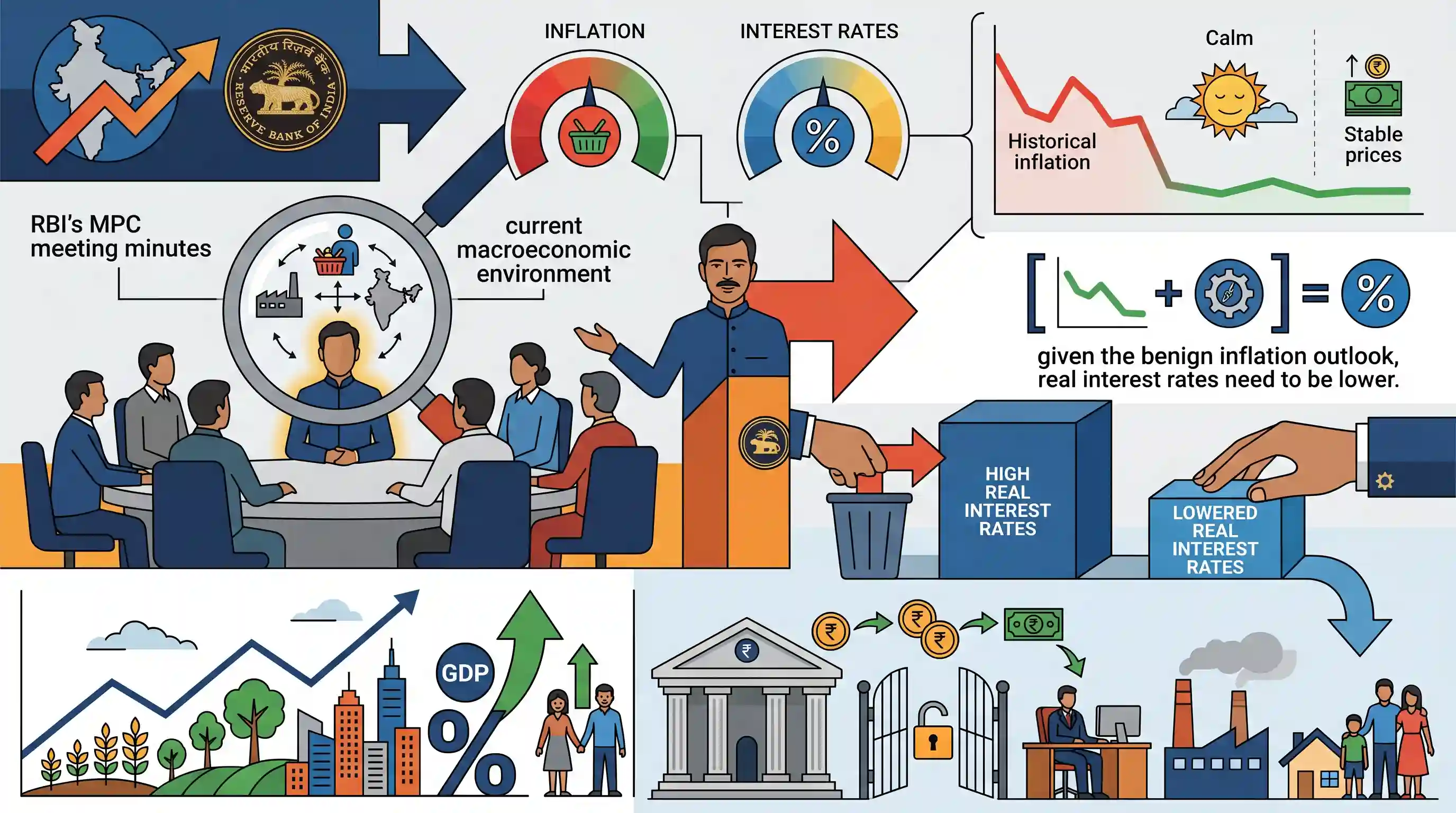
RBI MPC की बैठकों में कम वास्तविक ब्याज दरों की आवश्यकता पर जोर दिया गया
स्रोत:इंडियन एक्सप्रेस ↗
क्यों मायने रखता है
The decisions of the RBI's Monetary Policy Committee (MPC) and the governor's stance on real interest rates directly impact India's macroeconomic stability. Understanding the relationship between nominal interest rates, real interest rates, and inflation targeting is a core part of the GS-3 syllabus, crucial for grasping how the central bank maneuvers to balance growth and inflation.
सारांश
भारतीय रिजर्व बैंक (RBI) की मौद्रिक नीति समिति (MPC) की बैठक के मिनट्स वर्तमान व्यापक आर्थिक परिदृश्य पर चर्चाओं को दर्शाते हैं, जो विशेष रूप से मुद्रास्फीति और ब्याज दरों पर केंद्रित हैं। RBI गवर्नर संजय मल्होत्रा ने इस बात पर जोर दिया कि मुद्रास्फीति के अनुकूल परिदृश्य को देखते हुए, वास्तविक ब्याज दरों को कम करने की आवश्यकता है। यह दृष्टिकोण बताता है कि मुद्रास्फीति के नियंत्रण में होने के कारण उच्च वास्तविक ब्याज दरों को बनाए रखना अनावश्यक है और उनमें ढील देने से आर्थिक विकास और ऋण को बढ़ावा मिल सकता है।
मुख्य बिंदु
- RBI की मौद्रिक नीति समिति (MPC) की बैठक के मिनट्स में भारतीय अर्थव्यवस्था में प्रचलित अनुकूल मुद्रास्फीति परिदृश्य को रेखांकित किया गया।
- RBI गवर्नर संजय मल्होत्रा ने संकेत दिया कि नियंत्रित मुद्रास्फीति के कारण, प्रचलित वास्तविक ब्याज दरें कम होनी चाहिए।
- कम वास्तविक ब्याज दर का परिवेश, अत्यधिक मूल्य वृद्धि के जोखिम के बिना ऋण वृद्धि और व्यापक आर्थिक गतिविधियों को सहायता प्रदान कर सकता है।
- यह चर्चा मुद्रास्फीति के प्रबंधन और मौद्रिक नीति समायोजन के माध्यम से आर्थिक विकास को बढ़ावा देने के बीच केंद्रीय बैंक के निरंतर संतुलन बनाने के प्रयास को दर्शाती है।
महत्वपूर्ण शब्द
वास्तविक ब्याज दर

मुद्रास्फीति-समायोजित ब्याज दर, जिसकी गणना नॉमिनल ब्याज दर में से मुद्रास्फीति की दर को घटाकर की जाती है; यह उधार लेने की वास्तविक लागत या ऋणदाताओं के लिए वास्तविक प्रतिफल (real return) को दर्शाता है।
UPSC context
Crucial for GS-III; tests understanding of purchasing power, investment incentives, and how inflation erodes nominal returns.
मौद्रिक नीति समिति (MPC)
A six-member statutory body established under the RBI Act, 1934, responsible for fixing the benchmark policy (repo) rate to maintain price stability while supporting growth.
UPSC context
GS-III और प्रीलिम्स के लिए उच्च-प्राथमिकता वाला विषय; यह भारत के मौद्रिक शासन (monetary governance), संरचना (3+3) और मतदान प्रणालियों के ज्ञान का परीक्षण करता है।
लचीला मुद्रास्फीति लक्ष्यीकरण (FIT)
India's monetary policy framework (since 2016) that mandates the RBI to maintain headline inflation at 4%, with a tolerance band of 2% to 6%.
UPSC context
Essential for GS-III; tests the balance between price stability and economic growth, and the legal mandate of the RBI.
सौम्य मुद्रास्फीति
ऐसी स्थिति जहाँ मुद्रास्फीति कम, स्थिर और पूर्वानुमेय होती है, जिसे आमतौर पर स्वस्थ माना जाता है क्योंकि यह आर्थिक अस्थिरता पैदा किए बिना खर्च और निवेश को प्रोत्साहित करती है।
UPSC context
Tests conceptual clarity in GS-III on types of inflation and their varying impacts on macroeconomic stability.
भारतीय रिज़र्व बैंक (RBI)
India's central bank and regulatory body, established in 1935, responsible for issuing currency, managing foreign exchange reserves, and overseeing the nation's financial system.
UPSC context
Fundamental for GS-III; tests the functions of the central bank as the 'Lender of Last Resort' and its regulatory role.
Consumer Price Index (CPI)
एक मूल्य सूचकांक जो परिवारों द्वारा खरीदी जाने वाली वस्तुओं और सेवाओं की एक टोकरी (basket) की कीमतों में होने वाले बदलावों को ट्रैक करता है; यह RBI के मुद्रास्फीति लक्ष्यीकरण (inflation targeting) के लिए प्राथमिक एंकर है।
UPSC context
Core Prelims/Mains concept; tests understanding of how the 'cost of living' is measured and used to formulate policy.
Repo Rate
The fixed interest rate at which the RBI lends money to commercial banks against government securities to manage liquidity in the economy.
UPSC context
प्रमुख मौद्रिक उपकरण; यह परीक्षण करता है कि RBI बाजार की ब्याज दरों को प्रभावित करने के लिए अपने नीतिगत रुख (hawkish बनाम dovish) का संकेत कैसे देता है।
प्रारंभिक ट्रैप
"The RBI's Monetary Policy Committee is mandated to directly fix the real interest rate."
The MPC sets the nominal policy repo rate. The real rate (Nominal minus Inflation) is a resulting economic condition, not a statutory target fixed by the RBI.
संबंधित अवधारणाएँ
वास्तविक ब्याज दर, सांकेतिक ब्याज दर (Nominal Interest Rate) से किस प्रकार भिन्न है?
- नाममात्र की दर: मुद्रास्फीति के लिए असमायोजित घोषित ब्याज दर, जैसे कि RBI द्वारा निर्धारित मानक रेपो दर या किसी बैंक की उद्धृत ऋण दर (quoted lending rate)।
- वास्तविक दर: Calculated by subtracting inflation from the nominal rate. It reveals the true cost of borrowing for businesses and the actual purchasing power yield on savings.
- Policy Stance: उच्च वास्तविक दर एक सख्त मौद्रिक नीति का संकेत देती है, जबकि कम वास्तविक दर एक उदार रुख का संकेत देती है जिसे ऋण और आर्थिक विकास को प्रोत्साहित करने के लिए बनाया गया है।
What is the statutory framework of the Monetary Policy Committee (MPC)?
- Core Mandate: संवृद्धि के उद्देश्य को ध्यान में रखते हुए, मुद्रास्फीति को 4% (±2%) के लक्ष्य के भीतर सीमित करने के लिए बेंचमार्क नीतिगत ब्याज दर (रेपो रेट) निर्धारित करना।
- संरचना: A six-member body (3 RBI officials, 3 external GoI appointees). The RBI Governor acts as the ex-officio chairperson.
- मतदान के नियम: निर्णय बहुमत के आधार पर लिए जाते हैं। RBI गवर्नर के पास वीटो पावर नहीं होती है, लेकिन मतों के बराबर होने की स्थिति में उनके पास निर्णायक मत (casting vote) का अधिकार होता है।
अंतर-विषय पैटर्न
Real rates and FPI flight
भारत की वास्तविक ब्याज दरों में लंबे समय तक होने वाली गिरावट, विशेष रूप से यदि US फेडरल रिजर्व की दरें ऊंची बनी रहती हैं, तो यह विदेशी पोर्टफोलियो निवेश (FPI) की निकासी को गति दे सकती है और रुपये के मूल्य में गिरावट ला सकती है।
EBLR और मौद्रिक संचरण
The RBI's push for lower real rates only works if banks transmit repo cuts. External Benchmark Lending Rates (EBLR) ensure faster transmission of these cuts to MSME and retail borrowers.

2026 Prelims में नॉमिनल (nominal) बनाम वास्तविक ब्याज दरों (real interest rates) और बॉन्ड यील्ड (bond yields) तथा FPI प्रवाह (FPI flows) पर उनके प्रभाव के बीच तुलना करने वाले एक बहु-कथनीय (multi-statement) प्रश्न की अपेक्षा करें।
संबद्ध PYQ · 4
संबद्ध PYQ · 4
- 2017PrelimsGS1
Which of the following statements is/are correct regarding the Monetary Policy Committee (MPC)? 1. It decides the RBI's benchmark interest rates. 2. It is a 12-member body including the Governor of RBI and is reconstituted every year. 3. It functions under the chairmanship of the Union Finance Minister. Select the correct answer using the code given below:
- 2024MainsGS3
What are the causes of persistent high food inflation in India? Comment on the effectiveness of the monetary policy of the RBI to control this type of inflation.
- 2022PrelimsGS1
With reference to the Indian economy, what are the advantages of "Inflation-Indexed Bonds (IIBs)"? 1. Government can reduce the coupon rates on its borrowing by way of IIBs. 2. IIBs provide protection to the investors from uncertainty regarding inflation. 3. The interest received as well as capital gains on IIBs are not taxable. Which of the statements given above are correct?
- 2016PrelimsGS1
What is/are the purpose/purposes of the 'Marginal Cost of Funds based Lending Rate (MCLR)' announced by RBI? 1. These guidelines help improve the transparency in the methodology followed by banks for determining the interest rates on advances. 2. These guidelines help ensure availability of bank credit at interest rates which are fair to the borrowers as well as the banks. Select the correct answer using the code given below.
