RBI MPC Minutes Highlight Need for Lower Real Interest Rates
Source:Indian Express ↗
Why It Matters
The decisions of the RBI's Monetary Policy Committee (MPC) and the governor's stance on real interest rates directly impact India's macroeconomic stability. Understanding the relationship between nominal interest rates, real interest rates, and inflation targeting is a core part of the GS-3 syllabus, crucial for grasping how the central bank maneuvers to balance growth and inflation.
Summary
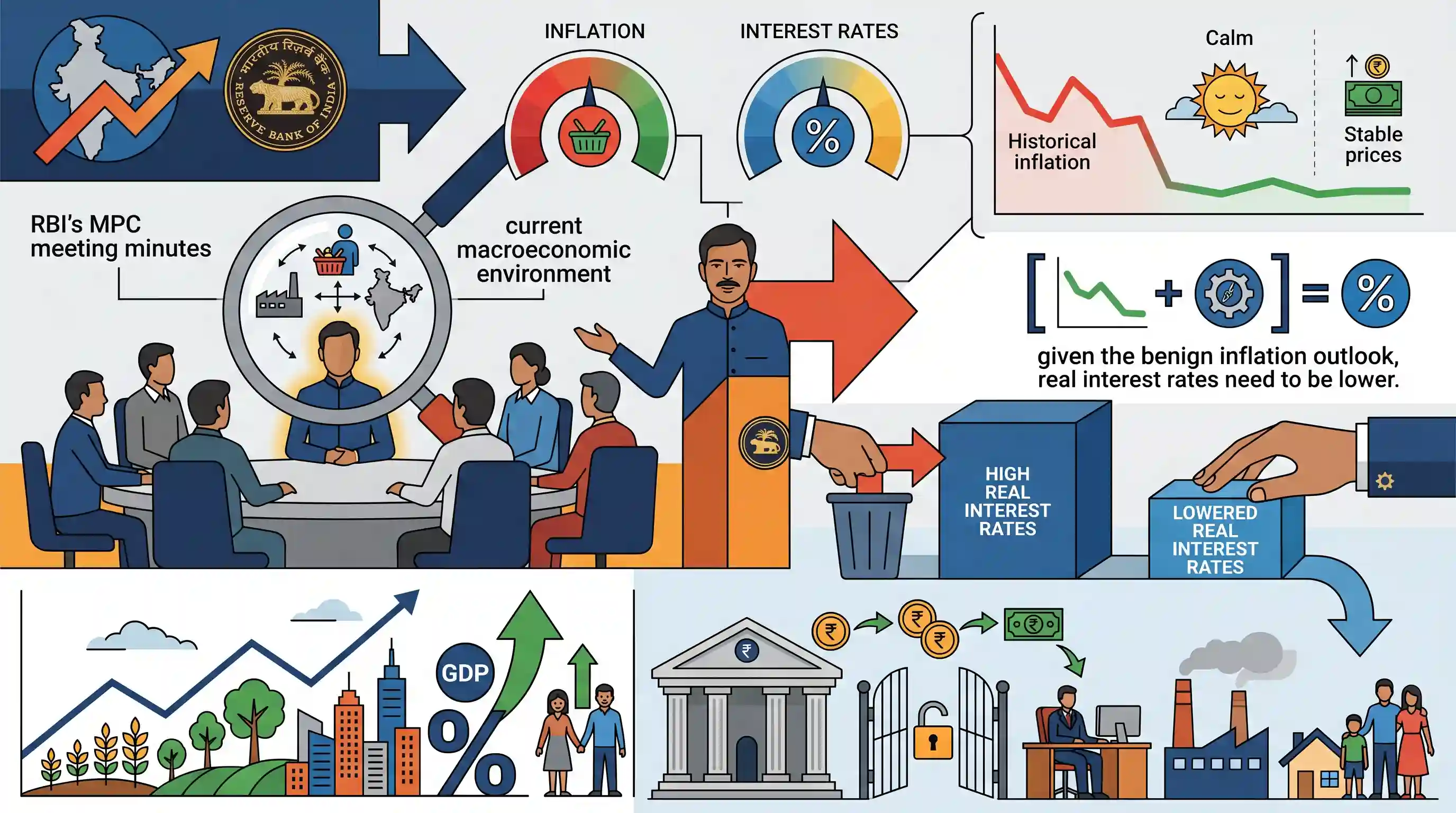
The minutes of the Reserve Bank of India's (RBI) Monetary Policy Committee (MPC) meeting reflect discussions on the current macroeconomic environment, specifically focusing on inflation and interest rates. RBI Governor Sanjay Malhotra highlighted that given the benign inflation outlook, real interest rates need to be lower. This perspective suggests that with inflation under control, maintaining high real interest rates is unnecessary and that easing them could help stimulate economic growth and borrowing.
Key Points
- The minutes from the RBI Monetary Policy Committee (MPC) meeting highlighted the prevailing benign inflation outlook in the Indian economy.
- RBI Governor Sanjay Malhotra indicated that due to controlled inflation, the prevailing real interest rates should be lower.
- A lower real interest rate environment could support credit growth and broader economic activity without risking excessive price rises.
- The discussion reflects the central bank's continuous balancing act between managing inflation and fostering economic growth through monetary policy adjustments.
Important Terms
Real Interest Rate

The inflation-adjusted interest rate, calculated by subtracting the inflation rate from the nominal interest rate; it represents the true cost of borrowing or real return for lenders.
UPSC context
Crucial for GS-III; tests understanding of purchasing power, investment incentives, and how inflation erodes nominal returns.
Monetary Policy Committee (MPC)
A six-member statutory body established under the RBI Act, 1934, responsible for fixing the benchmark policy (repo) rate to maintain price stability while supporting growth.
UPSC context
High-yield topic for GS-III and Prelims; tests knowledge of India's monetary governance, composition (3+3), and voting mechanisms.
Flexible Inflation Targeting (FIT)
India's monetary policy framework (since 2016) that mandates the RBI to maintain headline inflation at 4%, with a tolerance band of 2% to 6%.
UPSC context
Essential for GS-III; tests the balance between price stability and economic growth, and the legal mandate of the RBI.
Benign Inflation
A situation where inflation is low, stable, and predictable, typically considered healthy as it encourages spending and investment without creating economic instability.
UPSC context
Tests conceptual clarity in GS-III on types of inflation and their varying impacts on macroeconomic stability.
Reserve Bank of India (RBI)
India's central bank and regulatory body, established in 1935, responsible for issuing currency, managing foreign exchange reserves, and overseeing the nation's financial system.
UPSC context
Fundamental for GS-III; tests the functions of the central bank as the 'Lender of Last Resort' and its regulatory role.
Consumer Price Index (CPI)
A price index that tracks the change in prices of a basket of goods and services purchased by households; it is the primary anchor for RBI’s inflation targeting.
UPSC context
Core Prelims/Mains concept; tests understanding of how the 'cost of living' is measured and used to formulate policy.
Repo Rate
The fixed interest rate at which the RBI lends money to commercial banks against government securities to manage liquidity in the economy.
UPSC context
Key monetary tool; tests how the RBI signals policy stance (hawkish vs. dovish) to influence market interest rates.
Prelims Trap
"The RBI's Monetary Policy Committee is mandated to directly fix the real interest rate."
The MPC sets the nominal policy repo rate. The real rate (Nominal minus Inflation) is a resulting economic condition, not a statutory target fixed by the RBI.
Static Concepts Connected
How does the Real Interest Rate differ from the Nominal Interest Rate?
- Nominal Rate: The stated interest rate unadjusted for inflation, such as the standard repo rate set by the RBI or a bank's quoted lending rate.
- Real Rate: Calculated by subtracting inflation from the nominal rate. It reveals the true cost of borrowing for businesses and the actual purchasing power yield on savings.
- Policy Stance: A high real rate indicates a tight monetary policy, while a lower real rate signals an accommodative stance designed to spur borrowing and economic growth.
What is the statutory framework of the Monetary Policy Committee (MPC)?
- Core Mandate: To fix the benchmark policy interest rate (repo rate) to contain inflation within the 4% (±2%) target while keeping the objective of growth in mind.
- Composition: A six-member body (3 RBI officials, 3 external GoI appointees). The RBI Governor acts as the ex-officio chairperson.
- Voting Rules: Decisions are made by majority vote. The RBI Governor does not have a veto but holds a casting vote in the event of a tie.
Cross-Topic Patterns
Real rates and FPI flight
A prolonged drop in India's real interest rates, especially if US Federal Reserve rates remain high, can trigger Foreign Portfolio Investment (FPI) outflows and depreciate the Rupee.
EBLR and monetary transmission
The RBI's push for lower real rates only works if banks transmit repo cuts. External Benchmark Lending Rates (EBLR) ensure faster transmission of these cuts to MSME and retail borrowers.

Expect a 2026 Prelims multi-statement question contrasting nominal vs. real interest rates and their impact on bond yields and FPI flows.
Linked PYQs · 4
Linked PYQs · 4
- 2017PrelimsGS1
Which of the following statements is/are correct regarding the Monetary Policy Committee (MPC)? 1. It decides the RBI's benchmark interest rates. 2. It is a 12-member body including the Governor of RBI and is reconstituted every year. 3. It functions under the chairmanship of the Union Finance Minister. Select the correct answer using the code given below:
- 2024MainsGS3
What are the causes of persistent high food inflation in India? Comment on the effectiveness of the monetary policy of the RBI to control this type of inflation.
- 2022PrelimsGS1
With reference to the Indian economy, what are the advantages of "Inflation-Indexed Bonds (IIBs)"? 1. Government can reduce the coupon rates on its borrowing by way of IIBs. 2. IIBs provide protection to the investors from uncertainty regarding inflation. 3. The interest received as well as capital gains on IIBs are not taxable. Which of the statements given above are correct?
- 2016PrelimsGS1
What is/are the purpose/purposes of the 'Marginal Cost of Funds based Lending Rate (MCLR)' announced by RBI? 1. These guidelines help improve the transparency in the methodology followed by banks for determining the interest rates on advances. 2. These guidelines help ensure availability of bank credit at interest rates which are fair to the borrowers as well as the banks. Select the correct answer using the code given below.
