Monetary Policy Committee Stance on Interest Rates
Source:Indian Express ↗
Why It Matters
Monetary policy and inflation dynamics are core topics in UPSC GS3 and Prelims. Understanding the difference between nominal and real interest rates, and how the MPC balances inflation targeting with growth objectives, is crucial for answering questions on RBI's policy stance and its macroeconomic impact.
Summary
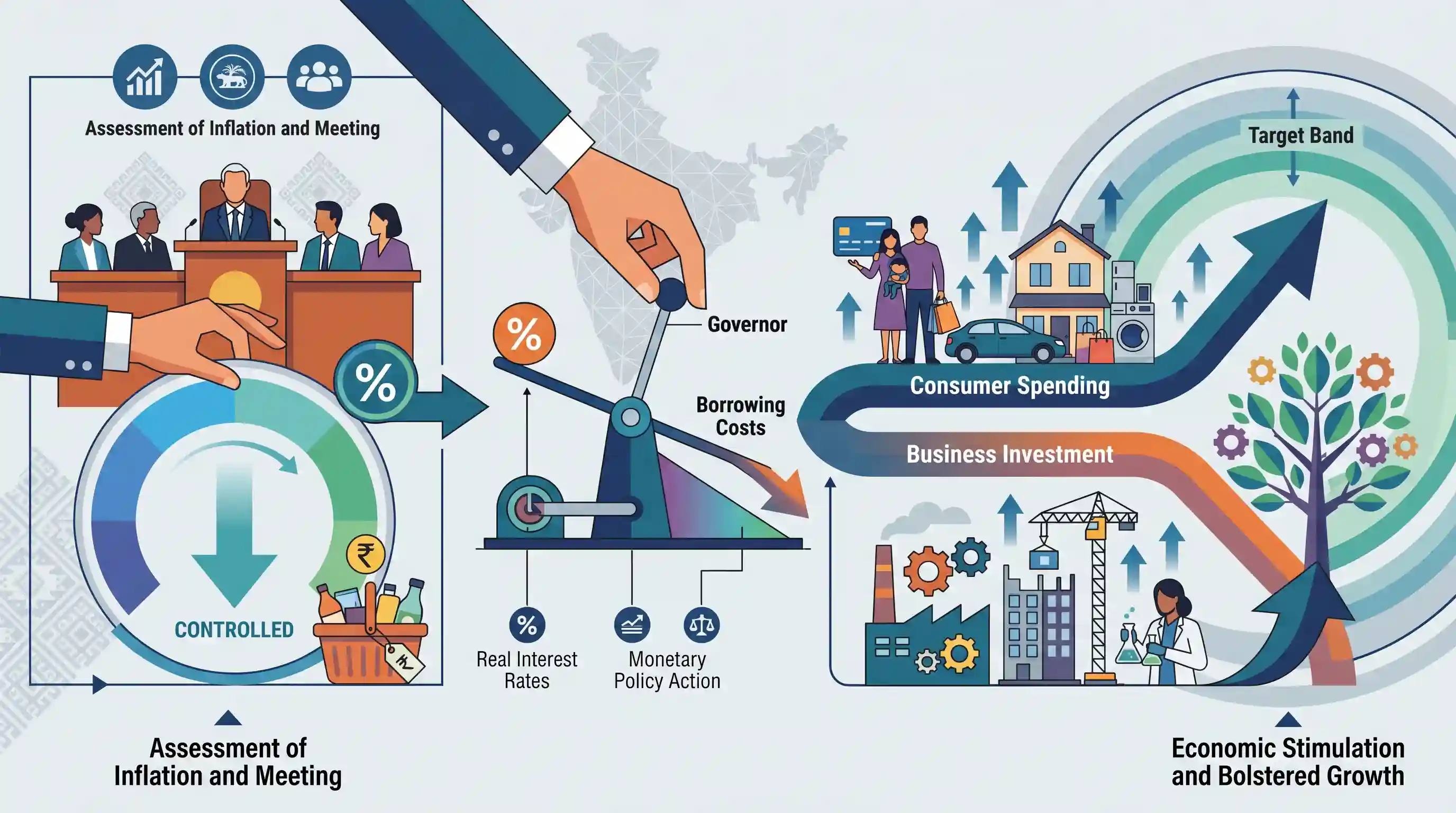
The recently released minutes of the Reserve Bank of India's Monetary Policy Committee (MPC) highlight discussions on the country's macroeconomic trajectory. RBI Governor Sanjay Malhotra noted a benign inflation outlook, suggesting that price pressures are well under control. Given this favorable scenario, he emphasized that real interest rates should be lower to stimulate economic activity. Lowering real interest rates would reduce borrowing costs, encouraging both consumer spending and business investment, reflecting the RBI's focus on bolstering growth while maintaining inflation within its target band.
Key Points
- The Monetary Policy Committee (MPC) minutes reveal RBI Governor Sanjay Malhotra's stance that the current inflation outlook is benign.
- He argued that because inflation is well-behaved, the real interest rates (nominal interest rates minus inflation) currently experienced in the economy are higher than necessary and need to be lowered.
- Lower real interest rates would reduce the actual cost of borrowing, thereby incentivizing private investment and boosting economic growth without compromising price stability.
- This highlights the ongoing balancing act by the MPC to manage the dual mandate of maintaining price stability while supporting growth.
Important Terms
Monetary Policy Committee (MPC)

A statutory 6-member body (3 RBI officials, 3 external members) that determines the policy interest rate (Repo Rate) to achieve India's inflation target while supporting economic growth.
UPSC context
GS Paper III (Economy). Key for understanding monetary policy transmission and the statutory framework of the RBI Act.
Reserve Bank of India (RBI)
India's central bank and regulatory body, established in 1935, responsible for issuing currency, managing foreign exchange, and conducting monetary policy to ensure financial stability.
UPSC context
GS Paper III (Economy). Essential for topics on banking, inflation management, and financial sector regulators.
Real Interest Rate
The nominal interest rate minus the rate of inflation. It represents the actual purchasing power earned by a lender or the true cost of borrowing for a debtor.
UPSC context
GS Paper III (Economy). Tests conceptual clarity on inflation's impact on debt, savings, and investment decisions.
Inflation Targeting
A policy framework where the central bank aims to keep inflation within a specific range. India follows a Flexible Inflation Targeting Framework (FITF) with a 4% goal.
UPSC context
GS Paper III (Economy). Critical for questions on price stability and the 4% +/- 2% mandate.
Consumer Price Index (CPI)
A measure that examines the weighted average of prices of a basket of consumer goods and services. It is the primary inflation anchor used by the RBI.
UPSC context
GS Paper III (Economy). Crucial for understanding 'headline inflation' versus 'core inflation' in policy-making.
Prelims Trap
"A sudden fall in the inflation rate automatically leads to a lower real interest rate in the economy."
If inflation falls while the nominal interest rate remains unchanged, the real interest rate actually INCREASES. The RBI must cut nominal rates to bring real rates down.
Static Concepts Connected
What is the Real Interest Rate and how does it impact the economy?
- The Formula: Calculated as the Nominal Interest Rate minus the Inflation Rate (the Fisher Equation).
- Economic Meaning: It represents the true cost of borrowing for businesses and the actual purchasing-power yield on savings for households.
- Impact on Growth: High real rates disincentivize private investment and borrowing; conversely, lower real rates stimulate credit growth and economic activity.
What is the structure and mandate of the Monetary Policy Committee (MPC)?
- Statutory Backing: A 6-member statutory body constituted under the amended RBI Act, 1934, tasked with determining the policy interest rate.
- Dual Mandate: Its primary statutory objective is to maintain price stability (4% CPI, ±2% band) while keeping in mind the objective of growth.
- Decision Making: Decisions are binding and taken by majority vote. The RBI Governor has a casting vote in a tie, but no veto power.
Cross-Topic Patterns
Real Interest Rates & Fiscal Crowding Out
Consistently high government borrowing can keep nominal rates elevated. Even if the RBI attempts to lower real rates for growth, large fiscal deficits can dilute effective monetary transmission.
Lower Rates and Rupee Depreciation Dynamics
Lowering real interest rates narrows the interest rate differential with advanced economies like the US, potentially triggering FPI outflows and putting depreciative pressure on the Rupee.

Expect a conceptual Prelims question testing how falling inflation actually increases real interest rates if nominal policy rates hold.
Linked PYQs · 3
Linked PYQs · 3
- 2017PrelimsGS1
Which of the following statements is/are correct regarding the Monetary Policy Committee (MPC)? 1. It decides the RBI's benchmark interest rates. 2. It is a 12-member body including the Governor of RBI and is reconstituted every year. 3. It functions under the chairmanship of the Union Finance Minister. Select the correct answer using the code given below:
- 2022PrelimsGS1
In India, which one of the following is responsible for maintaining price stability by controlling inflation?
- 2024MainsGS3
What are the causes of persistent high food inflation in India? Comment on the effectiveness of the monetary policy of the RBI to control this type of inflation.
