RBI Policy Panel Reduces Repo Rate to 5.25 Percent
Source:Indian Express ↗
Why It Matters
Understanding the RBI's monetary policy decisions is crucial for the UPSC syllabus (GS Paper 3: Indian Economy). This development is particularly important because it marks policy under a new RBI Governor, explains dynamic terms like the 'Goldilocks period' and 'disinflation', and illustrates the practical application of policy instruments (Repo, SDF, MSF) to achieve the dual mandate of price stability and growth.
Summary
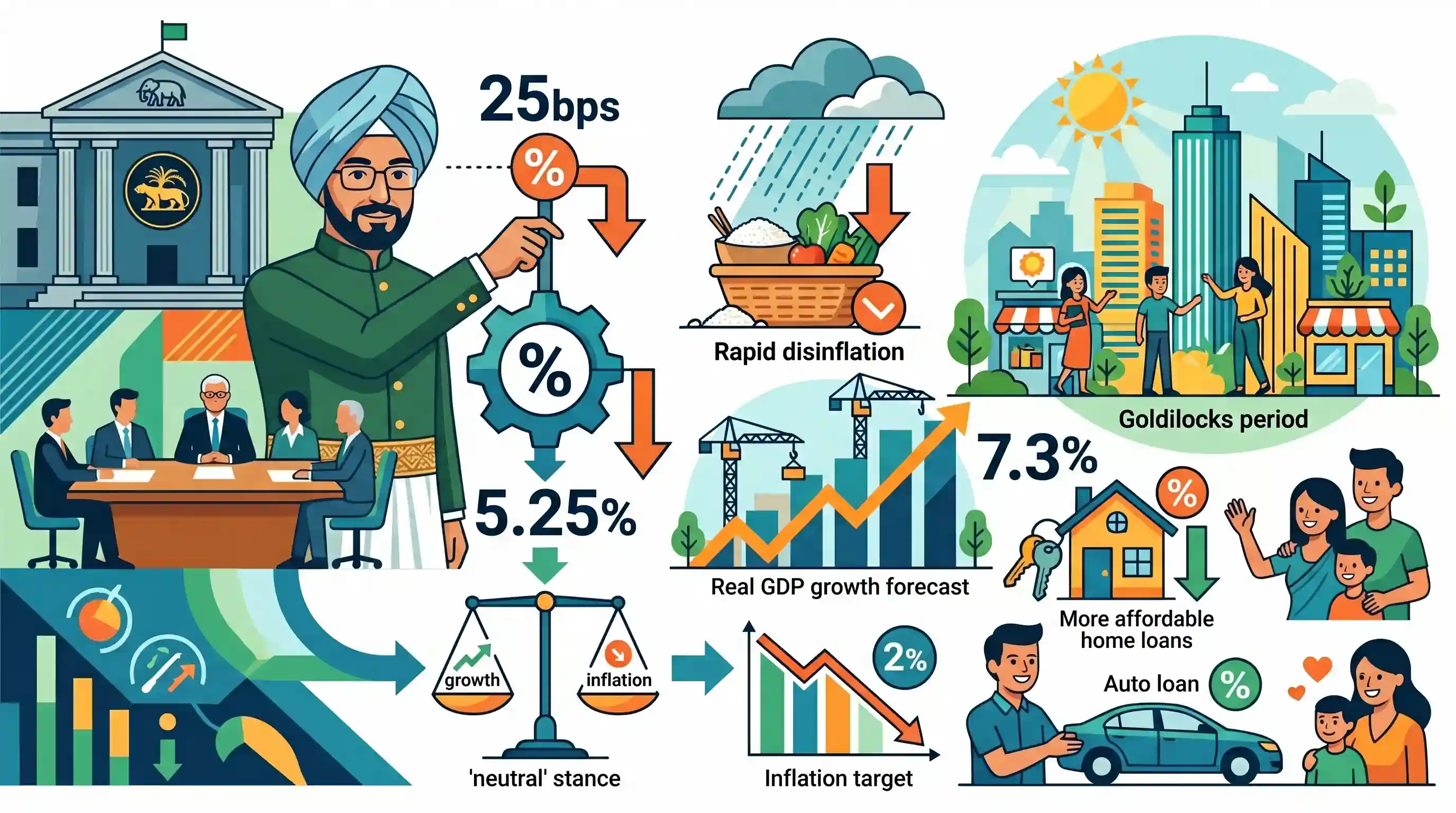
The Reserve Bank of India's Monetary Policy Committee (MPC), headed by newly appointed Governor Sanjay Malhotra, reduced the benchmark repo rate by 25 basis points to 5.25% during its December 2025 meeting. Maintaining a 'neutral' stance, the MPC aims to support economic expansion while keeping inflation in check. Supported by rapid disinflation and easing food prices, the CPI inflation projection for Q4 FY26 was slashed to 2%, and the real GDP growth forecast for FY26 was upgraded to 7.3%. Governor Malhotra described this macroeconomic scenario as a 'Goldilocks period' of robust growth paired with stable, low inflation, which is expected to translate into more affordable home and auto loans for consumers.
Key Points
- The RBI Monetary Policy Committee (MPC), led by Governor Sanjay Malhotra, reduced the repo rate by 25 basis points to 5.25%.
- The policy stance was kept 'neutral' to ensure flexibility amidst potential global uncertainties while supporting domestic growth.
- The Standing Deposit Facility (SDF) rate was adjusted to 5.00% and the Marginal Standing Facility (MSF) rate to 5.50%.
- Real GDP growth projection for FY26 was upgraded to 7.3% from the earlier 6.8%.
- Retail inflation (CPI) projections were sharply lowered to 2% for Q4 of FY26, driven by rapid disinflation and easing food prices.
- The RBI Governor characterized the current economic condition as a 'Goldilocks period'—a state of high economic growth coupled with low inflation.
Important Terms
Reserve Bank of India (RBI)

Established in 1935 under the RBI Act 1934, it is India’s central bank responsible for regulating the banking system, managing foreign exchange, and conducting monetary policy to ensure financial stability.
UPSC context
GS Paper III: Indian Economy. Tests knowledge of institutional frameworks and the central bank's role in macroeconomic stability.
Monetary Policy Committee (MPC)
A 6-member statutory body, chaired by the RBI Governor, mandated to fix the benchmark policy (repo) rate to maintain price stability while keeping in view the objective of growth.
UPSC context
GS Paper III: Economy. Vital for understanding the shift from individual-led to committee-based transparent decision-making.
Repo Rate
The interest rate at which the RBI lends short-term funds to commercial banks against government securities; it is the primary tool used to control liquidity and inflation.
UPSC context
GS Paper III: Economy. Frequently tested in Prelims and Mains regarding its impact on money supply and interest rates.
Inflation Targeting
A monetary policy framework where the central bank aims to keep Consumer Price Index (CPI) inflation within a specific range (currently 4% ± 2%) to anchor public expectations.
UPSC context
GS Paper III: Economy. Tests understanding of the 'Flexible Inflation Targeting' regime and its impact on price stability.
Neutral Stance
A policy position where the central bank remains flexible, neither biased toward increasing nor decreasing interest rates, allowing decisions to be based purely on incoming macroeconomic data.
UPSC context
GS Paper III: Economy. Evaluates the candidate's ability to distinguish between accommodative, hawkish, and neutral policy directions.
Goldilocks Period
An economic state characterized by robust GDP growth and low, stable inflation—neither 'too hot' (inflationary) nor 'too cold' (recessionary).
UPSC context
GS Paper III: Macroeconomics. Tests the ability to describe ideal macroeconomic conditions using standard financial terminology.
Prelims Trap
"SDF allows the RBI to absorb surplus liquidity from commercial banks by providing government securities as collateral."
The Standing Deposit Facility (SDF) is strictly a collateral-free mechanism. Aspirants confuse it with the traditional Reverse Repo, which requires collateral.
Static Concepts Connected
What is the Liquidity Adjustment Facility (LAF) corridor?
- LAF Corridor: The framework used by RBI to manage day-to-day liquidity, centered around the policy Repo rate.
- The Ceiling (MSF): Marginal Standing Facility (MSF) acts as the upper bound, where banks borrow emergency funds at a penal rate.
- The Floor (SDF): Standing Deposit Facility (SDF) acts as the lower bound to absorb surplus bank liquidity without requiring collateral.
What defines a 'Goldilocks Economy'?
- Optimal Balance: An economy that is neither 'too hot' (overheating with high inflation) nor 'too cold' (slipping into recession or deflation).
- Key Indicators: It is characterized by robust, steady GDP growth paired with low, stable inflation and high employment rates.
Cross-Topic Patterns
Policy transmission via EBLR
The projected drop in retail loan EMIs relies on the External Benchmark Lending Rate (EBLR) framework, which mandates banks to link home and auto loans directly to external benchmarks like the repo rate.
Food weightage in CPI vs WPI
The sharp drop in CPI due to easing food prices highlights the massive weightage (~46%) of 'Food and Beverages' in the CPI-Combined index—a frequent Prelims comparison point against the WPI.

SDF as the LAF floor + 'Goldilocks economy' indicators will likely merge into a single multi-statement Economy question in 2026.
Linked PYQs · 4
Linked PYQs · 4
- 2017PrelimsGS1
Which of the following statements is/are correct regarding the Monetary Policy Committee (MPC)? 1. It decides the RBI's benchmark interest rates. 2. It is a 12-member body including the Governor of RBI and is reconstituted every year. 3. It functions under the chairmanship of the Union Finance Minister. Select the correct answer using the code given below:
- 2022PrelimsGS1
In India, which one of the following is responsible for maintaining price stability by controlling inflation?
- 2020PrelimsGS1
If the RBI decides to adopt an expansionist monetary policy, which of the following would it not do ? 1. Cut and optimize the Statutory Liquidity Ratio 2. Increase the Marginal Standing Facility Rate 3. Cut the Bank Rate and Repo Rate Select the correct answer using the code given below:
- 2024MainsGS3
What are the causes of persistent high food inflation in India? Comment on the effectiveness of the monetary policy of the RBI to control this type of inflation.
