RBI Maintains Repo Rate Unchanged at Monetary Review
Source:The Hindu ↗
Why It Matters
It provides crucial updates on India's macroeconomic indicators (repo rate, GDP projections, CPI targets) and demonstrates the intersection of global geopolitics (Strait of Hormuz disruptions), climate (El Niño), and domestic central bank policymaking.
Summary
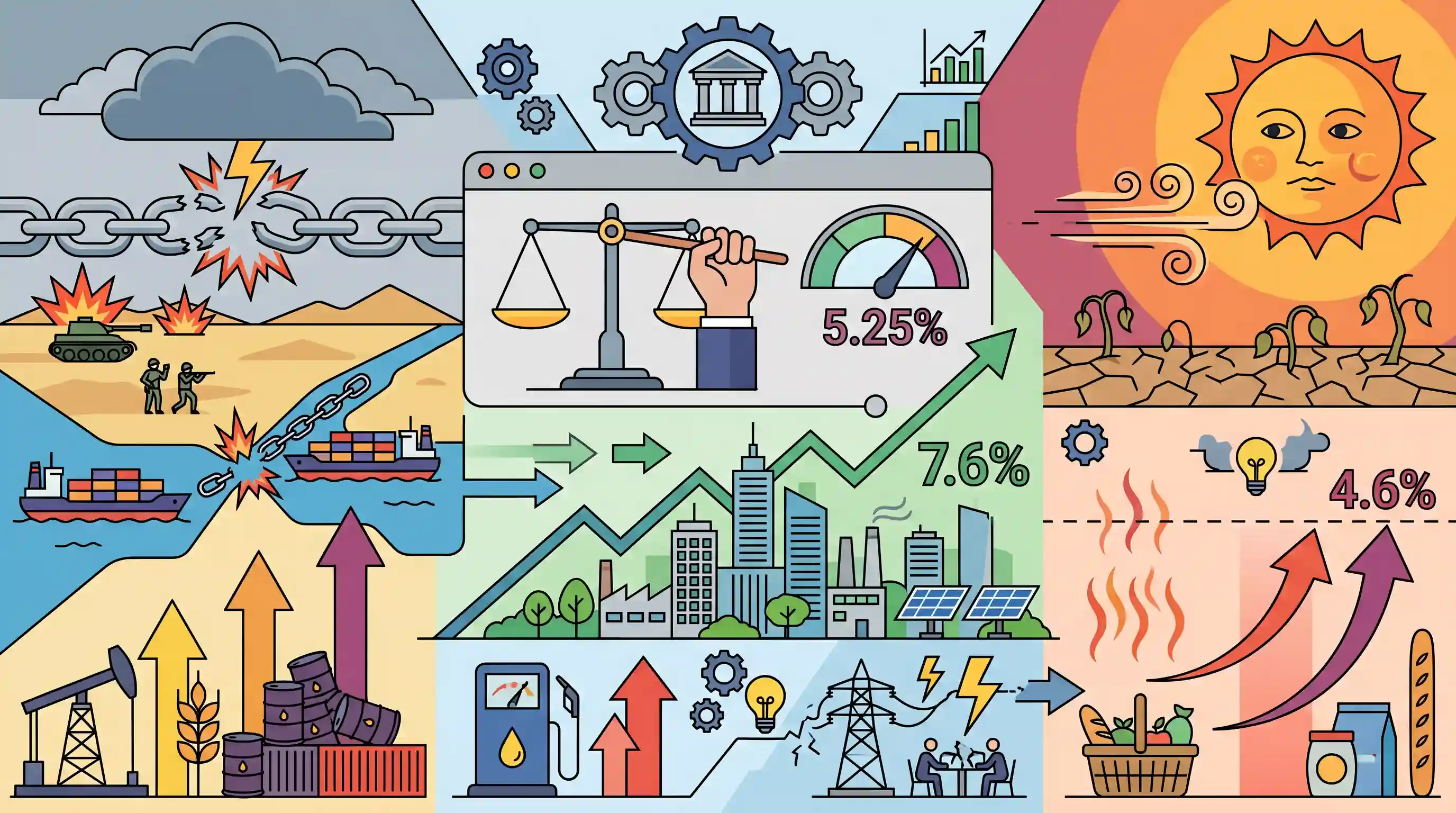
The Reserve Bank of India's Monetary Policy Committee (MPC) opted to hold the repo rate steady at 5.25% in its April 2026 review, maintaining a neutral stance. While the domestic economy exhibits resilience with an estimated 7.6% growth in 2025-26, the RBI Governor cited an ongoing 'supply shock' driven by the conflict in West Asia and associated shipping blockages near the Strait of Hormuz. These global supply chain bottlenecks have elevated energy and commodity prices, putting upside pressure on the 2026-27 inflation target of 4.6%. The possibility of an El Niño further clouds the inflation outlook.
Key Points
- The RBI's Monetary Policy Committee maintained the benchmark repo rate unchanged at 5.25%, retaining a neutral policy stance.
- India's GDP growth is estimated at 7.6% for 2025-26, with a slight moderation to a projected 6.9% for the financial year 2026-27.
- Headline CPI inflation reached 3.2% in February 2026, with average CPI inflation projected at 4.6% for 2026-27.
- The RBI noted immediate upside risks to inflation and domestic production due to a 'supply shock' caused by conflict in West Asia, shipping disruptions in the Strait of Hormuz, and potential El Niño effects.
Important Terms
Monetary Policy Committee (MPC)

A statutory 6-member body under the RBI Act, 1934, mandated to fix the benchmark interest rate (repo rate) to achieve the inflation target while supporting growth.
UPSC context
GS Paper 3 (Economy); institutional framework for inflation targeting and interest rate decisions.
Repo Rate
The interest rate at which the RBI lends short-term money to commercial banks against government securities, acting as the primary tool to control liquidity and inflation.
UPSC context
GS Paper 3 (Economy); core monetary policy instrument frequently tested in Prelims and Mains.
Neutral Stance
A policy position where the central bank remains flexible to either increase or decrease interest rates depending on future inflation and growth data.
UPSC context
GS Paper 3 (Economy); tested under central bank signaling and macroeconomic management strategies.
Strait of Hormuz
A strategic maritime chokepoint between the Persian Gulf and Gulf of Oman, essential for India's energy security as it handles significant crude and LNG imports.
UPSC context
GS Paper 2 (International Relations) and GS Paper 3 (Energy Security); critical geopolitical chokepoint.
El Niño
A climate phenomenon involving the warming of Pacific Ocean surface waters that often weakens the Indian monsoon, impacting agricultural output and food inflation.
UPSC context
GS Paper 1 (Geography) and GS Paper 3 (Agriculture); connects weather patterns to economic stability.
Supply Shock
An unexpected event that suddenly changes the availability of a commodity, causing rapid price fluctuations (cost-push inflation) beyond the central bank's direct control.
UPSC context
GS Paper 3 (Economy); vital for understanding inflation dynamics and policy limitations.
Prelims Trap
The Reserve Bank of India independently sets the official inflation target under the FIT framework.
The inflation target (4% +/- 2%) is set by the Government of India, in consultation with the RBI, once every five years—not independently by the central bank.
Static Concepts Connected
How is the Monetary Policy Committee (MPC) constituted under the RBI Act?
- Composition: Six members: three internal from the RBI (including the Governor as chair) and three external members appointed by the Central Government.
- Voting Rules: Decisions are taken by a majority vote. The RBI Governor does not have a veto but holds a casting vote in the event of a tie.
- Primary Mandate: To determine the policy interest rate (repo rate) required to achieve the inflation target while keeping the objective of growth in mind.
Which major water bodies does the Strait of Hormuz connect?
- Connected Waterways: It serves as the highly strategic and sole sea passage connecting the oil-rich Persian Gulf to the Gulf of Oman and the Arabian Sea.
- Bordering Nations: The maritime chokepoint is bounded by Iran to the north and Oman (the Musandam Peninsula) and the United Arab Emirates to the south.
Cross-Topic Patterns
Monetary Policy + Climate Anomalies
El Niño's suppression of the Indian monsoon creates agricultural supply shocks, driving food inflation that restricts the RBI's ability to lower interest rates to spur growth.
Maritime Chokepoints + Cost-Push Inflation
Geopolitical disruptions in the Strait of Hormuz directly translate to domestic Indian inflation through elevated imported crude oil prices and increased shipping logistics costs.

Expect a multi-statement Prelims question linking El Niño, cost-push inflation, and the RBI MPC's policy stance constraints in 2026.
Linked PYQs · 4
Linked PYQs · 4
- 2022PrelimsGS1
In India, which one of the following is responsible for maintaining price stability by controlling inflation?
- 2017PrelimsGS1
Which of the following statements is/are correct regarding the Monetary Policy Committee (MPC)? 1. It decides the RBI's benchmark interest rates. 2. It is a 12-member body including the Governor of RBI and is reconstituted every year. 3. It functions under the chairmanship of the Union Finance Minister. Select the correct answer using the code given below:
- 2025MainsGS3
Why is maritime security vital to protect India's sea trade? Discuss maritime and coastal security challenges and the way forward.
- 2017PrelimsGS1
With reference to 'Indian Ocean Dipole (IOD)' sometimes mentioned in the news while forecasting Indian monsoon, which of the following statements is/are correct? 1. IOD phenomenon is characterised by a difference in sea surface temperature between tropical Western Indian Ocean and tropical Eastern Pacific Ocean. 2. An IOD phenomenon can influence an El Nino's impact on the monsoon. Select the correct answer using the code given below:
