RBI MPC repo rate status quo and inflation growth outlook
Source:The Hindu ↗
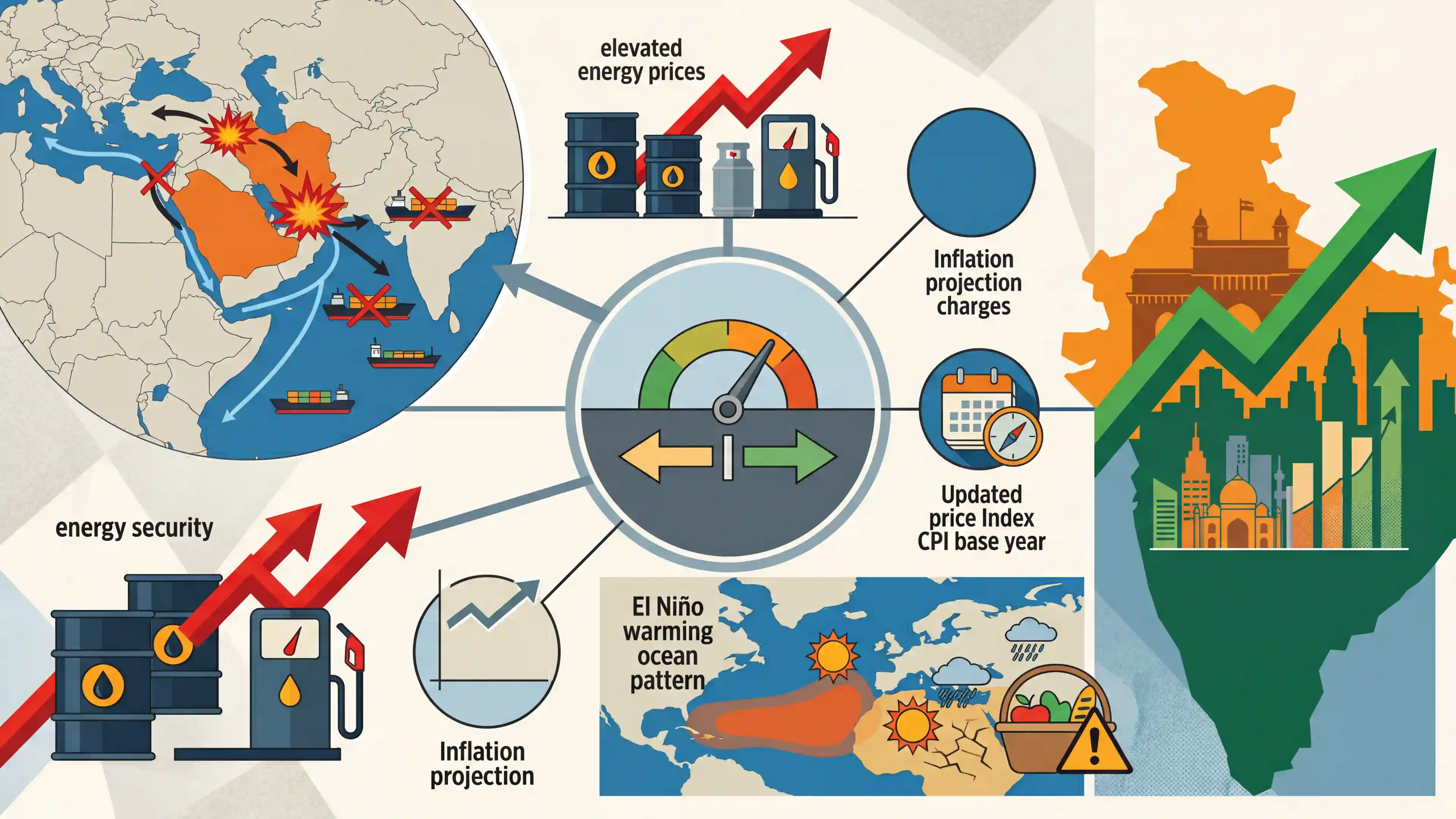
Why It Matters
Monetary policy decisions, particularly the tools used by the RBI (LAF, repo, MSF), are core GS3 economy topics. The article explicitly connects domestic inflation and growth targets with global geopolitical events (Strait of Hormuz, West Asia), highlighting the vulnerability of supply chains and energy security, which frequently feature in both Prelims and Mains questions.
Summary
The Reserve Bank of India’s Monetary Policy Committee (MPC) held the repo rate steady at 5.25% with a neutral stance, driven by concerns over geopolitical tensions and inflation risks. RBI Governor Sanjay Malhotra highlighted disruptions in the Strait of Hormuz and the broader West Asia conflict as significant supply shocks elevating energy prices. Despite these global headwinds, India's real GDP is estimated to grow at 7.6% in FY 2025-26. The central bank is utilizing a newly updated Consumer Price Index (CPI) with a 2024 base year, projecting inflation at 4.6% for 2026-27 while maintaining vigilance against risks such as El Niño.
Key Points
- The RBI's Monetary Policy Committee maintained the repo rate at 5.25% and kept its stance 'neutral' to balance inflation anchoring and growth.
- Real GDP is estimated to grow at 7.6% in 2025-26 and is projected at 6.9% for 2026-27.
- Under the new 2024=100 base year, CPI inflation increased to 3.2% in Feb 2026, with FY 2026-27 projected at 4.6%.
- RBI cited the West Asia conflict and Strait of Hormuz disruptions as supply shocks impacting energy prices and domestic production.
Important Terms
Monetary Policy Committee (MPC)

A statutory 6-member body (under the RBI Act, 1934) mandated to set the policy repo rate to achieve a 4% inflation target (+/- 2%) while supporting economic growth.
UPSC context
GS-III (Economy); tests knowledge of institutional frameworks for price stability and the shift to rule-based monetary policy.
Consumer Price Index (CPI)
A measure of retail inflation tracking price changes in a consumer basket; India updated its base year to 2024 (in 2026) to better reflect modern consumption patterns.
UPSC context
GS-III (Economy); tests understanding of inflation measurement, statistical reforms, and their impact on real-income calculations.
Neutral Stance
A policy stance indicating the central bank has no predetermined bias toward raising or lowering interest rates, allowing flexibility to respond to evolving inflation and growth data.
UPSC context
GS-III (Economy); tests the ability to interpret monetary policy signals and their implications for credit availability and investment.
Strait of Hormuz
A critical maritime chokepoint between Oman and Iran connecting the Persian Gulf to the Arabian Sea; it handles approximately 20% of the world's global oil and LNG trade.
UPSC context
GS-II (IR) & GS-III (Energy Security); tests understanding of geopolitical risks to India's energy supply chains and maritime strategy.
Standing Deposit Facility (SDF)
A collateral-free tool used by the RBI to absorb excess liquidity from the banking system, typically forming the floor of the Liquidity Adjustment Facility (LAF) corridor.
UPSC context
GS-III (Economy); tests technical knowledge of modern liquidity management instruments and their role in stabilizing overnight interest rates.
Liquidity Adjustment Facility (LAF)
The primary framework through which the RBI manages day-to-day liquidity in the banking system using instruments like Repo, Reverse Repo, SDF, and MSF.
UPSC context
GS-III (Economy); tests fundamental understanding of how the central bank controls money supply and interest rate transmission.
Prelims Trap
"The Reserve Bank of India updates the CPI base year and basket weights to accurately target inflation."
The National Statistical Office (NSO) under MoSPI updates the CPI base year and expenditure weights, not the RBI. The RBI only uses it as an anchor.
Static Concepts Connected
What is the structure and primary mandate of the Monetary Policy Committee (MPC)?
- Statutory Structure: It is a 6-member statutory body constituted under the RBI Act, 1934, comprising 3 RBI officials and 3 external members appointed by the Central Government.
- Inflation Mandate: Its primary objective is to determine the policy interest rate (Repo Rate) required to achieve the inflation target (4% ± 2%) while keeping in mind the objective of growth.
- Voting Mechanism: Decisions are taken by a majority vote. The RBI Governor chairs the committee and holds a casting vote in the event of a tie, but no veto power.
Why is the Strait of Hormuz a critical maritime chokepoint for India's economy?
- Strategic Location: It connects the oil-rich Persian Gulf to the Gulf of Oman and the Arabian Sea, flanked by Iran to the north and Oman to the south.
- Energy Security: It is the world's most important oil transit chokepoint. Any blockade or disruption spikes global crude prices, directly threatening India's energy security and widening its current account deficit.
Cross-Topic Patterns
CPI re-weighting + HCES 2023-24
The shift to a 2024 CPI base year integrates the latest Household Consumption Expenditure Survey, fundamentally altering food vs. non-food weightages and changing how the MPC measures cost-push inflation.
El Niño's monetary policy shadow
Climate events like El Niño suppress the southwest monsoon, driving agricultural supply shocks. This creates cost-push food inflation that forces the RBI to delay rate cuts despite growth imperatives.
Geopolitical chokepoints + Domestic inflation
Disruptions in the Strait of Hormuz directly translate to imported energy inflation in India, demonstrating how West Asian maritime security directly dictates domestic interest rate cycles.

Expect a 2026 prelims question linking the new 2024 CPI base year weights to the MPC's inflation targeting mandate and climate shocks.
Linked PYQs · 5
Linked PYQs · 5
- 2024PrelimsGS1
Consider the following statements : 1. In India, Non-Banking Financial Companies can access the Liquidity Adjustment Facility window of the Reserve Bank of India. 2. In India, Foreign Institutional Investors can hold the Government Securities (G-Secs). 3. In India, Stock Exchanges can offer separate trading platforms for debts. Which of the statements given above is/are correct?
- 2020PrelimsGS1
If the RBI decides to adopt an expansionist monetary policy, which of the following would it not do ? 1. Cut and optimize the Statutory Liquidity Ratio 2. Increase the Marginal Standing Facility Rate 3. Cut the Bank Rate and Repo Rate Select the correct answer using the code given below:
- 2024PrelimsGS1
Consider the following statements : Statement-I : Sumed pipeline is a strategic route for Persian Gulf oil and natural gas shipments to Europe. Statement-II : Sumed pipeline connects the Red Sea with the Mediterranean Sea. Which one of the following is correct in respect of the above statements?
- 2020PrelimsGS1
Consider the following statements: 1. The weightage of food in Consumer Price Index (CPI) is higher than that in Wholesale Price Index (WPI). 2. The WPI does not capture changes in the prices of services, which CPI does. 3. Reserve Bank of India has now adopted WPI as its key measure of inflation and to decide on changing the key policy rates. Which of the statements given above is/are correct?
- 2023PrelimsGS1
Consider the following statements: Statement-I: In the post-pandemic recent past, many Central Banks worldwide had carried out interest rate hikes. Statement-II: Central Banks generally assume that they have the ability to counteract the rising consumer prices via monetary policy means. Which one of the following is correct in respect of the above statements?
