RBI Monetary Policy Committee Maintains Repo Rate and Neutral Stance
Source:The Hindu ↗
Why It Matters
The article provides critical updates on India's macroeconomic management, reflecting the RBI's ongoing strategy to balance growth and price stability through monetary policy. Changes to the Lead Bank Scheme, NBFC regulations, and lending to REITs directly tie into the GS3 syllabus regarding financial sector reforms, inclusive growth, and mobilization of resources.
Summary
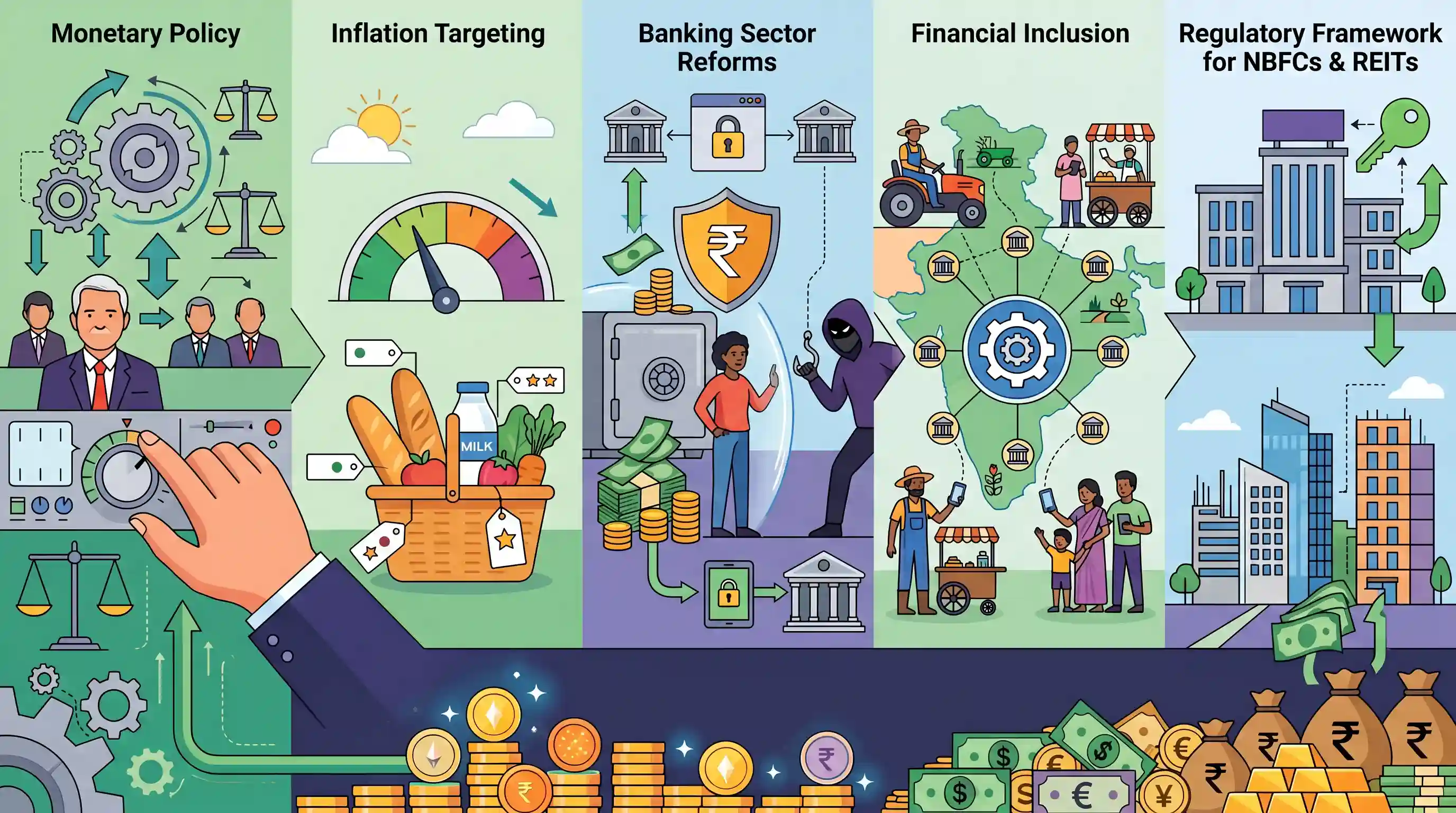
The Reserve Bank of India's Monetary Policy Committee (MPC), led by Governor Sanjay Malhotra, unanimously decided to maintain the policy repo rate at 5.25% with a neutral stance, prioritizing inflation containment. Alongside projecting CPI inflation at 2.1% for FY 2025-26, the RBI announced several financial sector interventions. Key measures include developing a unified portal to enhance the Lead Bank Scheme, relaxing branch expansion norms for large non-deposit-taking NBFCs, and allowing bank lending to Real Estate Investment Trusts (REITs). To bolster consumer trust, the RBI also proposed compensating banking customers up to ₹25,000 for financial fraud losses, against a backdrop of stable systemic liquidity and record high foreign exchange reserves.
Key Points
- The RBI MPC unanimously kept the policy repo rate unchanged at 5.25%, maintaining a 'neutral' monetary policy stance.
- The MPC projected CPI inflation for FY26 at 2.1%, signaling a continued focus on aligning inflation durably with the 4% target amidst global uncertainties.
- Regulatory changes were announced, including easing branch opening norms for certain non-deposit-taking NBFCs and permitting banks to lend to REITs with specific safeguards.
- A unified portal will be created to improve the administration, data management, and monitoring of the Lead Bank Scheme.
- Consumer protection was reinforced with a proposal to compensate customers up to ₹25,000 for losses stemming from financial fraud.
Important Terms
Monetary Policy Committee (MPC)

A six-member statutory body under the RBI Act 1934 that determines the benchmark repo rate to achieve price stability while supporting economic growth, targeting inflation within a 2-6% range.
UPSC context
GS Paper 3/Economy; tests knowledge of inflation targeting and institutional mechanisms for monetary stability.
Lead Bank Scheme
An institutional framework introduced in 1969 where a designated "Lead Bank" coordinates district-level credit planning and financial inclusion. RBI is currently streamlining it via a unified digital portal for data management.
UPSC context
GS Paper 3/Financial Inclusion; tests understanding of rural credit delivery systems and inter-bank coordination.
Real Estate Investment Trusts (REITs)
SEBI-regulated investment vehicles that own and manage income-generating real estate. They provide investors dividends from rental income, with recent reforms allowing direct bank lending to strengthen their financing.
UPSC context
GS Paper 3/Economy; relevant for capital market reforms and financing strategies for commercial real estate.
Non-Banking Financial Companies (NBFCs)
Financial entities providing bank-like services without a full banking license. They cannot accept demand deposits. RBI recently eased branch expansion norms for large non-deposit-taking NBFCs to improve operational flexibility.
UPSC context
GS Paper 3/Banking; tests knowledge of "shadow banking" regulations and their role in credit deepening.
Reserve Bank of India (RBI)
India's central bank and regulatory body established in 1935. It regulates the financial system, manages foreign exchange reserves, and maintains price stability through monetary policy as the "lender of last resort."
UPSC context
GS Paper 3/Economy; core body for Indian finance, regulation, and macroeconomic management.
Prelims Trap
"Real Estate Investment Trusts (REITs) are regulated by the Reserve Bank of India."
While the RBI formulates guidelines on how banks can lend to REITs, REITs themselves are registered with and strictly regulated by SEBI.
Static Concepts Connected
What is the Lead Bank Scheme?
- Origin: Introduced by the RBI in 1969 based on the Gadgil Study Group and Nariman Committee recommendations.
- Core Mechanism: Assigns a specific commercial bank to act as a consortium leader to coordinate credit planning and financial inclusion efforts in an adopted district.
- District Credit Plan: The Lead Bank formulates the Annual Credit Plan (ACP) to ensure adequate credit flow, particularly to priority sectors.
What are Real Estate Investment Trusts (REITs)?
- Structure: They are mutual-fund-like investment vehicles that pool capital from multiple investors to own, operate, or finance income-generating real estate.
- Regulation: REITs are registered and primarily regulated by the Securities and Exchange Board of India (SEBI).
- Investor Benefit: They provide retail investors a way to earn regular income from real estate without having to buy or manage physical properties directly.
Cross-Topic Patterns
Monetary Policy vs. Regulatory Action
The RBI often pairs status-quo monetary policy (interest rates) with targeted micro-prudential easing (like relaxing NBFC norms or allowing REIT lending) to stimulate specific sectors without altering systemic liquidity.
DPI risks and Consumer Protection
Rising digital payment adoption pushes RBI to mandate compensation for small-value digital frauds. This intersects closely with broader cybersecurity governance frameworks (CERT-In) and the DPDP Act.

Expect a 2026 Prelims multi-statement question interlinking RBI's Lead Bank Scheme, Priority Sector Lending, and SEBI regulation of REITs.
Linked PYQs · 5
Linked PYQs · 5
- 2017PrelimsGS1
Which of the following statements is/are correct regarding the Monetary Policy Committee (MPC)? 1. It decides the RBI's benchmark interest rates. 2. It is a 12-member body including the Governor of RBI and is reconstituted every year. 3. It functions under the chairmanship of the Union Finance Minister. Select the correct answer using the code given below:
- 2022PrelimsGS1
In India, which one of the following is responsible for maintaining price stability by controlling inflation?
- 2010PrelimsGS1
With reference to the Non-banking Financial Companies (NBFCs) in India, consider the following statements:
- 2012PrelimsGS1
The basic aim of Lead Bank Scheme is that
- 2019PrelimsGS1
The Service Area Approach was implemented under the purview of
