RBI MPC Keeps Policy Repo Rate Unchanged at 5.25 Percent
Source:The Hindu ↗
આ શા માટે મહત્વનું છે
The MPC's policy decisions and inflation targeting framework are core components of the GS3 Indian Economy syllabus. Aspirants must understand the distinction between headline and core inflation, the functioning of monetary tools like the repo rate, MSF, and SDF, and how factors like El Niño and global headwinds impact domestic macroeconomic stability.
સારાંશ
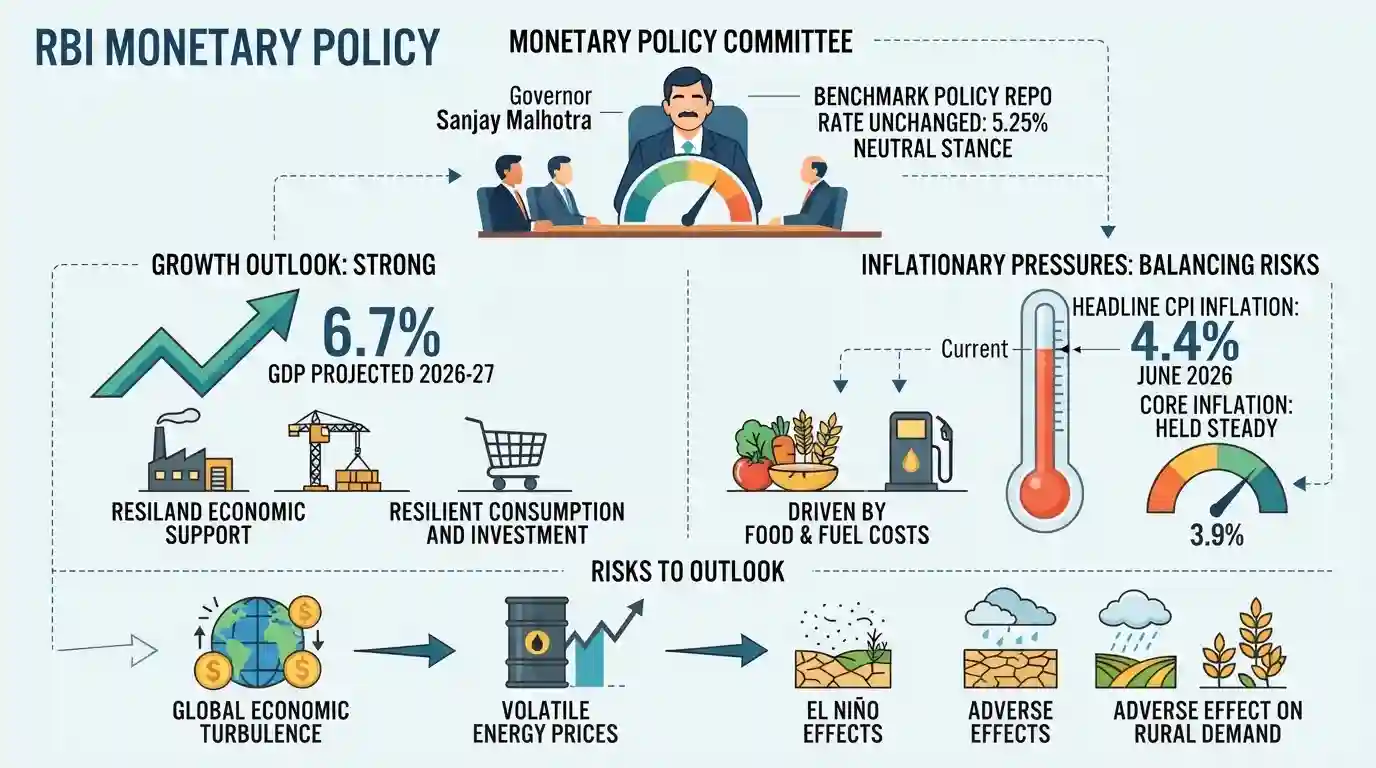
The Reserve Bank of India's Monetary Policy Committee (MPC), headed by Governor Sanjay Malhotra, has opted to keep the benchmark policy repo rate unchanged at 5.25% with a neutral stance. The decision balances a strong growth outlook—with GDP projected to expand by 6.7% in 2026-27—against emerging inflationary pressures. Headline consumer price inflation rose to 4.4% in June 2026, driven largely by food and fuel costs, while core inflation held steady at 3.9%. The central bank noted that the domestic economy is supported by resilient consumption and investment, but warned of significant external and internal risks, including global economic turbulence, volatile energy prices, and the adverse effects of El Niño on the southwest monsoon and rural demand.
મુખ્ય મુદ્દા
- The RBI's Monetary Policy Committee (MPC) kept the policy repo rate unchanged at 5.25%, maintaining a 'neutral' stance.
- The Standing Deposit Facility (SDF) rate stands at 5%, while the Marginal Standing Facility (MSF) and Bank Rate are at 5.50%.
- India's real GDP growth for 2026-27 is projected at 6.7%, supported by robust domestic demand, resilient investment, and rebounding exports.
- Headline CPI inflation increased to 4.4% in June 2026 due to rising food and fuel prices, though core inflation remained unchanged at 3.9%.
- The RBI highlighted potential risks to the economic outlook from global headwinds, supply chain pressures, and the impact of El Niño on the southwest monsoon and agricultural sector.
મહત્વપૂર્ણ શબ્દો
Reserve Bank of India (RBI)

India's central banking institution established under the RBI Act, 1934. It formulates monetary policy, regulates the banking sector, manages foreign exchange, and issues national currency.
UPSC context
GS Paper III (Indian Economy). Tests institutional knowledge of financial regulators and macroeconomic stability.
Monetary Policy Committee (MPC)
A six-member statutory body under the RBI Act, 1934, chaired by the Governor, tasked with setting the benchmark repo rate to achieve the national inflation target.
UPSC context
GS Paper III (Monetary Policy). Tests structural understanding of interest rate determination and price control tools.
Repo Rate
The key interest rate at which the RBI lends short-term funds to commercial banks against government securities to manage liquidity and control inflation.
UPSC context
GS Paper III (Indian Economy). Tests direct mechanisms of liquidity management, monetary transmission, and monetary policy tools.
Flexible Inflation Targeting
India's monetary policy framework under which the RBI targets a 4% CPI retail inflation rate, within a statutory 2% to 6% tolerance band, to balance stability and growth.
UPSC context
GS Paper III (Fiscal/Monetary Policy). Tests understanding of macro stability, statutory policy mandates, and central bank accountability.
Core Inflation
The measure of price rise in an economy that excludes volatile components like food and fuel, indicating the underlying and stable trend of long-term inflation.
UPSC context
GS Paper III (Macroeconomics). Tests knowledge of inflation types, structural issues, and their implications on monetary policy.
પ્રિલિમ્સ ટ્રેપ
The Monetary Policy Committee (MPC) is statutory body empowered to independently set and revise India's inflation targets.
The inflation target is determined by the Central Government in consultation with the RBI (Sec 45ZA), not by the MPC itself. The MPC is only mandated to achieve this pre-set target.
સંલગ્ન સ્થિર ખ્યાલો
What constitutes the Liquidity Adjustment Facility (LAF) corridor in India?
- Marginal Standing Facility: The upper bound of the corridor through which commercial banks can borrow emergency overnight funds from the RBI at a penal rate.
- Standing Deposit Facility: The lower bound of the corridor used to absorb excess liquidity overnight from banks without the RBI needing to provide collateral (G-Secs).
- Repo Rate: The benchmark policy rate at which RBI lends short-term funds to banks; it sits precisely in the middle of the MSF-SDF corridor.
How do Headline and Core Inflation differ in Indian macroeconomic policy?
- Headline Inflation: Measured using CPI-Combined, tracking total retail inflation including highly volatile components like food, vegetables, and fuel.
- Core Inflation: Calculated by stripping away food and fuel components from CPI to capture underlying, long-term demand-driven price trends in the economy.
- Policy Mandate: The RBI's statutory mandate is to target Headline CPI (4% with a +/- 2% band), though policy actions closely monitor core inflation to gauge demand.
આંતર-વિષય પેટર્ન
Monetary Policy + Agri-meteorology
El Niño-induced monsoon shocks directly spike retail food inflation, compelling the MPC to maintain high rates despite steady core inflation and robust industrial growth.
Fiscal Expansion + Liquidity Corridors
State-led capital expenditure drives domestic investment, creating a delicate balance for the RBI to manage liquidity absorption without crowding out private credit.

LAF corridor architecture (SDF collateral-free status vs Reverse Repo) and MPC's target-setting limitations will dominate 2026 prelims.
સંલગ્ન PYQ · 5
સંલગ્ન PYQ · 5
- 2020PrelimsGS1
If the RBI decides to adopt an expansionist monetary policy, which of the following would it not do ? 1. Cut and optimize the Statutory Liquidity Ratio 2. Increase the Marginal Standing Facility Rate 3. Cut the Bank Rate and Repo Rate Select the correct answer using the code given below:
- 2024PrelimsGS1
Consider the following statements : 1. In India, Non-Banking Financial Companies can access the Liquidity Adjustment Facility window of the Reserve Bank of India. 2. In India, Foreign Institutional Investors can hold the Government Securities (G-Secs). 3. In India, Stock Exchanges can offer separate trading platforms for debts. Which of the statements given above is/are correct?
- 2024MainsGS3
What are the causes of persistent high food inflation in India? Comment on the effectiveness of the monetary policy of the RBI to control this type of inflation.
- 2014MainsGS3
There is also a point of view that Agricultural Produce Market Committees (APMCs) set up under the State Acts have not only impeded the development of agriculture but also have been the cause of food inflation in India. Critically examine.
- 2020PrelimsGS1
Consider the following statements: 1. The weightage of food in Consumer Price Index (CPI) is higher than that in Wholesale Price Index (WPI). 2. The WPI does not capture changes in the prices of services, which CPI does. 3. Reserve Bank of India has now adopted WPI as its key measure of inflation and to decide on changing the key policy rates. Which of the statements given above is/are correct?
