RBI Repo Rate Cut and Accommodative Monetary Policy Stance
Source:The Hindu ↗
Why It Matters
RBI monetary policy decisions directly impact the broader economy, affecting lending rates, inflation, and growth. Understanding the MPC's rationale (like shifting from neutral to accommodative stance due to global headwinds) is essential for GS3's macroeconomic syllabus.
Summary
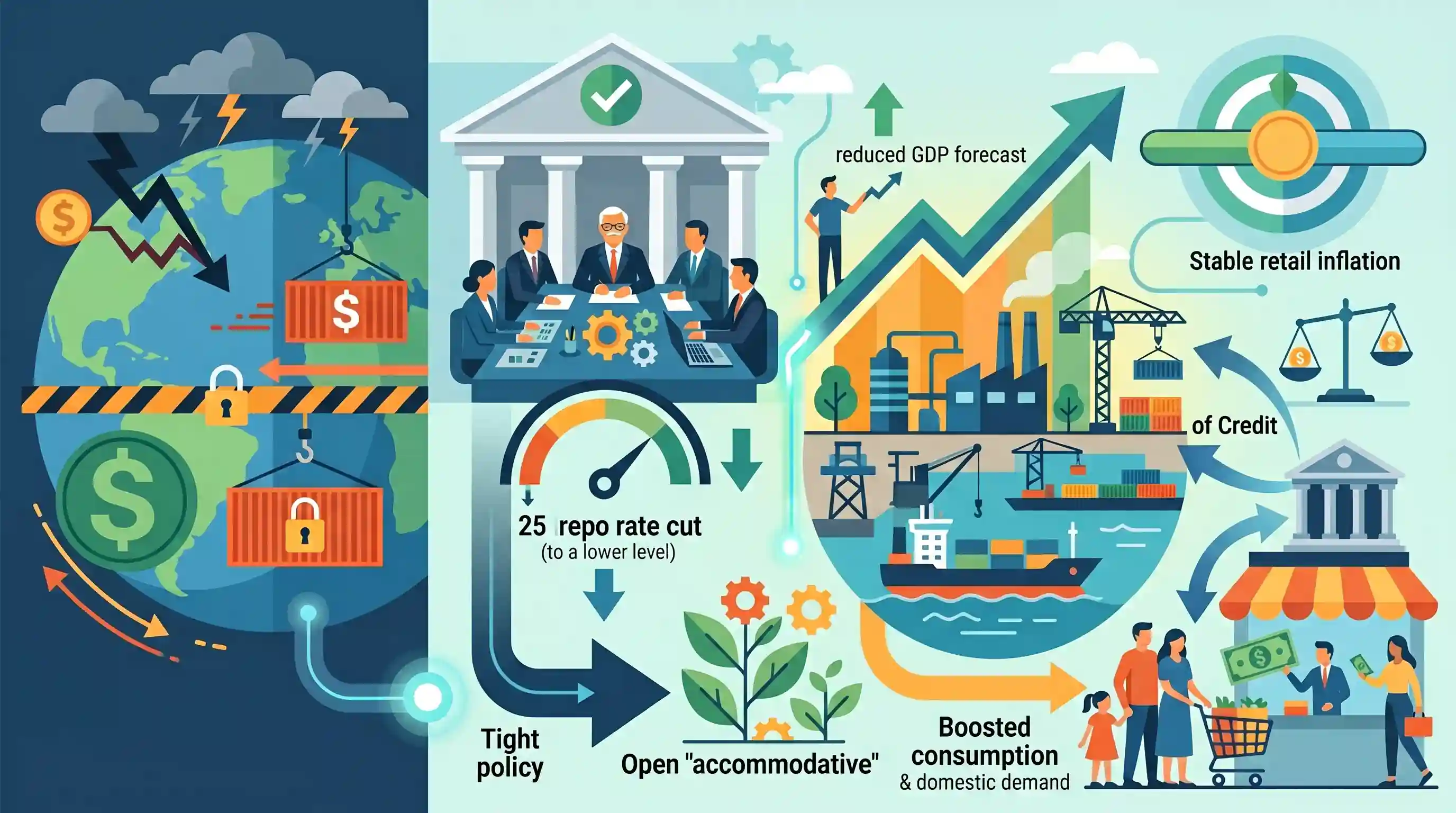
In response to growing global uncertainties and trade war fears sparked by new US tariffs, the RBI's Monetary Policy Committee (MPC), led by Governor Sanjay Malhotra, implemented a 25 basis point repo rate cut to 6.00% on April 9, 2025. This marked the second consecutive rate reduction. Accompanying the cut, the RBI shifted its policy stance to 'accommodative', signaling a prioritization of economic growth as it lowered its 2025-26 GDP forecast to 6.5%. With retail inflation projected to remain stable at 4%, the central bank found the macroeconomic space to ease borrowing costs to support domestic investment and consumption.
Key Points
- The RBI's Monetary Policy Committee cut the repo rate by 25 basis points to 6.00% in its April 2025 meeting.
- The MPC changed its monetary policy stance from 'neutral' to 'accommodative', indicating the potential for further rate cuts to support growth.
- Real GDP growth forecast for 2025-26 was revised downwards to 6.5%, while the CPI inflation projection was retained at 4%.
- The rate cut was primarily driven by the need to buffer the domestic economy from uncertainties caused by global trade tensions and new US tariffs.
- Other liquidity facility rates were also adjusted: the Standing Deposit Facility (SDF) rate was set at 5.75%, and the Marginal Standing Facility (MSF) rate and Bank Rate at 6.25%.
Important Terms
Monetary Policy Committee (MPC)

A six-member statutory body (three RBI, three external experts) established under the RBI Act, 1934, responsible for setting the benchmark repo rate to achieve India's inflation target.
UPSC context
GS III (Economy); tests knowledge of institutional frameworks for price stability and the shift toward rule-based monetary policy-making.
Repo Rate
The interest rate at which the RBI lends short-term funds to commercial banks against government securities; it is the primary tool for managing liquidity and inflation.
UPSC context
GS III (Economy); fundamental for understanding how the RBI influences borrowing costs, investment, and consumption in the domestic economy.
Accommodative Stance
A monetary policy stance where the central bank is prepared to expand the money supply and keep interest rates low to stimulate economic growth.
UPSC context
GS III (Economy); tests the ability to analyze how the RBI balances the growth-inflation trade-off during economic slowdowns.
Flexible Inflation Targeting (FIT)
A framework adopted in 2016 where the RBI targets a 4% Consumer Price Index (CPI) inflation rate, within a tolerance band of 2% to 6%.
UPSC context
GS III (Economy); critical for understanding India's modern monetary mandate and its impact on macroeconomic stability and investor confidence.
Liquidity Adjustment Facility (LAF)
A mechanism used by the RBI to manage day-to-day liquidity in the banking system through instruments like repo and reverse repo auctions.
UPSC context
GS III (Economy); requires understanding of the specific operational tools used by the central bank to align market rates with the repo rate.
Sanjay Malhotra
The 26th Governor of the Reserve Bank of India (assumed office December 2024), an IAS officer who chairs the MPC and leads India's monetary response.
UPSC context
Prelims; current affairs identification of key institutional heads and their role in steering the economy through global trade uncertainties.
Prelims Trap
"Under the Standing Deposit Facility (SDF), the RBI provides government securities as collateral to banks."
SDF is an uncollateralized liquidity absorption tool. The RBI absorbs excess money from banks without providing G-Secs, unlike the traditional Reverse Repo mechanism.
Static Concepts Connected
What are the components of the LAF (Liquidity Adjustment Facility) corridor?
- Repo Rate: The rate at which RBI lends short-term funds to banks against approved government collateral.
- SDF: The uncollateralized lower bound (floor) of the corridor used by RBI to absorb surplus liquidity.
- MSF: The upper bound (ceiling) penal rate where banks borrow overnight funds dipping into their SLR quota.
What do the primary monetary policy stances signify?
- Accommodative: The central bank intends to expand the money supply and is open to cutting rates to stimulate growth.
- Hawkish: The central bank prioritizes inflation control and is prepared to hike rates or tighten liquidity.
- Neutral: The central bank commits to neither direction, deciding rate changes strictly on incoming macroeconomic data.
Cross-Topic Patterns
Trade Wars & Monetary Easing
Protectionist policies like US tariffs risk slowing Indian exports, prompting the RBI to switch to an 'accommodative' stance to rely on domestic consumption as a macroeconomic buffer.
Flexible Inflation Targeting in Action
The MPC's decision practically demonstrates the dual mandate of the RBI Act: with CPI inflation stabilized at 4%, space is legally unlocked to stimulate growth amidst global headwinds.

A 2026 prelims statement will likely test the 'accommodative' stance definition and the uncollateralized nature of SDF within the LAF.
Linked PYQs · 5
Linked PYQs · 5
- 2024MainsGS3
What are the causes of persistent high food inflation in India? Comment on the effectiveness of the monetary policy of the RBI to control this type of inflation.
- 2018MainsGS3
How would the recent phenomena of protectionism and currency manipulations in world trade affect macroeconomic stability of India?
- 2019MainsGS3
Do you agree with the view that steady GDP growth and low inflation have left the Indian economy in good shape? Give reasons in support of your arguments.
- 2017PrelimsGS1
Which of the following statements is/are correct regarding the Monetary Policy Committee (MPC)? 1. It decides the RBI's benchmark interest rates. 2. It is a 12-member body including the Governor of RBI and is reconstituted every year. 3. It functions under the chairmanship of the Union Finance Minister. Select the correct answer using the code given below:
- 2023PrelimsGS1
Consider the following statements: Statement-I: In the post-pandemic recent past, many Central Banks worldwide had carried out interest rate hikes. Statement-II: Central Banks generally assume that they have the ability to counteract the rising consumer prices via monetary policy means. Which one of the following is correct in respect of the above statements?
