RBI Monetary Policy Committee Repo Rate Reduction
Source:The Hindu ↗
Why It Matters
Monetary policy decisions directly affect market liquidity, borrowing costs, inflation, and economic growth. Understanding the MPC's rationale, statutory framework (flexible inflation targeting), and policy tools (repo rate, MSF, SDF) is a high-frequency focus area for both Prelims and Mains (GS3).
Summary
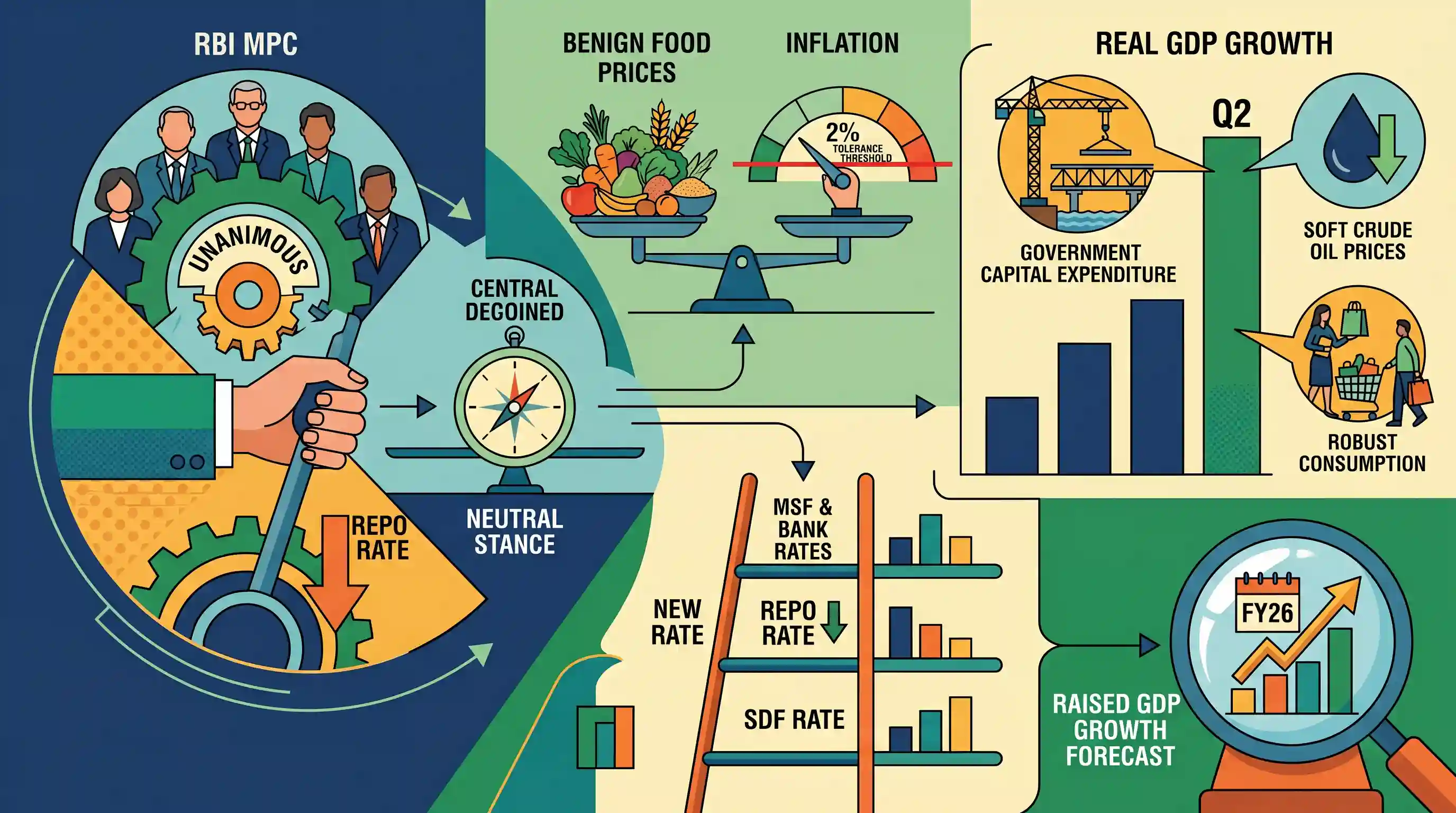
The Reserve Bank of India's Monetary Policy Committee (MPC) unanimously decided to cut the benchmark repo rate by 25 basis points to 5.25%, retaining a neutral stance. The decision is set against the backdrop of exceptionally benign food prices pulling headline inflation down to 1.7%—breaching the 2% lower tolerance threshold of the central bank's flexible inflation targeting framework. Concurrently, real GDP growth accelerated to 8.2% in the second quarter, buoyed by government capital expenditure, softened crude oil prices, and robust consumption. Given the strong economic fundamentals and low inflation, the RBI has raised its FY26 GDP growth forecast to 7.3%. The Standing Deposit Facility (SDF) rate was adjusted to 5.0%, and the Marginal Standing Facility (MSF) and Bank rates to 5.50%.
Key Points
- The RBI Monetary Policy Committee unanimously reduced the repo rate by 25 basis points to 5.25%.
- Under RBI Governor Sanjay Malhotra, the repo rate has seen cumulative cuts of 125 basis points across four occasions.
- Headline inflation plummeted to 1.7%, breaching the lower bound of the RBI's 2-6% flexible inflation targeting band.
- India's real GDP growth accelerated to 8.2% in Q2, prompting an upward revision of the FY26 growth projection to 7.3%.
- The MPC maintained a neutral stance, keeping the SDF rate at 5.0% and both MSF and Bank rates at 5.50%.
Important Terms
Monetary Policy Committee (MPC)

A statutory six-member body (3 RBI, 3 Government nominees) mandated to fix the benchmark repo rate to achieve a headline inflation target of 4% within a +/- 2% tolerance band.
UPSC context
GS Paper III: Indian Economy. Tests institutional structure, mandate for price stability, and the statutory basis of India's monetary framework.
Repo Rate
The benchmark interest rate at which the RBI lends short-term money to commercial banks against government securities; it is the primary tool for signaling the policy stance.
UPSC context
GS Paper III: Indian Economy. Key for understanding inflation control, interest rate transmission, and the Liquidity Adjustment Facility (LAF) corridor.
Standing Deposit Facility (SDF)
A collateral-free liquidity absorption tool that allows banks to deposit excess funds with the RBI. It currently serves as the floor of the Liquidity Adjustment Facility (LAF) corridor.
UPSC context
GS Paper III: Indian Economy. Tests knowledge of modern liquidity management tools and the shift from the traditional Reverse Repo mechanism.
Marginal Standing Facility (MSF)
An emergency window for scheduled banks to borrow overnight funds from the RBI by dipping into their SLR quota at a penal rate; it acts as the corridor ceiling.
UPSC context
GS Paper III: Indian Economy. Tests understanding of "last resort" borrowing, SLR flexibility, and managing extreme overnight inter-bank volatility.
Reserve Bank of India (RBI)
India’s central bank, a statutory body under the RBI Act 1934, responsible for monetary policy, banking regulation, currency issuance, and maintaining financial stability.
UPSC context
GS Paper III: Indian Economy. Core topic for understanding the role of the central bank in economic growth and resource mobilization.
Flexible Inflation Targeting (FIT)
A framework where the central bank targets a specific inflation rate (4% CPI) while maintaining flexibility to support growth and navigate supply-side shocks.
UPSC context
GS Paper III: Indian Economy. Tests the evolution of monetary policy rules and the accountability mechanism between the RBI and Parliament.
Prelims Trap
RBI must submit a report to the Central Government immediately upon inflation falling to 1.7%.
Under the RBI Act, the central bank is required to report a failure only if inflation breaches the 2-6% tolerance band for three consecutive quarters, not instantly.
Static Concepts Connected
How do SDF and MSF define the Liquidity Adjustment Facility (LAF) corridor?
- SDF (Floor): Absorbs surplus liquidity from banks without requiring government securities as collateral, setting the corridor's floor (Repo minus 0.25%).
- MSF (Ceiling): A penal rate for banks borrowing emergency funds by dipping into their SLR quota, setting the corridor's ceiling (Repo plus 0.25%).
- Symmetric anchor: The benchmark policy repo rate anchors this symmetric 50-basis-point corridor right in the middle.
What are the statutory rules for an inflation targeting failure?
- Failure condition: Average headline CPI inflation falls below 2% or rises above 6% for three consecutive quarters.
- Mandatory Report: RBI must submit a report to the government outlining reasons for failure, remedial actions proposed, and an estimated recovery timeline.
- Statutory backing: These accountability mechanisms are strictly mandated under Section 45ZN of the amended Reserve Bank of India Act, 1934.
Cross-Topic Patterns
CPI food weightage vs WPI dynamics
Benign food prices crashed headline CPI precisely because food and beverages comprise ~45.8% of the CPI basket, which is almost double their weight in the WPI basket.
Decoupling policy stance from rate action
A rate cut typically implies an 'accommodative' policy, but retaining a 'neutral' stance here gives the RBI flexibility to hike or cut in the future without forward guidance commitments.

Expect a 2026 prelims question testing the nuances of the SDF vs MSF symmetric corridor and statutory triggers for FIT framework failures.
Linked PYQs · 4
Linked PYQs · 4
- 2017PrelimsGS1
Which of the following statements is/are correct regarding the Monetary Policy Committee (MPC)? 1. It decides the RBI's benchmark interest rates. 2. It is a 12-member body including the Governor of RBI and is reconstituted every year. 3. It functions under the chairmanship of the Union Finance Minister. Select the correct answer using the code given below:
- 2020PrelimsGS1
If the RBI decides to adopt an expansionist monetary policy, which of the following would it not do ? 1. Cut and optimize the Statutory Liquidity Ratio 2. Increase the Marginal Standing Facility Rate 3. Cut the Bank Rate and Repo Rate Select the correct answer using the code given below:
- 2022PrelimsGS1
In India, which one of the following is responsible for maintaining price stability by controlling inflation?
- 2020PrelimsGS1
Consider the following statements: 1. The weightage of food in Consumer Price Index (CPI) is higher than that in Wholesale Price Index (WPI). 2. The WPI does not capture changes in the prices of services, which CPI does. 3. Reserve Bank of India has now adopted WPI as its key measure of inflation and to decide on changing the key policy rates. Which of the statements given above is/are correct?
