Reserve Bank of India monetary policy committee announcements
Source:The Hindu ↗
Why It Matters
Understanding RBI's monetary policy stance is critical for the UPSC GS3 Economy syllabus. This article provides vital real-world examples of how geopolitical events (like the Strait of Hormuz disruption) transmit into domestic inflation, current account deficits, and currency depreciation, demonstrating the interconnectedness of global supply chains and macroeconomic stability.
Summary
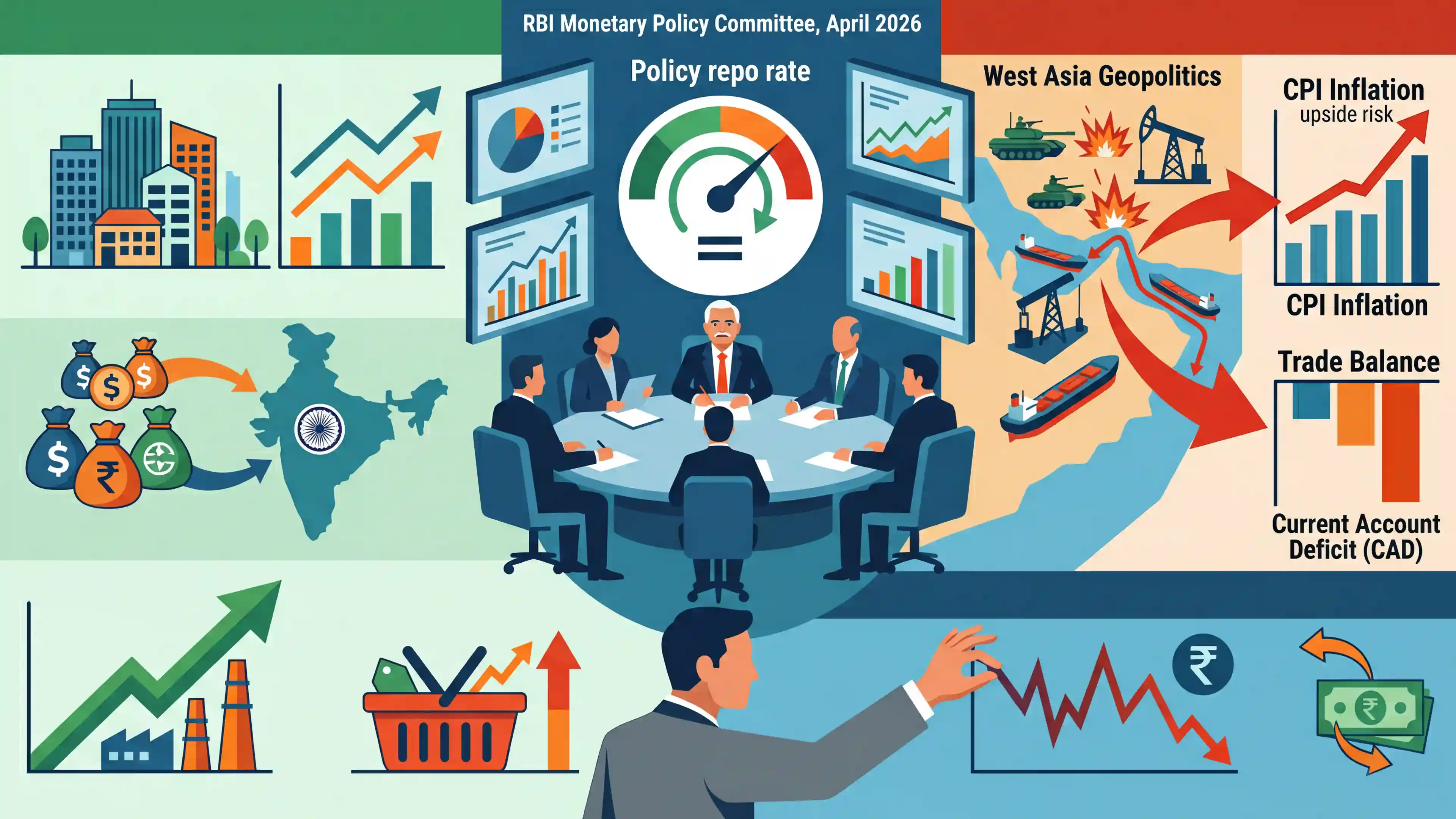
The Reserve Bank of India's Monetary Policy Committee (MPC) announced its decision to keep the policy repo rate steady at 5.25% in its April 2026 meeting. RBI Governor Sanjay Malhotra highlighted that while India's macroeconomic fundamentals, including NBFC health and remittance inflows, remain strong, geopolitical tensions in West Asia and disruptions in the Strait of Hormuz pose significant upside risks to inflation and the Current Account Deficit (CAD). Consequently, FY27 real GDP growth is projected at 6.9% with CPI inflation at 4.6%. The central bank reiterated its commitment to market-determined exchange rates, intervening only to smooth out excessive volatility amid recent FPI outflows and rupee depreciation.
Key Points
- The RBI MPC opted to keep the policy repo rate unchanged at 5.25%, maintaining its focus on anchoring headline CPI inflation to the 4% target.
- Real GDP growth for FY27 is projected at 6.9% and CPI inflation at 4.6%, though upside risks exist due to West Asia geopolitical tensions and supply disruptions.
- Geopolitical disruptions in the Strait of Hormuz are driving up energy and commodity prices, which may widen India's Current Account Deficit (CAD).
- FPI net outflows of $16.5 billion led to higher-than-average rupee depreciation, though RBI stated exchange rate interventions are solely to curb excessive volatility.
- Despite tighter liquidity and global pressures, India's Non-Banking Financial Companies (NBFCs) demonstrate robust fundamentals and improving asset quality.
Important Terms
Monetary Policy Committee (MPC)

A statutory 6-member committee under the RBI Act, 1934, mandated to determine the policy interest rate (repo rate) required to achieve specific inflation targets.
UPSC context
GS Paper III (Economy); tests knowledge of institutional frameworks for price stability and the 4%±2% inflation targeting mandate.
Repo Rate
The interest rate at which the RBI lends money to commercial banks against government securities; it is the primary tool for managing liquidity and inflation.
UPSC context
GS Paper III (Economy); fundamental for understanding monetary policy transmission, cost of credit, and liquidity adjustment facilities (LAF).
Current Account Deficit (CAD)
A measurement of a country's trade where the value of imported goods and services exceeds the value of those exported, indicating net borrowing from abroad.
UPSC context
GS Paper III (Economy); critical for Balance of Payments (BoP) analysis, external sector stability, and its impact on the Rupee's value.
Consumer Price Index (CPI)
An index tracking average price changes in a fixed basket of goods and services consumed by households; it serves as India's primary retail inflation anchor.
UPSC context
GS Paper III (Economy); primary metric for inflation targeting and assessing the cost of living and real economic growth.
Foreign Portfolio Investment (FPI)
Investment by non-residents in Indian financial assets like stocks and bonds; known for high liquidity and volatility compared to Foreign Direct Investment (FDI).
UPSC context
GS Paper III (Economy); significant for capital account dynamics, market volatility, and exchange rate management during global shocks.
Strait of Hormuz
A strategic maritime chokepoint between the Persian Gulf and Gulf of Oman, through which approximately 20% of global oil and gas shipments pass.
UPSC context
GS Paper II (IR) and III (Security); vital for India's energy security, as it handles a majority of its crude oil and LNG imports.
Prelims Trap
The RBI intervenes in the forex market to maintain a fixed exchange rate for the Rupee.
India follows a 'managed floating' regime. The RBI intervenes solely to curb excessive volatility, not to peg the Rupee to a specific target rate.
Static Concepts Connected
How does the Monetary Policy Committee (MPC) target inflation?
- Statutory Mandate: Constituted under the RBI Act, the MPC is tasked with maintaining price stability while keeping in mind the objective of economic growth.
- Target Metric: It specifically targets headline Consumer Price Index (CPI) inflation, currently mandated at 4% with a tolerance band of +/- 2%.
- Composition: A 6-member committee (3 from RBI, 3 Government appointees), with the RBI Governor holding a casting vote in the event of a tie.
What characterizes a Managed Floating Exchange Rate?
- Market Determined: The currency's value is primarily determined by external market forces of demand and supply without a fixed peg to another currency.
- Central Bank Intervention: The central bank (RBI) buys or sells foreign currency from its reserves strictly to smooth out excessive volatility and prevent disruptive speculative attacks.
Cross-Topic Patterns
Geopolitics driving Imported Inflation
Chokepoint disruptions in the Strait of Hormuz spike global crude prices, directly expanding India's oil import bill and widening the Current Account Deficit.
Capital Flight & Currency Depreciation
Global risk aversion triggers FPI outflows, reducing dollar supply. This depreciates the Rupee, prompting the RBI to deploy forex reserves to contain volatility.

Strait of Hormuz mapping + imported inflation + RBI's managed float likely to form a composite multi-statement Prelims question in 2026.
Linked PYQs · 5
Linked PYQs · 5
- 2022PrelimsGS1
With reference to the Indian economy, consider the following statements: 1. If the inflation is too high, Reserve Bank of India (RBI) is likely to buy government securities. 2. If the rupee is rapidly depreciating, RBI is likely to sell dollars in the market. 3. If interest rates in the USA or European Union were to fall, that is likely to induce RBI to buy dollars. Which of the statements given above are correct?
- 2017PrelimsGS1
Which of the following statements is/are correct regarding the Monetary Policy Committee (MPC)? 1. It decides the RBI's benchmark interest rates. 2. It is a 12-member body including the Governor of RBI and is reconstituted every year. 3. It functions under the chairmanship of the Union Finance Minister. Select the correct answer using the code given below:
- 2022PrelimsGS1
In India, which one of the following is responsible for maintaining price stability by controlling inflation?
- 2021PrelimsGS1
Consider the following statements : The effect of devaluation of a currency is that it necessarily 1. improves the competitiveness of the domestic exports in the foreign markets 2. increases the foreign value of domestic currency 3. improves the trade balance Which of the above statements is/are correct?
- 2021PrelimsGS1
Consider the following : 1. Foreign currency convertible bonds 2. Foreign institutional investment with certain conditions 3. Global depository receipts 4. Non-resident external deposits Which of the above can be included in Foreign Direct Investments?
