Reserve Bank of India Monetary Policy Stance and Inflation Targeting
Source:Indian Express ↗
Why It Matters
Monetary policy is a core macroeconomic tool in India. Understanding the interplay between inflation, GDP growth, and the RBI's repo rate decisions is vital for answering questions on inflation targeting, banking, and the overall trajectory of the Indian economy.
Summary
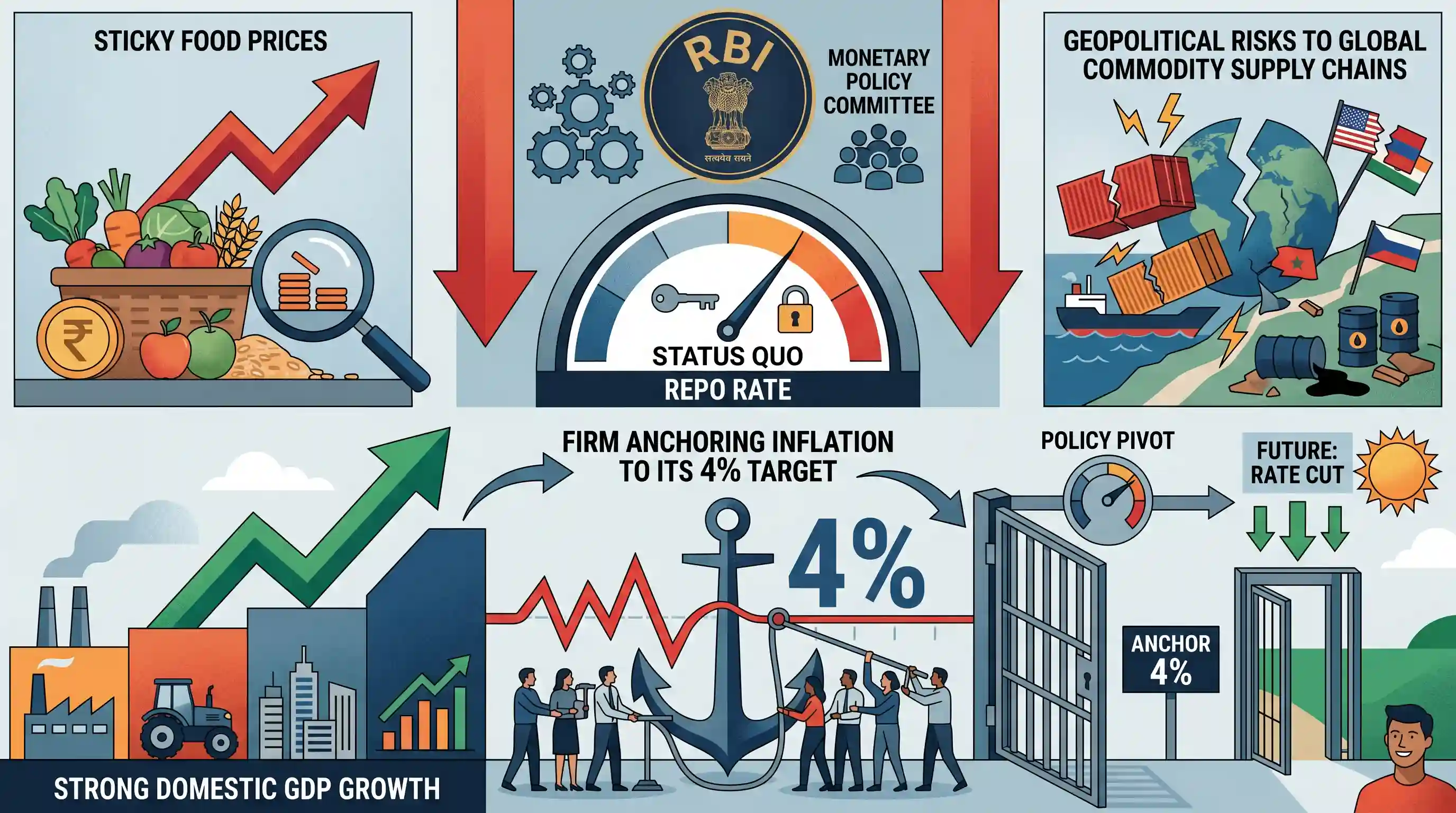
The article analyzes the rationale behind the expected decision of the Reserve Bank of India's Monetary Policy Committee (MPC) to maintain a status quo on the benchmark repo rate. A combination of sticky food prices and geopolitical risks to global commodity supply chains keeps the central bank cautious on the inflation front. At the same time, strong domestic GDP growth alleviates the immediate pressure to cut rates for economic stimulation, allowing the RBI to concentrate on firmly anchoring inflation to its 4% target before pivoting its monetary policy stance.
Key Points
- The RBI's Monetary Policy Committee (MPC) is widely expected to maintain the status quo on the benchmark repo rate and its policy stance.
- Persistently sticky food inflation combined with global geopolitical uncertainties are the primary reasons compelling the RBI to avoid premature rate cuts.
- Robust domestic economic growth provides the RBI the necessary headroom to keep interest rates steady and focus purely on aligning inflation durably to its 4% target.
- Uncertainties surrounding the US Federal Reserve's timeline for rate cuts also influence the RBI to maintain a cautious and stable policy approach.
Important Terms
Monetary Policy Committee (MPC)

A six-member statutory body under the RBI Act, 1934, tasked with determining the benchmark repo rate to achieve the inflation target while supporting economic growth.
UPSC context
GS III: Indian Economy; tests knowledge of the institutional framework for price stability and decision-making in monetary policy.
Repo Rate
The interest rate at which the RBI lends short-term funds to commercial banks against government securities to manage liquidity and control inflation.
UPSC context
GS III: Indian Economy; a fundamental tool of monetary policy used to balance economic growth and price stability.
Flexible Inflation Targeting (FIT)
A monetary framework requiring the RBI to maintain Consumer Price Index (CPI) inflation at 4% with a +/- 2% tolerance band (2% to 6%).
UPSC context
GS III: Indian Economy; tests understanding of the 2016 policy shift toward price stability as the primary monetary objective.
Reserve Bank of India (RBI)
India’s central bank and regulatory authority responsible for monetary stability, currency issuance, banking supervision, and management of foreign exchange reserves.
UPSC context
GS III: Indian Economy; core regulatory body for financial markets and macroeconomic stability.
US Federal Reserve (The Fed)
The central bank of the United States, whose interest rate adjustments significantly influence global capital flows, exchange rates, and India's external economic stability.
UPSC context
GS III: External Sector; tests the ability to analyze how global monetary shifts impact the Indian economy and Rupee valuation.
Prelims Trap
"The RBI independently sets the 4% inflation target under the Flexible Inflation Targeting (FIT) framework."
The Central Government, not the RBI, determines the inflation target (currently 4% with a +/- 2% band) once every five years in consultation with the RBI.
Static Concepts Connected
How is the Monetary Policy Committee (MPC) structured and how does it vote?
- Composition: It consists of 6 members: 3 from the RBI (including the Governor as ex-officio chairperson) and 3 external members appointed by the Central Government.
- Majority voting: Decisions are taken by a majority vote of the members present and voting.
- No veto power: The RBI Governor does not have a veto power but possesses a casting vote in the event of a tie.
How do US Federal Reserve interest rates impact India's currency and capital flows?
- Interest differential: A narrowing gap between Indian and US interest rates makes Indian debt assets less attractive to foreign institutional investors.
- Capital flight: Premature RBI rate cuts while the US Fed holds rates high can trigger rapid Foreign Portfolio Investment (FPI) outflows.
- Currency depreciation: The outflow of foreign capital increases the demand for dollars, leading to the depreciation of the Indian Rupee.
Cross-Topic Patterns
Monetary limits on supply-side food inflation
The RBI's demand-side tools (repo rate) are structurally ineffective against supply-side shocks, connecting monetary policy directly to agriculture, climate change, and geopolitical supply chain bottlenecks.
The Impossible Trinity (Mundell-Fleming)
RBI's rate decisions are constrained by managing currency stability, capital flows, and independent monetary policy—a real-world manifestation of the Mundell-Fleming macroeconomic trilemma.

Expect a 2026 multi-statement question linking US Fed rate cycles, FPI flows, and RBI's structural limits in controlling food inflation.
Linked PYQs · 3
Linked PYQs · 3
- 2017PrelimsGS1
Which of the following statements is/are correct regarding the Monetary Policy Committee (MPC)? 1. It decides the RBI's benchmark interest rates. 2. It is a 12-member body including the Governor of RBI and is reconstituted every year. 3. It functions under the chairmanship of the Union Finance Minister. Select the correct answer using the code given below:
- 2024MainsGS3
What are the causes of persistent high food inflation in India? Comment on the effectiveness of the monetary policy of the RBI to control this type of inflation.
- 2022PrelimsGS1
With reference to the Indian economy, consider the following statements: 1. If the inflation is too high, Reserve Bank of India (RBI) is likely to buy government securities. 2. If the rupee is rapidly depreciating, RBI is likely to sell dollars in the market. 3. If interest rates in the USA or European Union were to fall, that is likely to induce RBI to buy dollars. Which of the statements given above are correct?
