RBI Growth Projections and Macroeconomic Trends for FY26
Source:The Hindu ↗
Why It Matters
This article touches upon core macroeconomic parameters—growth projections, inflation targeting by the MPC, and FDI trends—which are highly relevant for GS Paper 3. The evolving trade dynamics with the US, particularly regarding tariffs and the agriculture sector, are critical for both GS2 (International Relations) and GS3 (Economy/Agriculture).
Summary
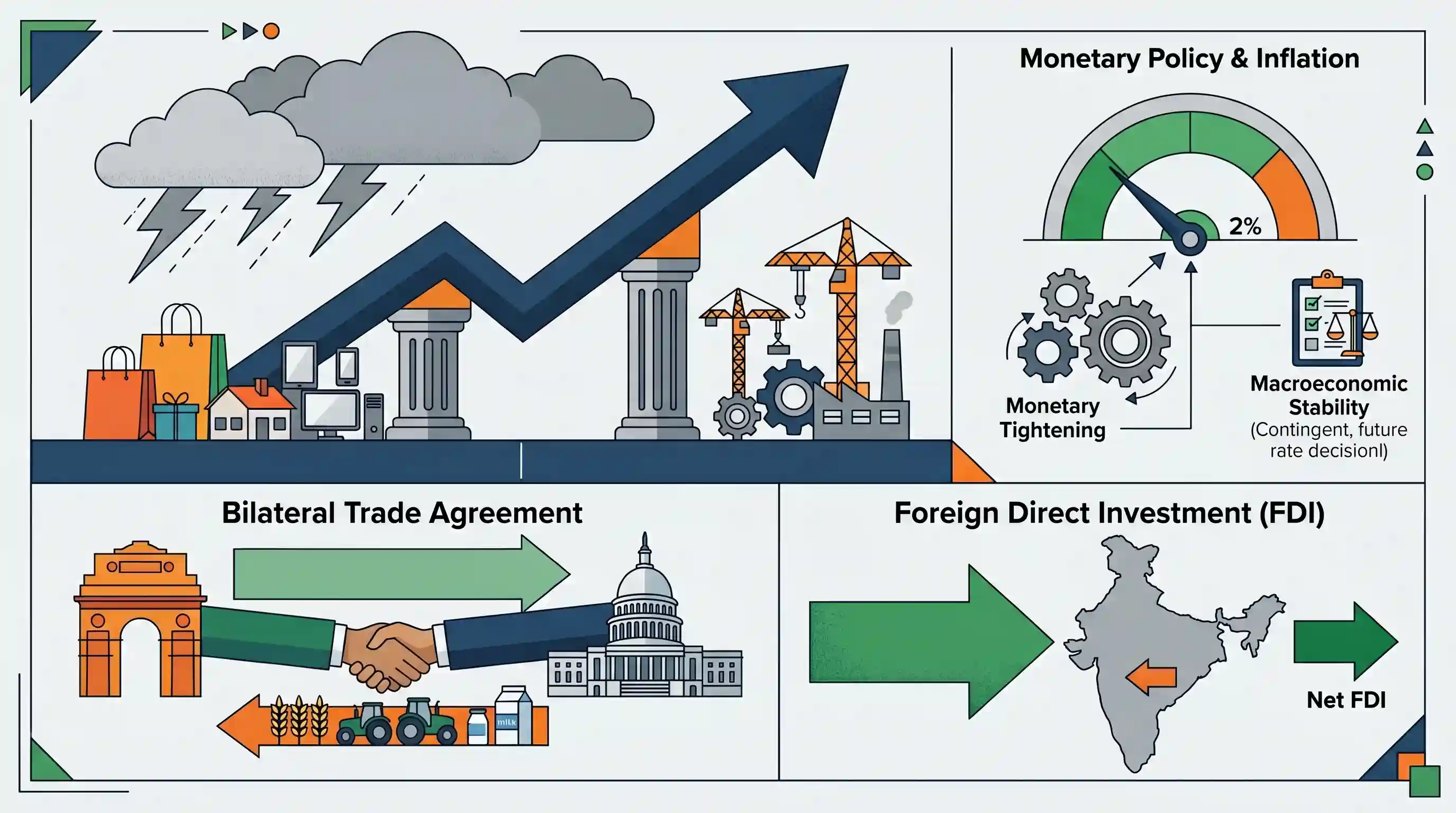
A Reserve Bank of India (RBI) Monetary Policy Committee (MPC) member forecasts the Indian economy to grow over 6.5% in FY26, insulated from global economic headwinds by robust domestic consumption and investment. Inflation is currently contained at around 2%, reflecting the effectiveness of recent monetary tightening, with any future rate cuts contingent on sustained macroeconomic stability. On the international front, India is negotiating a Bilateral Trade Agreement with the US, aiming for better access for its labor-intensive exports while navigating pressure to open its protected agriculture and dairy sectors. Concurrently, while gross FDI into India has grown, net FDI is tempered by the repatriation of funds by foreign entities.
Key Points
- RBI MPC member Nagesh Kumar projects India's economic growth to exceed 6.5% in FY26, primarily driven by strong domestic consumption and investment.
- CPI inflation is currently well-managed at around 2% due to strict MPC policies, though future rate cuts will depend on holistic macroeconomic indicators.
- India is exploring a Bilateral Trade Agreement (BTA) with the US to secure market access for labor-intensive goods, but negotiations face hurdles over US demands to lower agricultural and dairy tariffs.
- India is seeking the removal of the 26% additional US tariff on its goods and relief on steel and aluminum duties, contrasting with the sweeping concessions the US extracted from Indonesia.
- While gross Foreign Direct Investment (FDI) inflows into India rose to $81 billion in 2024-25, net FDI remains smaller due to outward repatriations by foreign companies.
Important Terms
Bilateral Trade Agreement (BTA)

A trade treaty between two nations to reduce or eliminate tariffs, quotas, and barriers. India and the US are currently negotiating a multi-sector BTA to enhance mutual market access.
UPSC context
GS Paper II (International Relations) & GS Paper III (Economy). Tests knowledge of trade diplomacy and its impact on domestic sectors.
Monetary Policy Committee (MPC)
A six-member statutory body under the RBI Act, 1934, tasked with fixing the benchmark repo rate to achieve the inflation target of 4% (within a 2-6% band).
UPSC context
GS Paper III (Indian Economy). Crucial for understanding monetary policy framework, price stability, and the legal mandates of the RBI.
Reserve Bank of India (RBI)
India's central bank, established in 1935, responsible for formulating monetary policy, issuing currency, managing foreign exchange, and supervising the banking system to ensure financial stability.
UPSC context
GS Paper III (Indian Economy). A fundamental institution for topics on banking, credit control, and macroeconomic stability.
World Trade Organization (WTO)
The global intergovernmental organization that regulates trade between nations. India is a founding member (since 1995), often advocating for the interests of developing countries (Global South).
UPSC context
GS Paper II (International Institutions) & GS Paper III (Economy). Tests understanding of multilateral trade rules and dispute settlement.
Net FDI vs Gross FDI
Gross FDI is the total foreign capital inflow; Net FDI is this amount minus disinvestments (repatriation of profits) and outward FDI by Indian entities.
UPSC context
GS Paper III (Economy). Tests ability to analyze balance of payments and the sustainability of capital inflows.
Prelims Trap
The RBI is statutorily mandated to target a 2% CPI inflation rate.
The RBI's statutory inflation target is 4% (with a ±2% tolerance band). 2% is the lower tolerance bound, not the central mandate under Section 45ZA of the RBI Act.
Static Concepts Connected
What is the distinction between Gross FDI and Net FDI?
- Gross FDI: The total volume of direct investment capital inflows entering a country from foreign investors during a specific period.
- Net FDI: Gross FDI minus the outward FDI by domestic firms and the repatriation of capital (disinvestments/profits) by foreign entities.
- Economic Indicator: It represents the actual foreign capital retained in the economy for productive deployment, offering a truer picture of external financing.
How does India protect sensitive sectors in Bilateral Trade Agreements?
- Negative Lists: A negotiated list of goods and services (usually including agriculture and dairy) that are entirely excluded from any tariff reduction or market access commitments.
- Tariff Rate Quotas: Mechanisms allowing imports at lower tariffs only up to a specified quota, beyond which significantly higher, prohibitive duties apply.
- Safeguard Duties: Treaty clauses that permit temporary tariff hikes if a sudden surge in imports threatens domestic industries.
Cross-Topic Patterns
Domestic vs Export-led growth models
India's >6.5% growth relies heavily on domestic consumption and internal capex, contrasting with traditional export-driven Asian Tiger models, which offers structural insulation from global trade shocks.
FTAs and India's Dairy Sector
Bilateral trade negotiations with the US, EU, and UK consistently stall over demands to expose India's fragmented, livelihood-intensive dairy and agriculture markets to heavily subsidized Western imports.

Expect a 2026 prelims multi-statement question contrasting Gross vs Net FDI, alongside India's FTA negative-list strategy for agriculture.
Linked PYQs · 5
Linked PYQs · 5
- 2017PrelimsGS1
Which of the following statements is/are correct regarding the Monetary Policy Committee (MPC)? 1. It decides the RBI's benchmark interest rates. 2. It is a 12-member body including the Governor of RBI and is reconstituted every year. 3. It functions under the chairmanship of the Union Finance Minister. Select the correct answer using the code given below:
- 2022PrelimsGS1
In India, which one of the following is responsible for maintaining price stability by controlling inflation?
- 2024MainsGS3
What are the causes of persistent high food inflation in India? Comment on the effectiveness of the monetary policy of the RBI to control this type of inflation.
- 2018MainsGS2
What are the key areas of reform if the WTO has to survive in the present context of "Trade War', especially keeping in mind the interest of India?
- 2021PrelimsGS1
Consider the following : 1. Foreign currency convertible bonds 2. Foreign institutional investment with certain conditions 3. Global depository receipts 4. Non-resident external deposits Which of the above can be included in Foreign Direct Investments?
