Reserve Bank of India Launches Three Key Consumer Surveys
Source:The Hindu ↗
Why It Matters
Understanding the forward-looking consumer surveys used by the RBI is vital for grasping the practical inputs, transmission mechanisms, and demand-side analysis that shape monetary policy and inflation targeting in India.
Summary
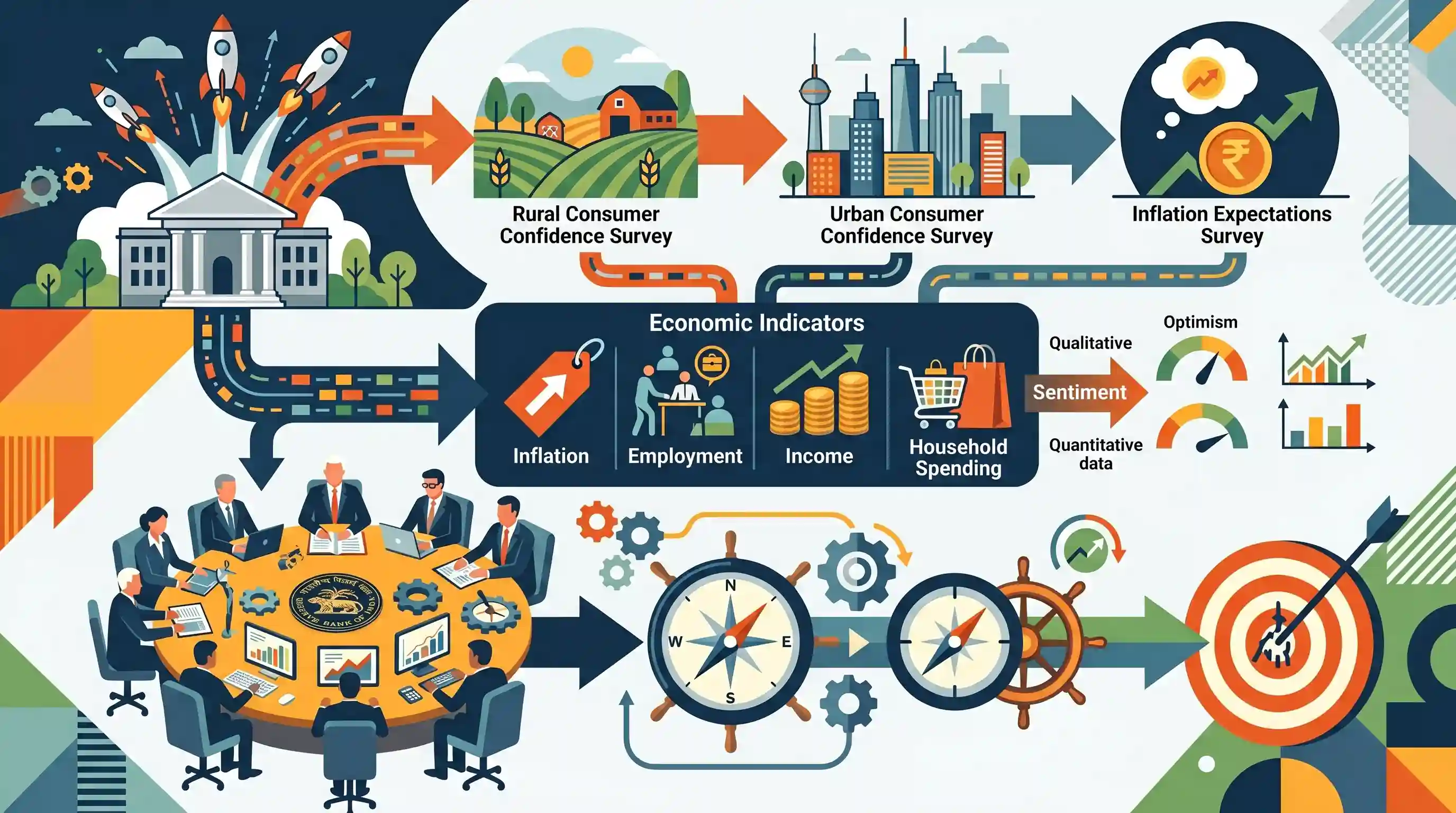
The Reserve Bank of India (RBI) has launched three critical household surveys—the Inflation Expectations Survey of Households, the Rural Consumer Confidence Survey, and the Urban Consumer Confidence Survey. These initiatives capture forward-looking qualitative and quantitative sentiments of citizens on key economic indicators such as inflation, employment, income, and household spending. The resulting data serves as empirical input for the Monetary Policy Committee (MPC) to formulate robust, forward-looking monetary policies.
Key Points
- The Reserve Bank of India (RBI) launched three key household-level surveys to gather vital qualitative and quantitative inputs for its monetary policy formulation ahead of the Monetary Policy Committee (MPC) meeting.
- The 'Inflation Expectations Survey of Households' seeks qualitative and quantitative feedback from households across 19 cities regarding three-months-ahead and one-year-ahead inflation rates and price movements.
- The 'Rural Consumer Confidence Survey' collects current perceptions and one-year-ahead expectations on economic parameters (general situation, employment, prices, household income, and spending) across 31 States/UTs.
- The 'Urban Consumer Confidence Survey' gathers qualitative sentiments from urban households across 19 major cities on the same core parameters: general economic status, employment, inflation, income, and spending.
- These forward-looking surveys act as key tools for the RBI to capture subjective assessments, aggregate consumer demand, and future inflation expectations, which are vital channels for monetary policy transmission.
Important Terms
Monetary Policy Committee (MPC)

A statutory body established under Section 45ZB of the RBI Act, 1934, chaired by the RBI Governor, responsible for setting India's benchmark interest rate to maintain price stability while sustaining economic growth.
UPSC context
GS-III (Economy): Tests understanding of monetary policy, inflation targeting framework, and the institutional structure of India's central bank.
Inflation Expectations Survey of Households
A regular bi-monthly household survey conducted by the RBI across 19 cities to capture subjective assessments and quantitative expectations of price movements and inflation over three-month and one-year horizons.
UPSC context
GS-III (Economy): Tests understanding of inflation, household expectations, and demand-side factors influencing monetary policy decisions.
Urban Consumer Confidence Survey
A bi-monthly RBI survey tracking urban households' perceptions and one-year-ahead expectations on five economic variables: economic situation, employment scenario, price level, household income, and spending across 19 cities.
UPSC context
GS-III (Economy): Tests knowledge of urban demand indicators, economic sentiment, consumer spending, and macroeconomic stability.
Rural Consumer Confidence Survey
A bi-monthly RBI survey covering rural and semi-urban households across 31 States and UTs, measuring current perceptions and future expectations on economic conditions, jobs, price levels, household income, and spending.
UPSC context
GS-III (Economy): Tests knowledge of rural demand, semi-urban consumption trends, and overall macroeconomic indicators in India.
Reserve Bank of India (RBI)
India's central banking institution established on April 1, 1935, under the RBI Act, 1934, responsible for regulating monetary policy, issuing currency, and supervising the nation's financial and credit systems.
UPSC context
GS-III (Economy): Tests understanding of regulatory bodies, currency management, and central banking operations in India.
Prelims Trap
The aggregate inflation expectation in the RBI’s IESH is calculated using the simple arithmetic average of all household responses.
UPSC tests statistical methodology. RBI uses 'median' inflation expectations instead of arithmetic averages to prevent extreme outliers from distorting the policy inputs.
Static Concepts Connected
What is the composition and mandate of the Monetary Policy Committee (MPC)?
- Statutory Basis: Created under Section 45ZB of the amended RBI Act, 1934, to fix the benchmark policy repo rate.
- Composition: Consists of six members: three from the RBI (including the Governor) and three appointed by the Central Government.
- Voting Power: Decided by a majority vote; the Governor has no veto power but holds a casting vote to break ties.
How do the Current Situation Index (CSI) and Future Expectations Index (FEI) measure consumer confidence?
- Neutrality Benchmark: Uses a diffusion index where 100 is the critical threshold separating optimism from pessimism.
- Temporal Horizons: CSI measures perceptions compared to one year ago, while FEI captures expectations for one year ahead.
Cross-Topic Patterns
Consumer Sentiment & Fiscal Targeting
Divergent rural-urban sentiments help the government calibrate direct benefit transfers versus capital expenditures to address asymmetrical domestic demand.
Inflation Expectations & Labour Dynamics
Unanchored household inflation expectations can trigger wage-push inflation as workers negotiate higher nominal wages, creating a self-fulfilling wage-price spiral.

2026 Prelims may test the specific distinction between RCCS/UCCS and the statistical use of median expectations in RBI's IESH.
Linked PYQs · 3
Linked PYQs · 3
- 2020PrelimsGS1
Consider the following statements: 1. The weightage of food in Consumer Price Index (CPI) is higher than that in Wholesale Price Index (WPI). 2. The WPI does not capture changes in the prices of services, which CPI does. 3. Reserve Bank of India has now adopted WPI as its key measure of inflation and to decide on changing the key policy rates. Which of the statements given above is/are correct?
- 2022PrelimsGS1
With reference to the Indian economy, consider the following statements: 1. If the inflation is too high, Reserve Bank of India (RBI) is likely to buy government securities. 2. If the rupee is rapidly depreciating, RBI is likely to sell dollars in the market. 3. If interest rates in the USA or European Union were to fall, that is likely to induce RBI to buy dollars. Which of the statements given above are correct?
- 2024MainsGS3
What are the causes of persistent high food inflation in India? Comment on the effectiveness of the monetary policy of the RBI to control this type of inflation.
