RBI मौद्रिक नीति रुख और व्यापक आर्थिक संकेतक
स्रोत:इंडियन एक्सप्रेस ↗
क्यों मायने रखता है
The RBI's monetary policy decisions are central to India's macroeconomic management. Understanding the distinction between food and core inflation, the concept of real interest rates, and how global uncertainties impact domestic policy provides vital context for GS3 topics on the Indian Economy, specifically regarding inflation targeting and the effectiveness of the Monetary Policy Committee.
सारांश
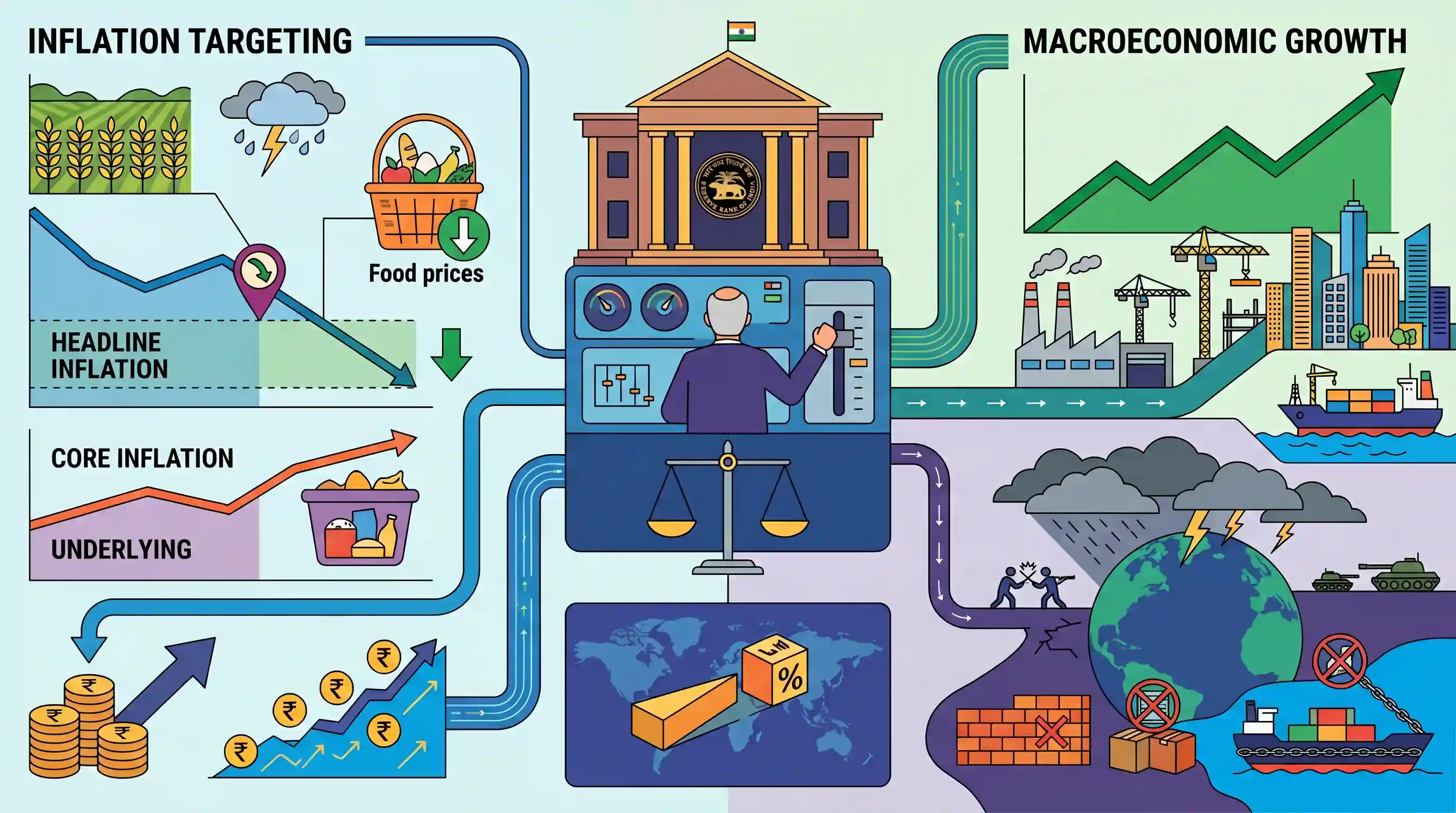
The Reserve Bank of India’s Monetary Policy Committee (MPC) decided to keep the benchmark repo rate unchanged while maintaining a neutral stance. The RBI lowered its inflation forecast for the year to 3.1%, largely due to easing food prices and favorable monsoon conditions, while retaining its growth projection at 6.5%. However, a slight uptick in core inflation and projections of rising inflation in 2025-26 due to base effects remain concerns. With real interest rates around 1%, the RBI has limited space for immediate rate cuts. Governor Sanjay Malhotra highlighted that while the domestic economy remains resilient, future monetary policy actions will be dictated by evolving macroeconomic conditions and headwinds from global uncertainties, including geopolitical tensions and potential shifts in global trade and tariff policies.
मुख्य बिंदु
- The RBI's Monetary Policy Committee (MPC) unanimously voted to keep the benchmark repo rate unchanged and maintain a neutral stance, prioritizing macroeconomic stability.
- The inflation forecast for the current year was reduced to 3.1% from 3.7%, primarily due to easing food price pressures, a good monsoon, and strong kharif sowing.
- हेडलाइन मुद्रास्फीति में गिरावट के बावजूद, कोर मुद्रास्फीति (खाद्य और ईंधन को छोड़कर) मामूली रूप से बढ़कर 4.4% हो गई, और प्रतिकूल बेस इफेक्ट (base effects) तथा मांग कारकों के कारण 2025-26 और 2026-27 में भविष्य की मुद्रास्फीति बढ़ने का अनुमान है।
- वास्तविक ब्याज दरों के 1% के आसपास रहने के कारण, RBI के पास तत्काल दर कटौती के लिए सीमित गुंजाइश है, जिससे भविष्य की नीतिगत कार्रवाइयां पूरी तरह से वर्तमान आकलनों से भिन्न होने वाले डेटा पर निर्भर करेंगी।
- The RBI retained its 6.5% growth projection but emphasized headwinds from global uncertainties, including geopolitical tensions, financial market volatility, and changing external demand linked to shifting global trade policies.
महत्वपूर्ण शब्द
Monetary Policy Committee (MPC)

A six-member statutory body under the RBI Act, 1934, tasked with fixing the benchmark interest rate (repo rate) to maintain price stability while supporting growth.
UPSC context
GS-III: भारतीय अर्थव्यवस्था। मुद्रास्फीति लक्ष्यीकरण (inflation targeting) और मौद्रिक शासन (monetary governance) के लिए संस्थागत ढाँचे के ज्ञान का परीक्षण करता है।
Repo Rate
The interest rate at which the Reserve Bank of India lends money to commercial banks against government securities; it is the primary tool for controlling liquidity.
UPSC context
GS-III: Indian Economy. Central to understanding monetary policy instruments and their impact on inflation and growth.
कोर मुद्रास्फीति
मुद्रास्फीति का एक माप जो खाद्य और ऊर्जा की कीमतों में होने वाले अस्थिर उतार-चढ़ाव को शामिल नहीं करता है, ताकि अर्थव्यवस्था में मूल्य स्तरों के अंतर्निहित और दीर्घकालिक रुझान को दर्शाया जा सके।
UPSC context
GS-III: Indian Economy. Essential for analyzing structural vs. temporary inflationary pressures in policy formulation.
तटस्थ रुख
A monetary policy position where the central bank is open to either increasing or decreasing interest rates depending on evolving macroeconomic data and inflation trends.
UPSC context
GS-III: भारतीय अर्थव्यवस्था। नीतिगत संकेतों और आर्थिक चक्रों के प्रति केंद्रीय बैंक की प्रतिक्रिया की समझ का परीक्षण करता है।
Real Interest Rate
The actual interest rate after adjusting for inflation (Nominal Rate - Inflation), representing the true cost of borrowing or the real return on savings.
UPSC context
GS-III: Macroeconomics. Important for assessing the true incentive for investment and consumption in the economy.
आधार प्रभाव (Base Effect)
पिछले वर्ष की समान अवधि में असामान्य रूप से उच्च या निम्न मूल्य स्तरों के कारण वर्तमान मुद्रास्फीति के आंकड़ों में होने वाली विसंगति।
UPSC context
GS-III: भारतीय अर्थव्यवस्था। मुद्रास्फीति की गणना और सांख्यिकीय विकृतियों (statistical distortions) पर वैचारिक स्पष्टता का मूल्यांकन करने के लिए अक्सर Prelims में पूछा जाता है।
प्रारंभिक ट्रैप
MPC ढांचे के तहत RBI का वैधानिक अधिदेश कोर इन्फ्लेशन को 2-6% के लक्ष्य बैंड के भीतर रखना है।
The RBI legally targets Headline CPI, which includes volatile food and fuel. While core inflation informs policy, the statutory 4% (+/-2%) target strictly applies to Headline CPI.
संबंधित अवधारणाएँ
कोर मुद्रास्फीति (Core Inflation) और हेडलाइन मुद्रास्फीति (Headline Inflation) में क्या अंतर है?
- Headline CPI: यह वस्तुओं और सेवाओं की एक विस्तृत बास्केट में मूल्य परिवर्तनों को मापता है, जिसमें अत्यधिक उतार-चढ़ाव वाले खाद्य और ईंधन शामिल हैं। यह RBI का आधिकारिक लक्ष्य है।
- कोर CPI: Excludes food and fuel components. It reflects underlying macroeconomic demand-driven prices and is more responsive to the central bank's monetary policy tools.
How does the 'Base Effect' impact inflation calculation?
- Statistical Illusion: इसका तात्पर्य पिछले वर्ष के इसी महीने में असामान्य रूप से उच्च या निम्न मूल्य स्तरों के कारण वर्तमान वर्ष-दर-वर्ष मुद्रास्फीति के आंकड़ों में होने वाली विकृति से है।
- नीतिगत निहितार्थ: पिछले वर्ष का उच्च आधार कृत्रिम रूप से वर्तमान मुद्रास्फीति के आंकड़ों को कम करता है, जिससे MPC को कीमतों की वास्तविक गति का आकलन करने के लिए इन आंकड़ों से परे देखने हेतु मजबूर होना पड़ता है।
अंतर-विषय पैटर्न
Imported inflation via global tariffs
Shifting global trade policies and tariff wars directly threaten domestic price stability, illustrating the growing link between GS2 International Relations events and GS3 macroeconomic management.
वास्तविक ब्याज दरें और पूंजी निर्माण
एक धनात्मक वास्तविक ब्याज दर (सांकेतिक दर घटाव मुद्रास्फीति) घरेलू वित्तीय बचत को प्रोत्साहित करती है, जो सीधे तौर पर घरेलू पूंजी निर्माण और दीर्घकालिक आर्थिक विकास में योगदान देती है।

कोर बनाम हेडलाइन मुद्रास्फीति के बीच विचलन और 'वास्तविक ब्याज दरों' (Real Interest Rates) के निहितार्थ 2026 की प्रारंभिक परीक्षा (Prelims) के बहु-कथनीय प्रश्न (multi-statement Q) के लिए अत्यंत महत्वपूर्ण हैं।
संबद्ध PYQ · 5
संबद्ध PYQ · 5
- 2017PrelimsGS1
Which of the following statements is/are correct regarding the Monetary Policy Committee (MPC)? 1. It decides the RBI's benchmark interest rates. 2. It is a 12-member body including the Governor of RBI and is reconstituted every year. 3. It functions under the chairmanship of the Union Finance Minister. Select the correct answer using the code given below:
- 2022PrelimsGS1
With reference to the Indian economy, consider the following statements: 1. If the inflation is too high, Reserve Bank of India (RBI) is likely to buy government securities. 2. If the rupee is rapidly depreciating, RBI is likely to sell dollars in the market. 3. If interest rates in the USA or European Union were to fall, that is likely to induce RBI to buy dollars. Which of the statements given above are correct?
- 2022PrelimsGS1
In India, which one of the following is responsible for maintaining price stability by controlling inflation?
- 2020PrelimsGS1
Consider the following statements: 1. The weightage of food in Consumer Price Index (CPI) is higher than that in Wholesale Price Index (WPI). 2. The WPI does not capture changes in the prices of services, which CPI does. 3. Reserve Bank of India has now adopted WPI as its key measure of inflation and to decide on changing the key policy rates. Which of the statements given above is/are correct?
- 2024MainsGS3
What are the causes of persistent high food inflation in India? Comment on the effectiveness of the monetary policy of the RBI to control this type of inflation.
