RBI Monetary Policy Stance and Macroeconomic Indicators
Source:Indian Express ↗
Why It Matters
The RBI's monetary policy decisions are central to India's macroeconomic management. Understanding the distinction between food and core inflation, the concept of real interest rates, and how global uncertainties impact domestic policy provides vital context for GS3 topics on the Indian Economy, specifically regarding inflation targeting and the effectiveness of the Monetary Policy Committee.
Summary
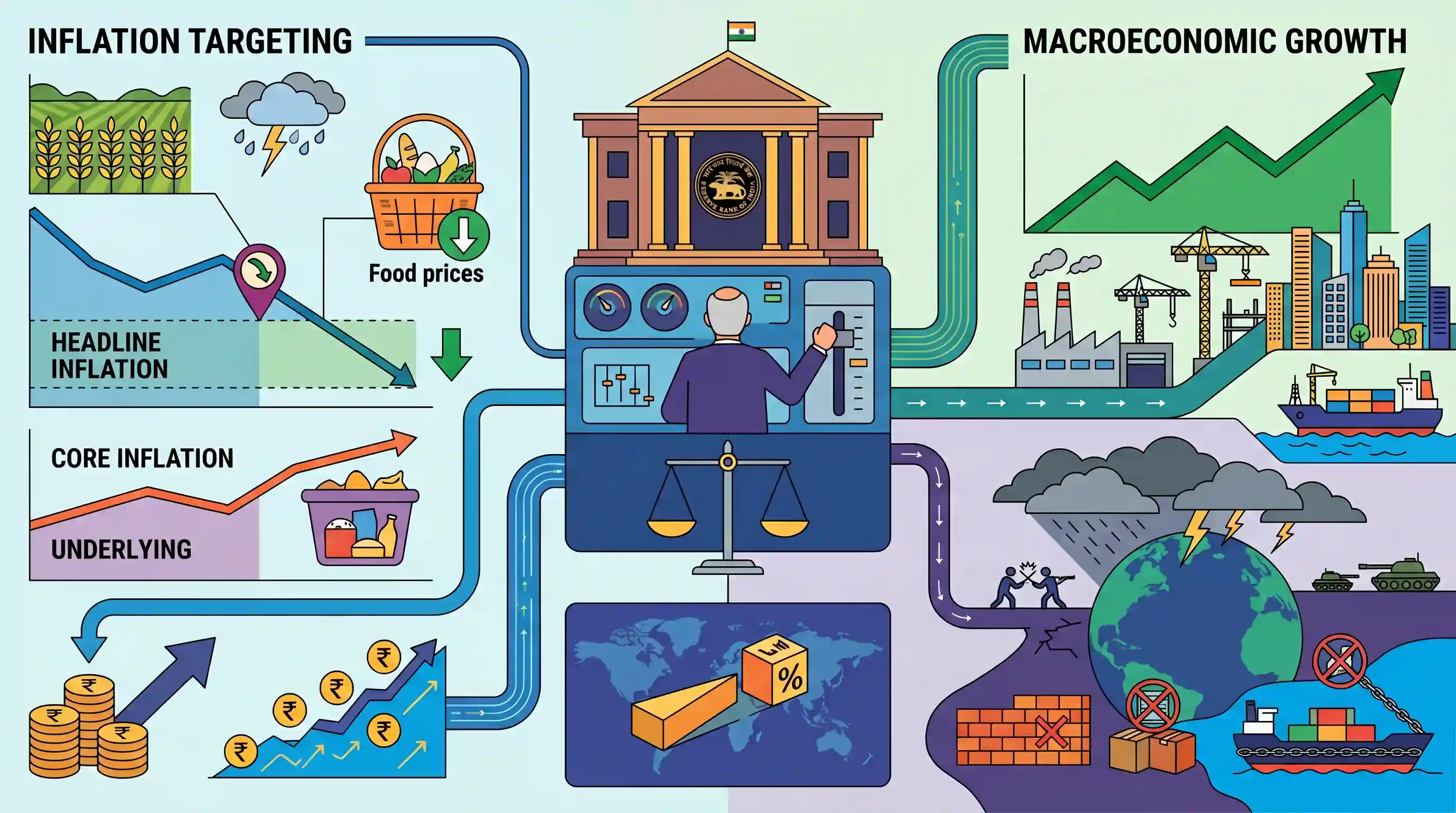
The Reserve Bank of India’s Monetary Policy Committee (MPC) decided to keep the benchmark repo rate unchanged while maintaining a neutral stance. The RBI lowered its inflation forecast for the year to 3.1%, largely due to easing food prices and favorable monsoon conditions, while retaining its growth projection at 6.5%. However, a slight uptick in core inflation and projections of rising inflation in 2025-26 due to base effects remain concerns. With real interest rates around 1%, the RBI has limited space for immediate rate cuts. Governor Sanjay Malhotra highlighted that while the domestic economy remains resilient, future monetary policy actions will be dictated by evolving macroeconomic conditions and headwinds from global uncertainties, including geopolitical tensions and potential shifts in global trade and tariff policies.
Key Points
- The RBI's Monetary Policy Committee (MPC) unanimously voted to keep the benchmark repo rate unchanged and maintain a neutral stance, prioritizing macroeconomic stability.
- The inflation forecast for the current year was reduced to 3.1% from 3.7%, primarily due to easing food price pressures, a good monsoon, and strong kharif sowing.
- Despite falling headline inflation, core inflation (excluding food and fuel) rose slightly to 4.4%, and future inflation in 2025-26 and 2026-27 is projected to climb due to unfavorable base effects and demand factors.
- With real interest rates hovering around 1%, the RBI has limited room for immediate rate cuts, tying future policy actions strictly to data deviating from current assessments.
- The RBI retained its 6.5% growth projection but emphasized headwinds from global uncertainties, including geopolitical tensions, financial market volatility, and changing external demand linked to shifting global trade policies.
Important Terms
Monetary Policy Committee (MPC)

A six-member statutory body under the RBI Act, 1934, tasked with fixing the benchmark interest rate (repo rate) to maintain price stability while supporting growth.
UPSC context
GS-III: Indian Economy. Tests knowledge of institutional frameworks for inflation targeting and monetary governance.
Repo Rate
The interest rate at which the Reserve Bank of India lends money to commercial banks against government securities; it is the primary tool for controlling liquidity.
UPSC context
GS-III: Indian Economy. Central to understanding monetary policy instruments and their impact on inflation and growth.
Core Inflation
A measure of inflation that excludes volatile price movements in food and energy to reflect the underlying, long-term trend of price levels in an economy.
UPSC context
GS-III: Indian Economy. Essential for analyzing structural vs. temporary inflationary pressures in policy formulation.
Neutral Stance
A monetary policy position where the central bank is open to either increasing or decreasing interest rates depending on evolving macroeconomic data and inflation trends.
UPSC context
GS-III: Indian Economy. Tests understanding of policy signaling and the central bank's response to economic cycles.
Real Interest Rate
The actual interest rate after adjusting for inflation (Nominal Rate - Inflation), representing the true cost of borrowing or the real return on savings.
UPSC context
GS-III: Macroeconomics. Important for assessing the true incentive for investment and consumption in the economy.
Base Effect
The distortion in current inflation figures caused by abnormally high or low price levels in the corresponding period of the previous year.
UPSC context
GS-III: Indian Economy. Frequently tested in Prelims to evaluate conceptual clarity on inflation calculation and statistical distortions.
Prelims Trap
"The RBI's statutory mandate under the MPC framework is to keep Core Inflation within the 2-6% target band."
The RBI legally targets Headline CPI, which includes volatile food and fuel. While core inflation informs policy, the statutory 4% (+/-2%) target strictly applies to Headline CPI.
Static Concepts Connected
What differentiates Core Inflation from Headline Inflation?
- Headline CPI: Measures price changes across a broad basket of goods and services, including highly volatile food and fuel. It is the RBI's official target.
- Core CPI: Excludes food and fuel components. It reflects underlying macroeconomic demand-driven prices and is more responsive to the central bank's monetary policy tools.
How does the 'Base Effect' impact inflation calculation?
- Statistical Illusion: Refers to the distortion of current year-on-year inflation figures caused by unusually high or low price levels in the corresponding month of the previous year.
- Policy Implication: A high base in the previous year artificially suppresses current inflation readings, forcing the MPC to look past the data to gauge true price momentum.
Cross-Topic Patterns
Imported inflation via global tariffs
Shifting global trade policies and tariff wars directly threaten domestic price stability, illustrating the growing link between GS2 International Relations events and GS3 macroeconomic management.
Real interest rates and capital formation
A positive real interest rate (nominal rate minus inflation) incentivizes household financial savings, feeding directly into domestic capital formation and long-term economic growth.

Core vs. Headline inflation divergence and the implications of 'Real Interest Rates' are prime for a 2026 multi-statement prelims Q.
Linked PYQs · 5
Linked PYQs · 5
- 2017PrelimsGS1
Which of the following statements is/are correct regarding the Monetary Policy Committee (MPC)? 1. It decides the RBI's benchmark interest rates. 2. It is a 12-member body including the Governor of RBI and is reconstituted every year. 3. It functions under the chairmanship of the Union Finance Minister. Select the correct answer using the code given below:
- 2022PrelimsGS1
With reference to the Indian economy, consider the following statements: 1. If the inflation is too high, Reserve Bank of India (RBI) is likely to buy government securities. 2. If the rupee is rapidly depreciating, RBI is likely to sell dollars in the market. 3. If interest rates in the USA or European Union were to fall, that is likely to induce RBI to buy dollars. Which of the statements given above are correct?
- 2022PrelimsGS1
In India, which one of the following is responsible for maintaining price stability by controlling inflation?
- 2020PrelimsGS1
Consider the following statements: 1. The weightage of food in Consumer Price Index (CPI) is higher than that in Wholesale Price Index (WPI). 2. The WPI does not capture changes in the prices of services, which CPI does. 3. Reserve Bank of India has now adopted WPI as its key measure of inflation and to decide on changing the key policy rates. Which of the statements given above is/are correct?
- 2024MainsGS3
What are the causes of persistent high food inflation in India? Comment on the effectiveness of the monetary policy of the RBI to control this type of inflation.
