RBI Revised Integrated Ombudsman Scheme For Banks And NBFC Grievances
Source:The Hindu ↗
Why It Matters
The Integrated Ombudsman Scheme is a critical component of India's financial architecture, ensuring accountability among banking and non-banking financial entities. Understanding this framework is important for UPSC candidates as it links to both consumer protection (Governance) and banking regulation (Economy), and direct questions on the Banking Ombudsman's powers have appeared in previous Prelims.
Summary
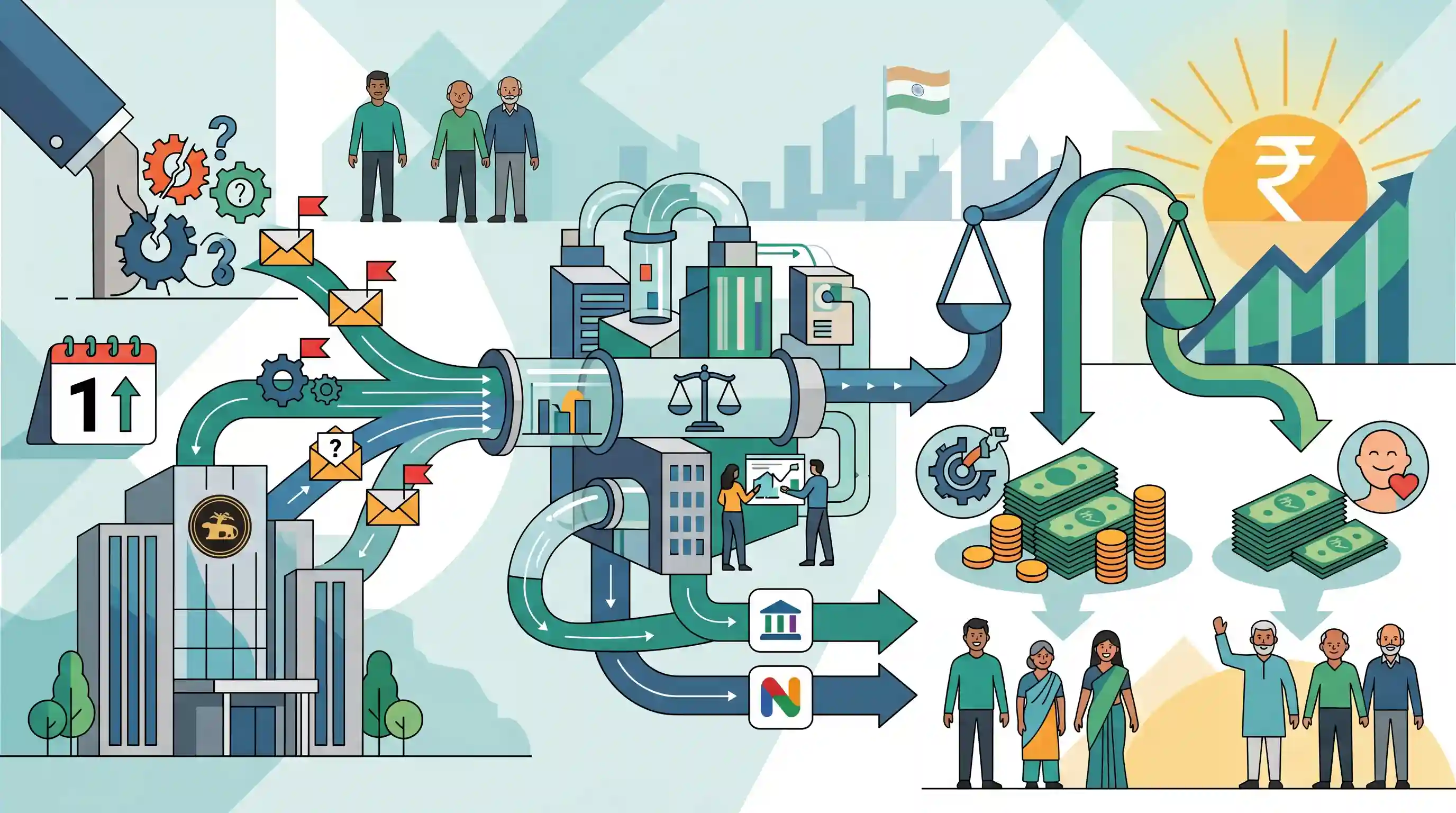
The Reserve Bank of India (RBI) has introduced a revised Integrated Ombudsman Scheme, effective July 1, 2026, to strengthen the consumer grievance redressal mechanism against banks and Non-Banking Financial Companies (NBFCs). The updated framework operationalises a Centralised Receipt and Processing Centre to handle complaints related to service deficiencies. It removes monetary limits on dispute values and empowers the Ombudsman to award compensation up to ₹30 lakh for direct consequential losses and up to ₹3 lakh for mental anguish and expenses. This initiative marks a significant step towards improved consumer protection and financial inclusion in India.
Key Points
- The RBI has issued a revised Integrated Ombudsman Scheme to streamline grievance redressal against banks, NBFCs, and other regulated entities.
- The scheme comes into effect on July 1, 2026, and establishes a Centralised Receipt and Processing Centre to handle complaints regarding deficiency in service.
- There is no monetary limit on the dispute amount that can be brought before the Ombudsman.
- The Ombudsman can award compensation up to ₹30 lakh for consequential financial losses and up to ₹3 lakh for loss of time, expenses, and mental anguish.
- The RBI Ombudsman is now empowered to make another regulated entity a party to the dispute if they failed to comply with directions.
Important Terms
Integrated Ombudsman Scheme (RB-IOS)

A unified 'One Nation One Ombudsman' framework by the RBI providing cost-free grievance redressal. It merges previous schemes for banks, NBFCs, and digital transactions into a single, jurisdiction-neutral portal for complaints.
UPSC context
GS Paper 3 (Banking) and GS Paper 2 (Governance). Tests knowledge of financial inclusion and structural reforms in consumer grievance mechanisms.
Centralised Receipt and Processing Centre (CRPC)
A single-point hub established by the RBI to receive and conduct initial scrutiny of physical and email complaints. It filters non-maintainable grievances to streamline processing before assignment to an Ombudsman.
UPSC context
GS Paper 2 (Governance). Tests understanding of institutional mechanisms for administrative efficiency and centralized dispute resolution for 'Ease of Living.'
Regulated Entities (REs)
Financial institutions under RBI oversight, including commercial banks, NBFCs, and payment system operators. These entities must adhere to RBI-mandated service standards and fall under the Integrated Ombudsman’s jurisdiction.
UPSC context
GS Paper 3 (Indian Economy). Essential for understanding the regulatory perimeter of the RBI and institutional accountability in the financial sector.
Deficiency in Service
Any shortcoming or inadequacy in financial services that an entity is legally required to provide. Under the 2026 revised scheme, it acts as the primary ground for filing consumer complaints.
UPSC context
GS Paper 2 (Social Justice/Statutory Bodies). Relates to consumer rights and the legal benchmarks for service quality in public-facing financial systems.
Reserve Bank of India (RBI)
India's central bank and regulatory authority established under the RBI Act, 1934. It manages monetary policy, regulates the banking sector, and implements consumer protection frameworks to ensure financial stability.
UPSC context
GS Paper 3 (Economy). A core topic for Prelims and Mains regarding institutional frameworks, monetary regulation, and systemic stability.
Appellate Authority
The higher-level authority where a complainant or regulated entity can appeal against the Ombudsman’s decision. It is the Executive Director in-charge of the RBI's Consumer Education and Protection Department.
UPSC context
GS Paper 2 (Grievance Redressal). Tests knowledge of the hierarchical structure and quasi-judicial processes within India's financial regulatory architecture.
Prelims Trap
"The RBI Ombudsman can only adjudicate disputes where the value is up to ₹30 lakhs."
Aspirants confuse the compensation cap (₹30 lakh for financial loss) with the jurisdictional dispute limit. There is no maximum limit on the dispute amount itself.
Static Concepts Connected
What is the 'One Nation One Ombudsman' scheme by RBI?
- Integration: It merged three earlier schemes (Banking, NBFC, and Digital Transactions) into a single, integrated grievance redressal framework.
- Jurisdiction-neutral: It operates through a Centralised Receipt and Processing Centre (CRPC), eliminating territorial jurisdiction limits for filing complaints.
- Cost-free ADR: It acts as a free alternative dispute resolution (ADR) mechanism for customers facing service deficiencies.
Which regulated entities fall under the RBI Integrated Ombudsman Scheme?
- Banks: Commercial banks, Regional Rural Banks (RRBs), and Scheduled Primary (Urban) Co-operative Banks.
- NBFCs: Non-Banking Financial Companies (NBFCs), including those authorized to issue digital payments.
- System Participants: Non-bank payment system participants and Credit Information Companies (CICs).
Cross-Topic Patterns
Consumer Protection Act vs RBI Ombudsman
While the Consumer Protection Act handles broad unfair trade practices, the RBI Ombudsman provides specialized, cost-free ADR. Prelims often mixes their respective appellate and jurisdictional boundaries.
Digital Payments & Cyber Fraud linkages
Inclusion of digital payment issuers ties directly into cybersecurity and internal security, reflecting RBI's systemic response to the massive surge in UPI and digital wallet grievances.

A multi-statement Prelims question testing the 'no monetary limit' on disputes versus the ₹30 lakh compensation cap is highly likely in 2026.
Linked PYQs · 1
Linked PYQs · 1
- 2010PrelimsGS1
With reference to the institution of Banking Ombudsman in India, which one of the statements is not correct?
