RBI holds repo rate and projects FY27 GDP growth slowdown
Source:Indian Express ↗
Why It Matters
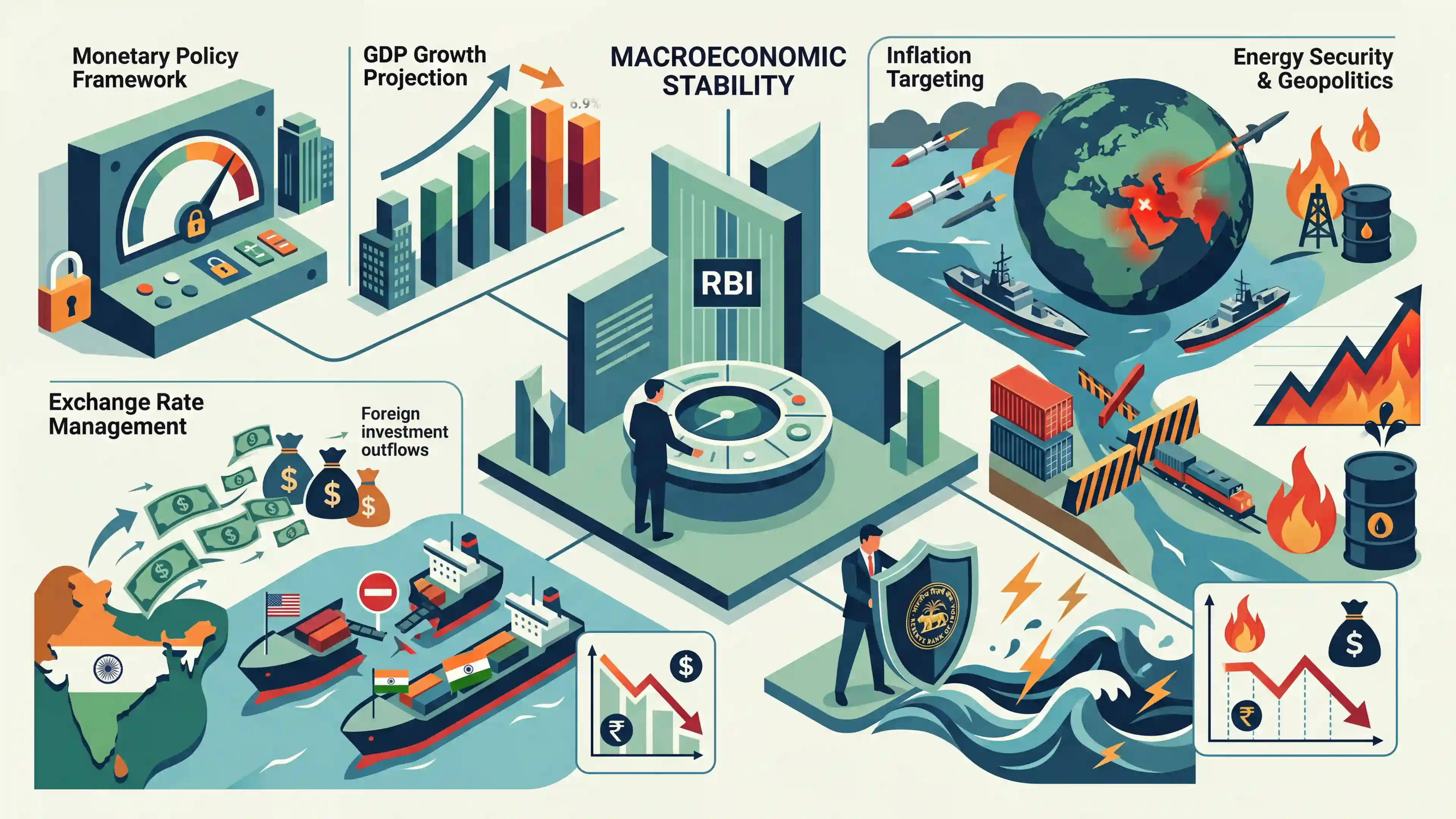
The article illustrates the intricate link between global geopolitics (Strait of Hormuz, US trade dynamics) and domestic macroeconomic stability. It provides practical context for UPSC aspirants regarding how the RBI balances inflation targeting, currency depreciation, and growth expectations amidst external shocks like crude oil price volatility.
Summary
The Reserve Bank of India's Monetary Policy Committee has decided to keep the repo rate unchanged at 5.25%, while projecting a slowdown in India's GDP growth to 6.9% for FY27. The central bank highlighted that inflation risks persist, primarily due to geopolitical conflicts in West Asia and threats to the Strait of Hormuz, which have elevated crude oil price assumptions to $85/bbl and strained supply chains. Concurrently, the RBI is managing a depreciating rupee, which weakened past 90 per dollar following foreign investment outflows tied to delays in the India-US trade deal, emphasizing that its forex interventions are solely to curb excessive volatility.
Key Points
- The RBI's Monetary Policy Committee (MPC) maintained the benchmark repo rate at 5.25%, projecting a slowdown in GDP growth to 6.9% for FY27.
- Inflation for FY27 is projected at 4.6%, with upward risks stemming from geopolitical tensions and supply chain disruptions.
- Tensions in West Asia, particularly the potential closure of the Strait of Hormuz by Iran, have prompted the RBI to revise its crude oil price assumption to $85 per barrel.
- The rupee has depreciated past 90/91 against the US dollar, driven by foreign portfolio outflows amid uncertainties over an India-US trade deal.
- The RBI reiterated that its exchange rate policy is market-determined and focuses solely on smoothing excessive volatility rather than targeting specific currency levels.
Important Terms
Monetary Policy Committee (MPC)

A six-member statutory body under the RBI Act, 1934, responsible for determining the benchmark interest rate (repo rate) to maintain price stability while supporting economic growth.
UPSC context
GS Paper III (Economy). Tests understanding of institutional mechanisms for inflation control and the 2016 legislative mandate for monetary policy.
Repo Rate
The interest rate at which the Reserve Bank of India lends money to commercial banks against government securities to manage short-term liquidity and control inflation.
UPSC context
GS Paper III (Economy). A fundamental tool of monetary policy essential for understanding liquidity management and its impact on growth.
Inflation Targeting
A monetary policy framework where the central bank (RBI) aims to maintain the Consumer Price Index (CPI) inflation within a specified target (4% ± 2%) to ensure price stability.
UPSC context
GS Paper III (Economy). Key framework for macroeconomic stability; tests knowledge of the 4% ± 2% mandate and the Urjit Patel Committee's role.
Strait of Hormuz
A strategically critical maritime chokepoint between the Persian Gulf and the Gulf of Oman, through which approximately 20% of global oil and significant Indian energy imports transit.
UPSC context
GS Paper I (Geography) and Paper II (International Relations). Vital for energy security; tests knowledge of global maritime chokepoints and West Asian geopolitics.
Forex Interventions
Actions by the central bank to buy or sell foreign currencies to manage exchange rate volatility and ensure the stability of the Indian Rupee against global shocks.
UPSC context
GS Paper III (Economy). Relevant for understanding exchange rate management, balance of payments, and the RBI's role in stabilizing the domestic currency.
Reserve Bank of India (RBI)
India's central bank and regulatory body, established under the RBI Act, 1934, responsible for monetary policy, banking regulation, and managing the nation's foreign exchange reserves.
UPSC context
GS Paper III (Economy). Core institution for banking and finance; tests knowledge of central banking functions and its role as the monetary authority.
Prelims Trap
The RBI intervenes in the forex market to defend a specific exchange rate target.
India uses a managed floating exchange rate. The RBI intervenes strictly to smooth out excessive market volatility, not to defend a predetermined currency level.
Static Concepts Connected
What is the composition and mandate of the Monetary Policy Committee (MPC)?
- Composition: 6 members (3 RBI officials including Governor as chair, 3 external experts appointed by the Central Government).
- Mandate: To determine the policy interest rate (repo rate) required to achieve the inflation target of 4% (± 2%).
- Voting: Decisions are made by majority vote; the RBI Governor has a casting vote in case of a tie.
What is the difference between currency depreciation and devaluation?
- Depreciation: A market-driven fall in currency value governed by demand and supply under a floating exchange rate.
- Devaluation: A deliberate, official reduction in the value of a currency by a central bank under a fixed exchange rate regime.
- India's regime: India follows a managed float where the RBI intervenes only to curb disruptive volatility, not to fix rates.
Cross-Topic Patterns
Geopolitics driving imported inflation
Tensions in chokepoints like the Strait of Hormuz directly inflate India's crude basket, forcing the MPC to adjust inflation projections and hold repo rates.
FPI outflows and managed float
Trade deal uncertainties trigger FPI exits, depreciating the Rupee and prompting RBI's forex interventions to smooth volatility without targeting specific currency levels.

Expect a 2026 Prelims question linking maritime chokepoints (Strait of Hormuz) to imported inflation and the RBI's managed float.
Linked PYQs · 4
Linked PYQs · 4
- 2017PrelimsGS1
Which of the following statements is/are correct regarding the Monetary Policy Committee (MPC)? 1. It decides the RBI's benchmark interest rates. 2. It is a 12-member body including the Governor of RBI and is reconstituted every year. 3. It functions under the chairmanship of the Union Finance Minister. Select the correct answer using the code given below:
- 2022PrelimsGS1
With reference to the Indian economy, consider the following statements: 1. If the inflation is too high, Reserve Bank of India (RBI) is likely to buy government securities. 2. If the rupee is rapidly depreciating, RBI is likely to sell dollars in the market. 3. If interest rates in the USA or European Union were to fall, that is likely to induce RBI to buy dollars. Which of the statements given above are correct?
- 2022PrelimsGS1
In India, which one of the following is responsible for maintaining price stability by controlling inflation?
- 2018MainsGS3
How would the recent phenomena of protectionism and currency manipulations in world trade affect macroeconomic stability of India?
