RBI Repo Rate Adjustments and Monetary Policy Impact on EMIs
Source:Indian Express ↗
Why It Matters
Crucial for understanding RBI's monetary policy transmission, liquidity management, and inflation targeting mechanisms relevant to GS Paper 3.
Summary
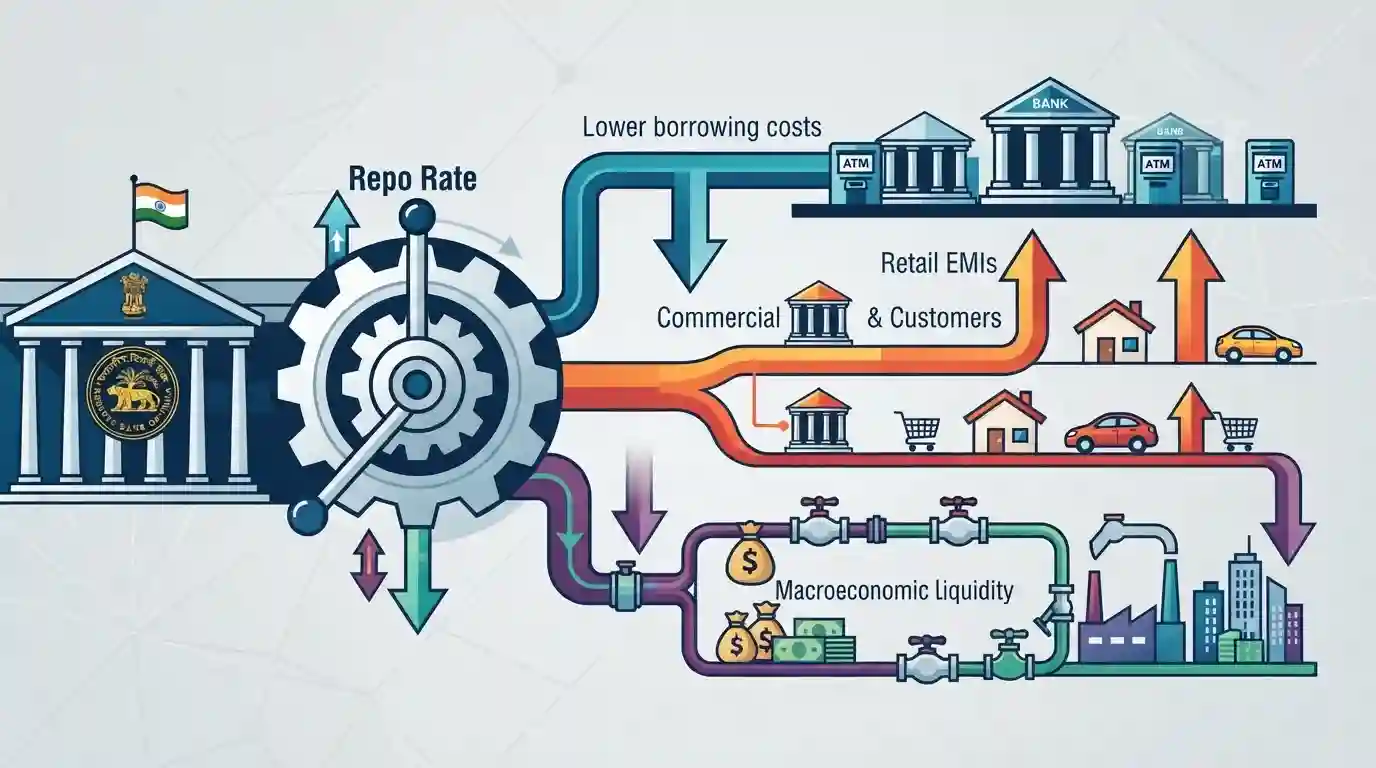
An overview of the Reserve Bank of India adjusting its benchmark repo rate, impacting commercial bank borrowing costs, retail EMIs, and broader macroeconomic liquidity management under its monetary policy framework.
Key Points
- The Reserve Bank of India's Monetary Policy Committee adjusted the benchmark repo rate, influencing borrowing costs and consumer EMIs across the banking sector.
- Changes in the repo rate serve as a primary monetary policy tool to anchor inflation expectations and manage domestic macroeconomic liquidity.
- Interest rate adjustments directly impact credit growth, investment sentiment, and retail lending rates for home and auto loans.
Important Terms
Reserve Bank of India

India's central banking institution that controls monetary policy, issues currency, regulates the banking system, and manages foreign exchange reserves.
UPSC context
GS Paper III (Indian Economy). Essential for understanding central banking functions, inflation targeting, and monetary management.
Monetary Policy Committee
A statutory body entrusted with fixing the benchmark policy interest rate (repo rate) to achieve the inflation target while supporting growth.
UPSC context
GS Paper III (Indian Economy). Tests knowledge of institutional framework for inflation control, voting structure, and monetary policy tools.
Prelims Trap
flexible inflation targeting requires maintaining headline CPI inflation strictly at 4% at all times.
Aspirants often confuse the statutory mandate of inflation targeting (4% with +/- 2% band) as a rigid 4% target rather than a flexible band anchored by law.
Static Concepts Connected
What are the core instruments and structural components of the RBI’s Liquidity Adjustment Facility (LAF)?
- Repo Rate: The Repo Rate serves as the operational target under the LAF window for day-to-day liquidity management.
- SDF Floor: The SDF (Standing Deposit Facility) serves as the lower bound of the LAF corridor, absorbing excess liquidity without collateral.
- MSF Ceiling: The MSF (Marginal Standing Facility) serves as the upper bound, allowing banks to borrow overnight against excess SLR holdings.
Cross-Topic Patterns
Monetary Policy Transmission vs. Fiscal Deficit
Central bank rate hikes increase debt-servicing costs for states, directly interacting with fiscal deficit targets under the FRBM Act and macro-fiscal stability assessments.

Expect a multi-statement prelims question on MPC composition, inflation targeting band (4% +/- 2%), or LAF corridor boundaries.
Linked PYQs · 2
Linked PYQs · 2
- 2024MainsGS3
What are the causes of persistent high food inflation in India? Comment on the effectiveness of the monetary policy of the RBI to control this type of inflation.
- 2020PrelimsGS1
If the RBI decides to adopt an expansionist monetary policy, which of the following would it not do ? 1. Cut and optimize the Statutory Liquidity Ratio 2. Increase the Marginal Standing Facility Rate 3. Cut the Bank Rate and Repo Rate Select the correct answer using the code given below:
