RBI Regulatory Reforms and Support for Cooperative Banks
Source:The Hindu ↗
આ શા માટે મહત્વનું છે
The governance and financial health of Urban Cooperative Banks (UCBs) have been heavily debated due to historical issues with dual regulation and financial scams. Recent RBI reforms and the push by the newly formed Ministry of Cooperation are critical for structural transformation, making it a highly probable topic for GS3 Economy and Prelims (Money and Banking).
સારાંશ
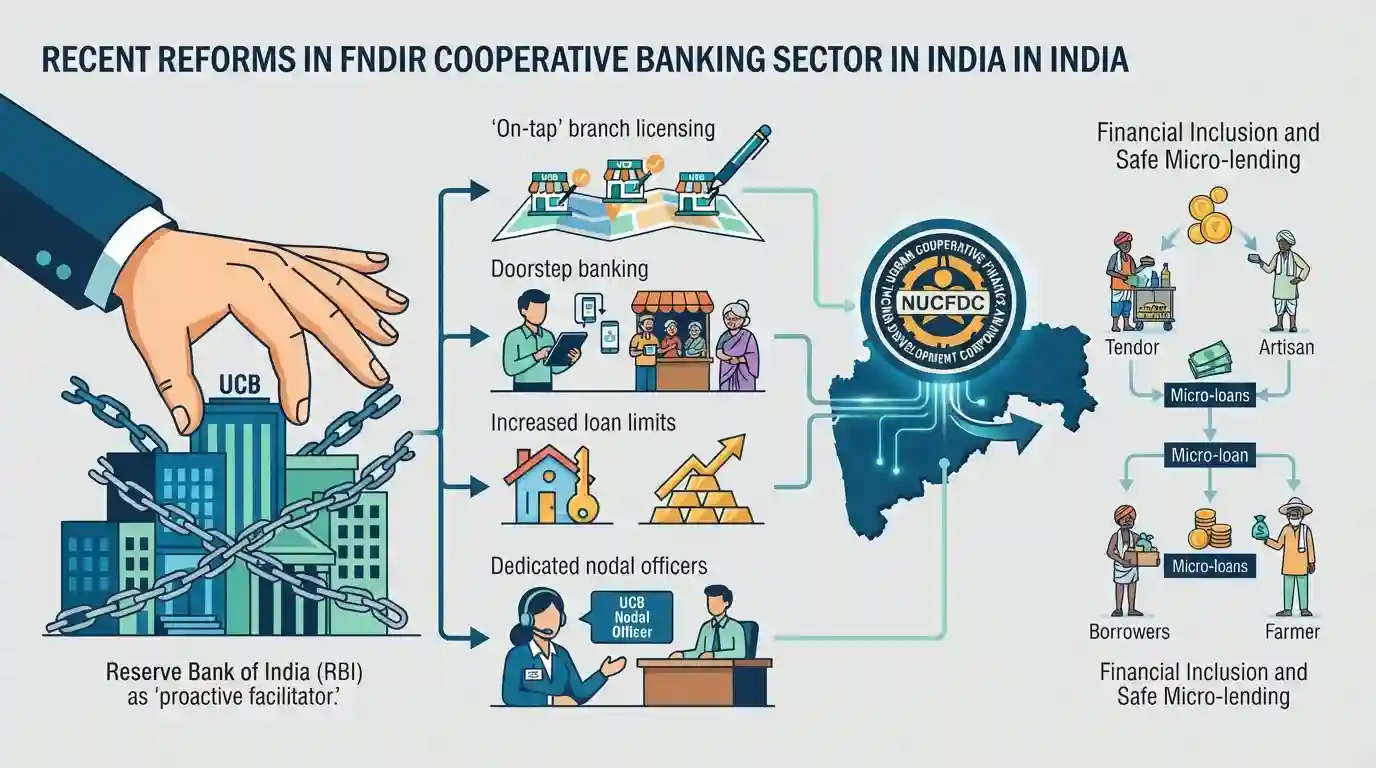
Union Minister of Cooperation Amit Shah has urged cooperative institutions to view the Reserve Bank of India (RBI) as a proactive facilitator rather than merely a strict regulator. Pointing to recent reforms, Shah noted that the RBI has cleared long-standing anomalies and introduced relaxations for Urban Cooperative Banks (UCBs). These measures include 'on-tap' branch licensing, doorstep banking, increased housing and gold loan limits, and dedicated nodal officers. Furthermore, an umbrella body, the National Urban Cooperative Finance and Development Corporation (NUCFDC), is being relocated to Maharashtra to bolster the sector. These steps aim to rejuvenate the cooperative banking sector and strengthen its role in financial inclusion by promoting safe, uncollateralized micro-lending to small borrowers.
મુખ્ય મુદ્દા
- Union Minister Amit Shah highlighted that the RBI has actively supported Urban Cooperative Banks (UCBs) by relaxing several regulations and resolving long-standing anomalies over the past two years.
- Key RBI relaxations for UCBs include 'on-tap' licensing for new branches, doorstep banking provisions, permission to issue demand drafts, higher limits for housing and gold loans, and a one-time settlement framework.
- An umbrella organization for UCBs, the National Urban Cooperative Finance and Development Corporation (NUCFDC), is being shifted to Maharashtra to better coordinate and strengthen the sector.
- Shah emphasized that uncollateralized micro-loans provided by cooperatives pose minimal risk to lenders and are essential for ensuring financial inclusion for the smallest borrowers without causing Non-Performing Assets (NPAs).
મહત્વપૂર્ણ શબ્દો
Urban Cooperative Banks (UCBs)

Primary cooperative banks in urban and semi-urban areas providing credit and banking services to retail customers, MSMEs, and small borrowers. They are jointly regulated by the RBI and the Registrar of Cooperative Societies.
UPSC context
Crucial for GS Paper 3 (Economy). Tests knowledge of financial inclusion, cooperative sector reforms, and regulatory frameworks.
National Urban Cooperative Finance and Development Corporation (NUCFDC)
An RBI-approved umbrella organization and self-regulatory body for UCBs. It provides capital, modern IT infrastructure, and liquidity support to revitalize cooperative banking and ensure better regulatory compliance.
UPSC context
Important for GS Paper 3 (Banking). Relevant for questions on financial institutions, tech adoption, and self-regulatory organizations.
Ministry of Cooperation
A Union ministry established in 2021 to provide a dedicated administrative and legal framework for India's cooperative movement. It operates under the guiding vision of "Sahkar se Samriddhi" (Prosperity through Cooperation).
UPSC context
Highly relevant for GS Paper 2 (Governance). Covers government policies, statutory frameworks, and the promotion of decentralized economic models.
Banking Regulation (Amendment) Act, 2020
A 2020 amendment that expanded the RBI's regulatory and supervisory authority over cooperative banks. It standardized norms for management, audit, and capital issuance to protect depositors and ensure financial stability.
UPSC context
Key for GS Paper 3 (Economy). Tests understanding of banking sector reforms, RBI's regulatory oversight, and financial stability measures.
પ્રિલિમ્સ ટ્રેપ
The Banking Regulation (Amendment) Act, 2020 completely abolished dual regulation of UCBs by transferring all administrative powers to the RBI.
The 2020 amendment only expanded RBI's banking regulatory powers; administrative aspects like registration and elections still rest with state/central Registrars of Cooperative Societies.
સંલગ્ન સ્થિર ખ્યાલો
How is the dual regulatory framework of Urban Cooperative Banks structured?
- Banking operations: RBI regulates banking functions, capital adequacy, and management under the Banking Regulation Act, 1949.
- Management and administration: Registrar of Cooperative Societies (State or Central) controls registration, administration, winding up, and elections.
What is the NUCFDC and its regulatory status?
- Legal status: Registered as a specialized non-deposit-taking NBFC with the RBI, acting as an apex umbrella organization.
- SRO role: Authorized to act as a Self-Regulatory Organization to improve governance and technology in the UCB sector.
આંતર-વિષય પેટર્ન
Cooperative banking + Federalism
Cooperative societies fall under State List Entry 32, meaning RBI's regulatory expansions over UCBs must balance central banking powers with state-level administrative autonomy.
Financial inclusion + SRO governance
Designating NUCFDC as an SRO highlights a shifting strategy of delegated governance to manage high-volume, uncollateralized micro-lending risks without overstraining RBI's direct machinery.

UPSC may test the division of administrative vs banking powers over UCBs alongside the SRO mandate of the NUCFDC in 2026.
સંલગ્ન PYQ · 1
સંલગ્ન PYQ · 1
- 2021PrelimsGS1
With reference to Urban Cooperative Banks' in India, consider the following statements : 1. They are supervised and regulated by local boards set up by the State Governments. 2. They can issue equity shares and preference shares. 3. They were brought under the purview of the Banking Regulation Act, 1949 through an Amendment in 1966. Which of the statements given above is/are correct?
