External Spillovers and Weather Risks to Economic Growth
Source:Indian Express ↗
Why It Matters
The intersection of global economic spillovers, monetary policy, and climate-induced inflation are central themes in the UPSC GS3 syllabus. Aspirants need to understand how the RBI navigates external shocks and domestic structural issues like weather-driven food inflation.
Summary
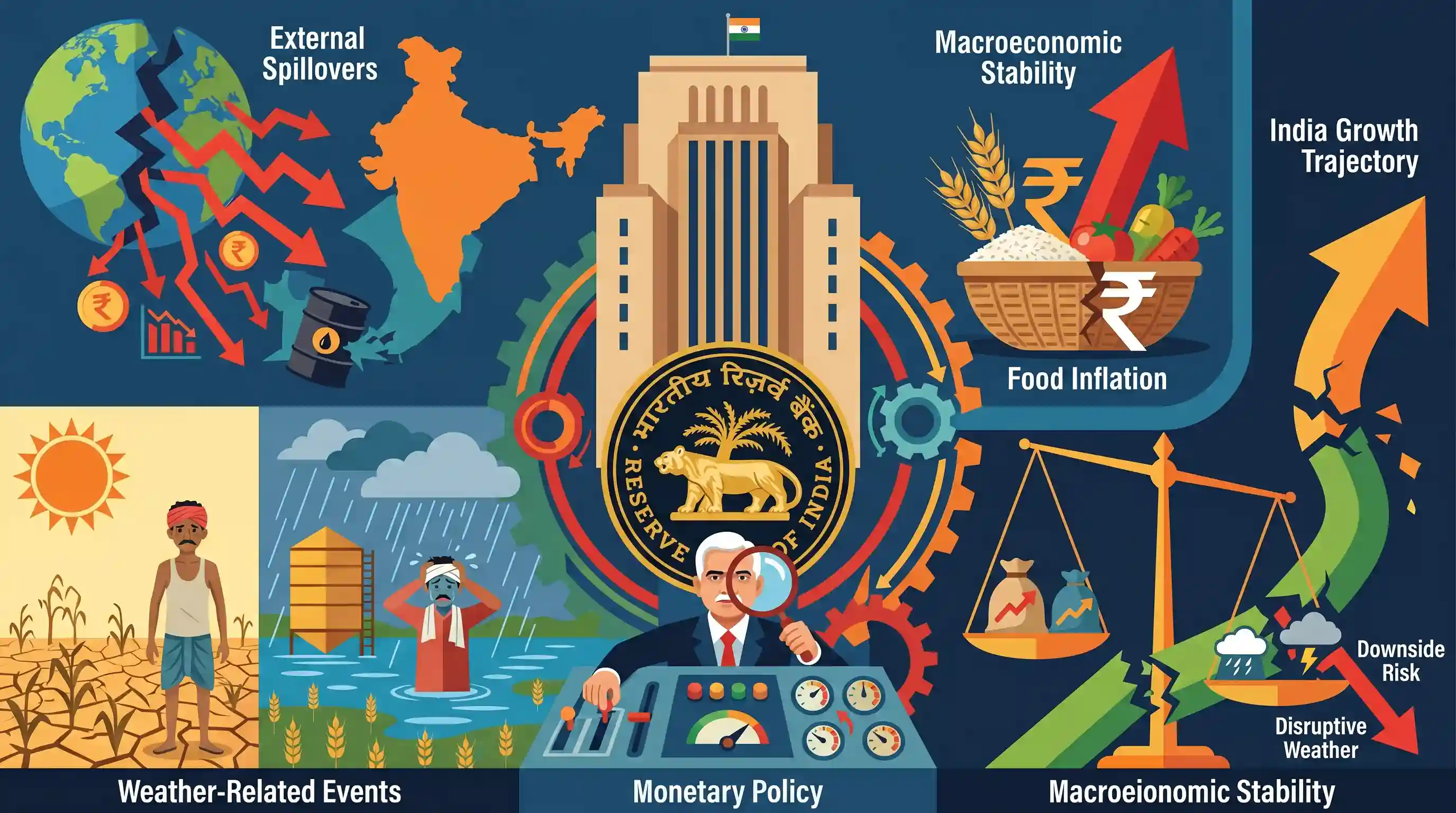
The RBI Governor has cautioned that India's economic growth trajectory faces potential downside risks stemming from external spillovers and weather-related events. Global economic uncertainties and extreme weather anomalies threaten macroeconomic stability, particularly by heightening the risk of food inflation and disrupting agricultural stability, necessitating vigilant monetary policy.
Key Points
- The RBI Governor highlighted that external spillovers, such as global economic uncertainties and geopolitical shifts, present significant downside risks to India's economic growth.
- Weather-related events, exacerbated by climate change, are identified as critical risks that could impact agricultural output and drive up food inflation.
- There is a need for continuous vigilance and proactive macroeconomic policy to shield the economy from external shocks and environmental disruptions.
Important Terms
Reserve Bank of India (RBI)

India’s central bank, established under the RBI Act 1934, responsible for formulating monetary policy, regulating the banking system, and maintaining price and financial stability.
UPSC context
GS-III (Economy): Essential for understanding the central bank's role in monetary management, inflation targeting, and financial regulation.
External Spillovers
Economic impacts felt in one country due to policy shifts, financial crises, or geopolitical shocks in another, typically transmitted through trade, capital flows, and global financial markets.
UPSC context
GS-III (Economy): Relevant for analyzing global interdependencies and how international volatility affects India's domestic growth trajectory.
Food Inflation
The persistent increase in the price of food products, which carries significant weight in India’s Consumer Price Index (CPI) and is often driven by supply-side disruptions.
UPSC context
GS-III (Economy): Tests knowledge of inflation types, supply chain management, and their impact on food security and the poor.
Monetary Policy
The framework used by the RBI to manage money supply and interest rates to achieve price stability while supporting economic growth, primarily through the Monetary Policy Committee.
UPSC context
GS-III (Economy): Core topic regarding the MPC, Repo Rate, and tools used to control inflation within the mandated 4% target.
Macroeconomic Stability
A condition where an economy’s key indicators, such as inflation, fiscal deficit, and exchange rates, are stable and predictable, fostering long-term investment and growth.
UPSC context
GS-III (Economy): Concerns the resilience of the Indian economy against internal shocks and external global uncertainties.
Supply Shock
An unexpected event that suddenly changes the availability and price of a commodity (e.g., weather-induced crop failure or energy price hikes), often causing cost-push inflation.
UPSC context
GS-III (Economy): Tests understanding of non-monetary inflation drivers like climate change and geopolitical conflicts.
Prelims Trap
"The RBI uses repo rate hikes to directly curb climate-induced food inflation."
Monetary policy tools like the repo rate address demand-side liquidity. They are largely ineffective against structural, supply-side food inflation caused by weather disruptions.
Static Concepts Connected
How does Headline Inflation differ from Core Inflation in India?
- Headline Inflation: The total inflation in the economy, measured by the Consumer Price Index (CPI-Combined). It includes volatile items like food and fuel.
- Core Inflation: Headline inflation minus food and fuel. It reflects underlying long-term macroeconomic trends and demand-driven price changes.
- RBI Target: Under the Monetary Policy Framework Agreement, the RBI's legal mandate is to target Headline CPI at 4% (with a +/- 2% tolerance band), not core inflation.
What is Imported Inflation and how is it triggered?
- Definition: A general price increase in the domestic economy caused by a rise in the cost of imported raw materials and essential goods (like crude oil or edible oils).
- Currency Depreciation: When the domestic currency (Rupee) weakens against trading currencies (like the USD), imports become more expensive, directly worsening imported inflation even if global commodity prices remain stable.
Cross-Topic Patterns
Climateflation and structural supply constraints
Extreme weather directly shrinks agricultural yields, creating persistent "climateflation" (structural supply shocks) that standard monetary tightening cannot fix, bridging GS3 Environment with GS3 Economy.
External spillovers and exchange rate volatility
Global monetary tightening (an external spillover) causes foreign capital to exit emerging markets, forcing the RBI to balance rate hikes against domestic growth needs to prevent severe currency depreciation.

Expect a 2026 Prelims question linking 'imported inflation' mechanics with the limits of RBI policy during climate-driven food shocks.
Linked PYQs · 3
Linked PYQs · 3
- 2024MainsGS3
What are the causes of persistent high food inflation in India? Comment on the effectiveness of the monetary policy of the RBI to control this type of inflation.
- 2018MainsGS3
How would the recent phenomena of protectionism and currency manipulations in world trade affect macroeconomic stability of India?
- 2022PrelimsGS1
With reference to the Indian economy, consider the following statements: 1. If the inflation is too high, Reserve Bank of India (RBI) is likely to buy government securities. 2. If the rupee is rapidly depreciating, RBI is likely to sell dollars in the market. 3. If interest rates in the USA or European Union were to fall, that is likely to induce RBI to buy dollars. Which of the statements given above are correct?
