Surging Forex Inflows Pose Domestic Liquidity Management Challenges
Source:Indian Express ↗
ఇది ఎందుకు ముఖ్యం
The article provides deep insight into the intersection of external capital flows, foreign exchange reserves management, and domestic liquidity management by the RBI, which is a core concept for GS Paper 3 (Indian Economy).
సారాంశం
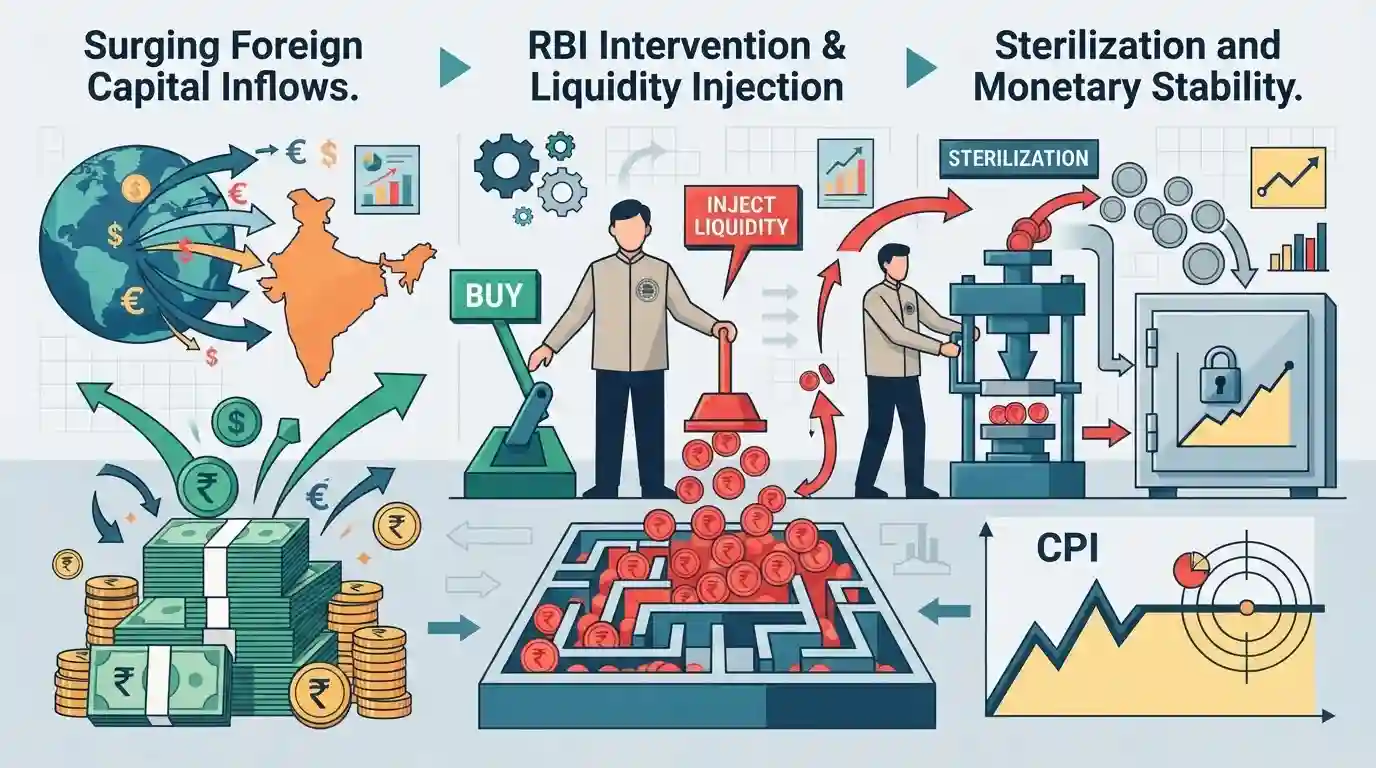
The editorial examines the policy challenges faced by the Reserve Bank of India (RBI) due to surging foreign exchange inflows resulting in excess domestic liquidity. It analyzes how the RBI's interventions in the foreign exchange market to manage rupee appreciation end up injecting liquidity into the system, requiring active sterilization and liquidity management tools like VRRRs to maintain monetary stability and control inflation.
ముఖ్య అంశాలు
- Surging forex inflows create liquidity surplus challenges for the Reserve Bank of India (RBI), complicating domestic monetary policy management.
- When foreign capital flows into the country, the RBI purchases dollars to curb excessive appreciation of the rupee, which pumps domestic currency (rupee liquidity) into the system.
- Managing excess liquidity requires the central bank to deploy tools like variable rate reverse repo (VRRR) auctions and open market operations to mop up surplus funds and prevent inflationary pressures.
- Balancing external sector stability (exchange rate management) with internal monetary stability (inflation control) remains a delicate trilemma for central banking in emerging economies.
ముఖ్యమైన పదాలు
Reserve Bank of India (RBI)

India's central banking institution which controls monetary policy, issues currency, regulates the banking system, and manages foreign exchange reserves and government debt.
UPSC context
Important for UPSC GS Paper III (Indian Economy - Central Banking, Monetary Policy, and Banking Sector Regulation).
Variable Rate Reverse Repo (VRRR)
A monetary policy tool used by the central bank to absorb excess liquidity from the banking system by inviting bids from commercial banks for reverse repo placements.
UPSC context
Important for UPSC GS Paper III under monetary policy instruments and liquidity management frameworks.
Liquidity Surplus
An excess supply of funds in the banking system relative to credit demand, which can drive short-term interest rates below policy rates and risk fueling inflation.
UPSC context
Important for UPSC GS Paper III (Banking, Monetary Policy, and Macroeconomic Stability).
అనుసంధానమైన స్థిర భావనలు
What are the primary instruments used by the RBI for liquidity management and sterilization?
- VRRR Auctions: Variable Rate Reverse Repo (VRRR) auctions are deployed to absorb short-term surplus liquidity from the banking system at market-determined rates.
- OMOs: Open Market Operations (OMOs) involve the outright sale or purchase of government securities by the RBI to manage durable liquidity.
- MSS Bonds: The Market Stabilization Scheme (MSS) issues special government bonds specifically to mop up structural liquidity arising from massive forex inflows.
అంతర-అంశ నమూనాలు
Forex Inflows & Domestic Inflation Management
Surging portfolio and FDI inflows force the RBI to inject rupees while buying dollars, creating excess liquidity that complicates domestic inflation targeting and monetary policy transmission.
Mundell-Fleming Trilemma in Emerging Markets
Central banks in emerging markets struggle to maintain independent monetary policy, exchange rate stability, and capital account openness simultaneously.

Expect a multi-statement Prelims question on how RBI sterilization operations impact domestic banking liquidity and inflation control.
అనుసంధాన PYQలు · 4
అనుసంధాన PYQలు · 4
- 2024PrelimsGS1
Consider the following statements in respect of the digital rupee : 1. It is a sovereign currency issued by the Reserve Bank of India (RBI) in alignment with its monetary policy. 2. It appears as a liability on the RBI's balance sheet. 3. It is insured against inflation by its very design. 4. It is freely convertible against commercial bank money and cash. Which of the statements given above are correct?
- 2025PrelimsGS1
Which of the following are the sources of income for the Reserve Bank of India? I. Buying and selling Government bonds II. Buying and selling foreign currency III. Pension fund management IV. Lending to private companies V. Printing and distributing currency notes Select the correct answer using the code given below.
- 2020PrelimsGS1
If the RBI decides to adopt an expansionist monetary policy, which of the following would it not do ? 1. Cut and optimize the Statutory Liquidity Ratio 2. Increase the Marginal Standing Facility Rate 3. Cut the Bank Rate and Repo Rate Select the correct answer using the code given below:
- 2024MainsGS3
What are the causes of persistent high food inflation in India? Comment on the effectiveness of the monetary policy of the RBI to control this type of inflation.
