RBI Extends Supersession of Abhyudaya Cooperative Bank Board
Source:The Hindu ↗
Why It Matters
It illustrates the RBI's enforcement powers and regulatory interventions in urban cooperative banks to ensure financial stability and protect depositors.
Summary
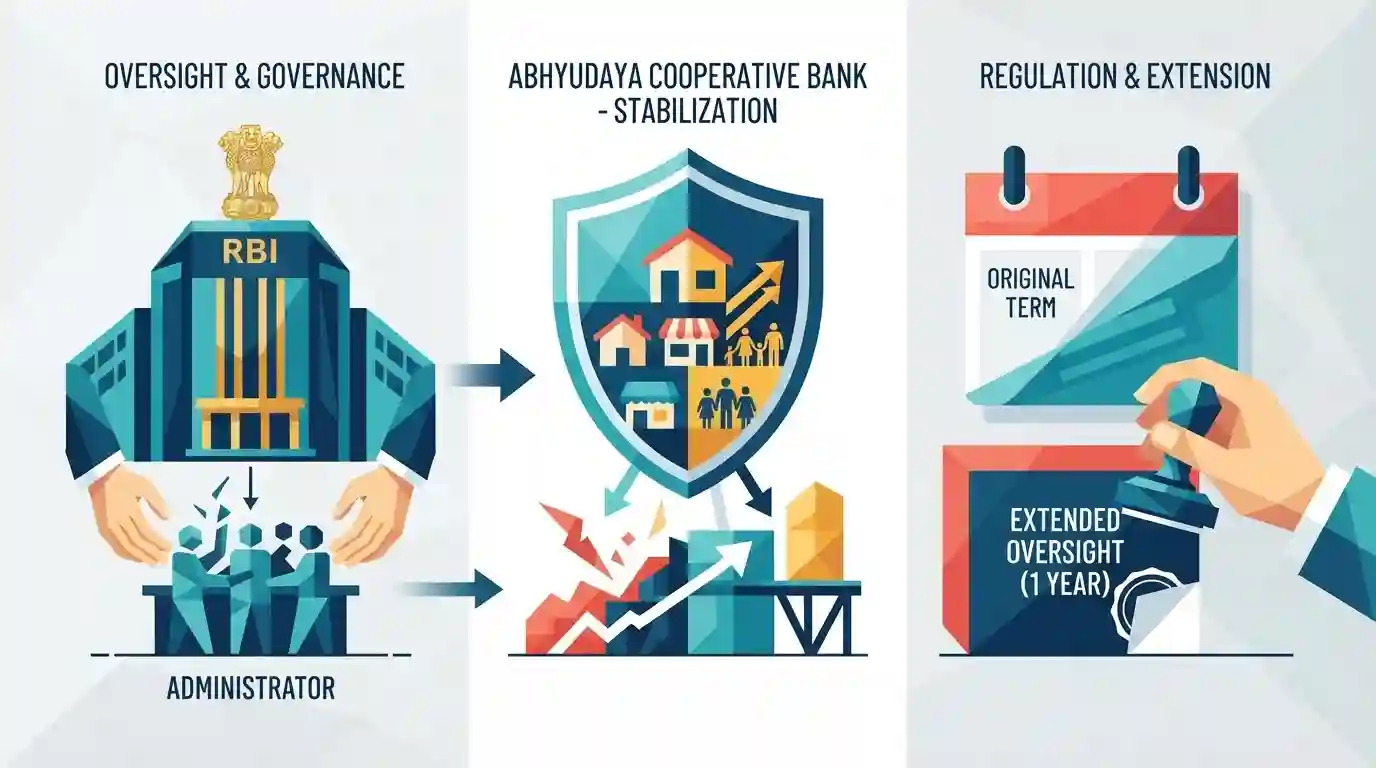
The Reserve Bank of India has extended the period of supersession of the board of Abhyudaya Cooperative Bank for an additional year. Originally taken over due to governance deficiencies and financial stress, the urban cooperative bank continues under the management of an RBI-appointed administrator to protect depositors and stabilize operations, underscoring the central bank's oversight role in the cooperative banking sector.
Key Points
- The Reserve Bank of India (RBI) extended the supersession of the board of directors of Abhyudaya Cooperative Bank by another year.
- The bank's board was originally superseded due to governance concerns and material financial deterioration.
- An RBI-appointed administrator continues to manage the affairs of the urban cooperative bank to safeguard depositors' interests.
- This highlights the central bank's regulatory powers over cooperative banks under the Banking Regulation Act.
Important Terms
Reserve Bank of India

The central banking institution of India, established under the RBI Act of 1934, responsible for regulating the monetary policy, issuing currency, and supervising commercial and cooperative banks.
UPSC context
UPSC Prelims/Mains (GS Paper III): Essential for questions on monetary policy, central banking functions, regulatory oversight, and financial stability.
Banking Regulation Act
A key legislation enacted in 1949 and amended via the Banking Regulation (Amendment) Act, 2020, empowering the RBI to regulate and supervise both commercial and urban cooperative banks in India.
UPSC context
UPSC Prelims/Mains (GS Paper III): Crucial for understanding cooperative bank governance, RBI regulatory powers, and the resolution of banking stress.
Abhyudaya Cooperative Bank
A multi-state urban cooperative bank whose board of directors was superseded by the RBI due to governance deficiencies and financial stress, operating currently under an RBI-appointed administrator.
UPSC context
UPSC Prelims/Mains (GS Paper III): Case study on cooperative banking governance issues, regulatory interventions, and depositor protection.
Static Concepts Connected
How are Urban Cooperative Banks (UCBs) regulated in India under the dual control framework?
- Dual Control: Dual Regulation: UCBs are regulated by both the RBI (for banking operations) and the Registrar of Cooperative Societies (for registration, audit, and management).
- RBI Powers: 2020 Amendment: The Banking Regulation (Amendment) Act, 2020 extended RBI's powers over cooperative banks regarding board supersession, audit, and structural amalgamation.
- PACS Exclusion: Exclusions: Primary Agricultural Credit Societies (PACS) do not fall under RBI's banking regulation purview.
Cross-Topic Patterns
Cooperative Banking vs. Federalism Dual Control
The 2020 Banking Regulation Amendment brought cooperative banks under direct RBI oversight, bridging a long-standing dual-control regulatory loophole between state registrars and the central bank.

RBI's expanded powers over UCBs post-2020 amendment will likely feature in a statement-based question on cooperative bank regulation.
Linked PYQs · 1
Linked PYQs · 1
- 2021PrelimsGS1
With reference to Urban Cooperative Banks' in India, consider the following statements : 1. They are supervised and regulated by local boards set up by the State Governments. 2. They can issue equity shares and preference shares. 3. They were brought under the purview of the Banking Regulation Act, 1949 through an Amendment in 1966. Which of the statements given above is/are correct?
