RBI Export Realization Relief Amid Shipping Disruptions
Source:Indian Express ↗
Why It Matters
This development perfectly illustrates the intersection of geopolitics (GS2) and economy (GS3). It shows how international conflicts like the Red Sea crisis directly affect India's macroeconomy (supply chains, freight costs, working capital) and how domestic institutions like the RBI use regulatory tools under FEMA to provide macroeconomic stability and support the balance of payments.
Summary
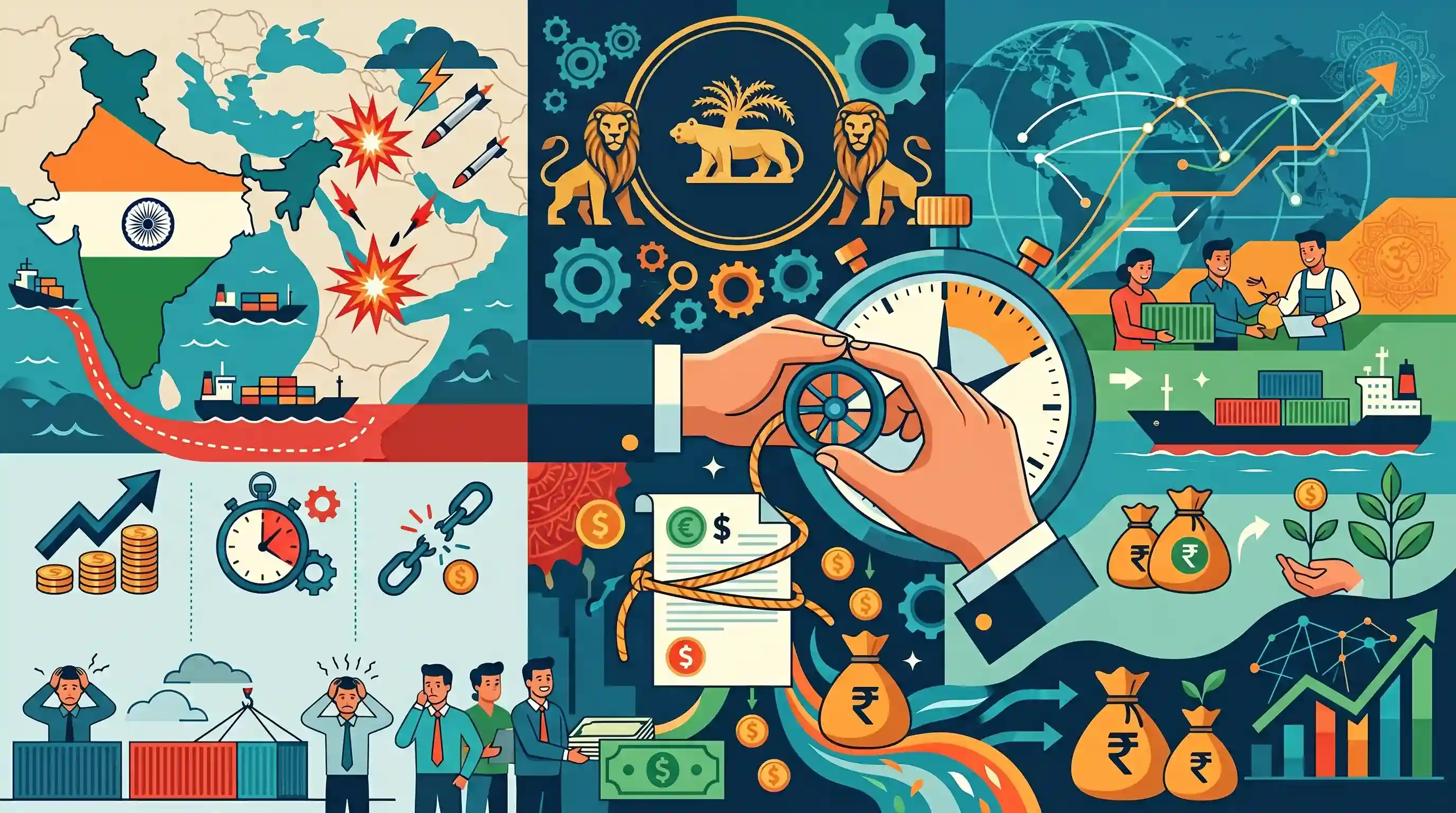
The Reserve Bank of India (RBI) has extended the timeline for the realization of export proceeds to provide relief to exporters affected by global shipping disruptions. The ongoing West Asia crisis and attacks in the Red Sea have forced commercial vessels to reroute, leading to longer transit times, soaring freight and insurance costs, and delayed payments. By relaxing the statutory time limits for repatriating foreign exchange, the RBI aims to ease working capital constraints for Indian businesses and stabilize trade operations amidst severe geopolitical and supply chain headwinds.
Key Points
- The RBI has extended the timeline for exporters to realize and repatriate foreign exchange proceeds from exports.
- The measure provides working capital relief to exporters facing delayed payments due to shipping disruptions and increased transit times.
- The disruptions are primarily driven by the ongoing West Asia crisis, particularly Houthi attacks on commercial shipping in the Red Sea.
- Vessels are being rerouted around the Cape of Good Hope, leading to surging freight costs, higher insurance premiums, and severe supply chain bottlenecks.
- The intervention highlights the vulnerability of India's international trade to geopolitical risks at maritime chokepoints and the central bank's role in mitigating these shocks.
Important Terms
Foreign Exchange Management Act (FEMA), 1999

Legislation regulating foreign exchange transactions in India. It empowers the RBI to set timelines for the repatriation of export proceeds to ensure external sector stability and prevent capital flight.
UPSC context
GS-III (Economy); tests knowledge of legal frameworks governing international trade and foreign exchange management.
Export Realization
The process of receiving and repatriating foreign exchange payments for exports to India. RBI extended this statutory deadline from 9 to 15 months to assist exporters facing logistical delays.
UPSC context
GS-III (External Sector); vital for understanding Balance of Payments and forex reserve stability.
Export Credit
Financial support including pre-shipment (production/packaging) and post-shipment (covering the gap until payment) credit. RBI extended the enhanced credit period to 450 days for disbursals until June 2026.
UPSC context
GS-III (Trade & Investment); examines trade finance mechanisms and liquidity support for the export sector.
Red Sea Crisis
Geopolitical tensions and maritime attacks in the Red Sea forcing shipping reroutes around Africa. This has significantly increased transit times, freight costs, and insurance premiums for Indian exporters.
UPSC context
GS-II/III (Geopolitics/Supply Chains); tests impact of external shocks on global trade routes and India's economy.
Interest Equalization Scheme (IES)
A government scheme providing interest subvention on pre- and post-shipment export credit. Exporters sought protection of these benefits despite payment delays caused by global shipping disruptions.
UPSC context
GS-III (Economy); relevant for government subsidies and financial support systems for small-scale exporters.
Working Capital
The liquidity required for a business's daily operations. Shipping delays and longer payment cycles strain this by trapping capital in transit, necessitating RBI’s regulatory relaxations.
UPSC context
GS-III (Economic Development); tests understanding of business liquidity cycles during supply chain shocks.
Reserve Bank of India (RBI)
India’s central bank responsible for monetary policy and regulating the external sector. It manages foreign exchange reserves and trade finance timelines to ensure macroeconomic stability.
UPSC context
GS-III (Macroeconomics); role as the regulator of India’s financial and external sectors.
Prelims Trap
The Ministry of Commerce extends the statutory timeline for the realization of export proceeds.
While DGFT manages trade policy, the repatriation of foreign exchange and its timelines are strictly governed by the RBI under the Foreign Exchange Management Act (FEMA).
Static Concepts Connected
What is the statutory requirement for realization of export proceeds?
- Statutory limit: Typically, foreign exchange from exports must be realized and repatriated to India within 9 months from the date of export.
- RBI authority: RBI regulates these forex transactions under FEMA and holds the power to relax timelines to ease exporters' working capital stress during global disruptions.
Which geographical features surround the Bab-el-Mandeb strait?
- Water bodies: It connects the Red Sea in the northwest to the Gulf of Aden and the Arabian Sea in the southeast.
- Land borders: It acts as a chokepoint separating Yemen (Arabian Peninsula) from Djibouti and Eritrea (Horn of Africa).
Cross-Topic Patterns
Red Sea Crisis & Imported Inflation
Rerouting ships via the Cape of Good Hope spikes freight and insurance costs. This supply-side shock risks imported inflation and widens India's Current Account Deficit (CAD).
Strategic de-risking via IMEC
India's 90% dependency on the Suez route for western cargo accelerates the strategic necessity of the India-Middle East-Europe Economic Corridor (IMEC) to bypass vulnerable maritime chokepoints.

Expect a 2026 prelims question linking RBI's FEMA powers, Red Sea geography (Bab-el-Mandeb), and their combined impact on India's CAD.
Linked PYQs · 4
Linked PYQs · 4
- 2024PrelimsGS1
Consider the following statements : Statement-I : Sumed pipeline is a strategic route for Persian Gulf oil and natural gas shipments to Europe. Statement-II : Sumed pipeline connects the Red Sea with the Mediterranean Sea. Which one of the following is correct in respect of the above statements?
- 2024PrelimsGS1
Consider the following statements : 1. The Red Sea receives very little precipitation in any form. 2. No water enters the Red Sea from rivers. Which of the statements given above is/are correct?
- 2013PrelimsGS1
The balance of payments of a country is a systematic record of
- 2025MainsGS3
What are the challenges before the Indian economy when the world is moving away from free trade and multilateralism to protectionism and bilateralism? How can these challenges be met?
