RBI Exempts Small Non Deposit Taking NBFCs from Registration
Source:The Hindu ↗
Why It Matters
This highlights the RBI's shift toward a risk-proportional regulatory framework for NBFCs, reducing red tape for smaller players while focusing oversight on systemically important entities. The disaster relief guidelines reflect a progressive, proactive approach to financial disaster management, ensuring rapid economic buffering for affected populations.
Summary
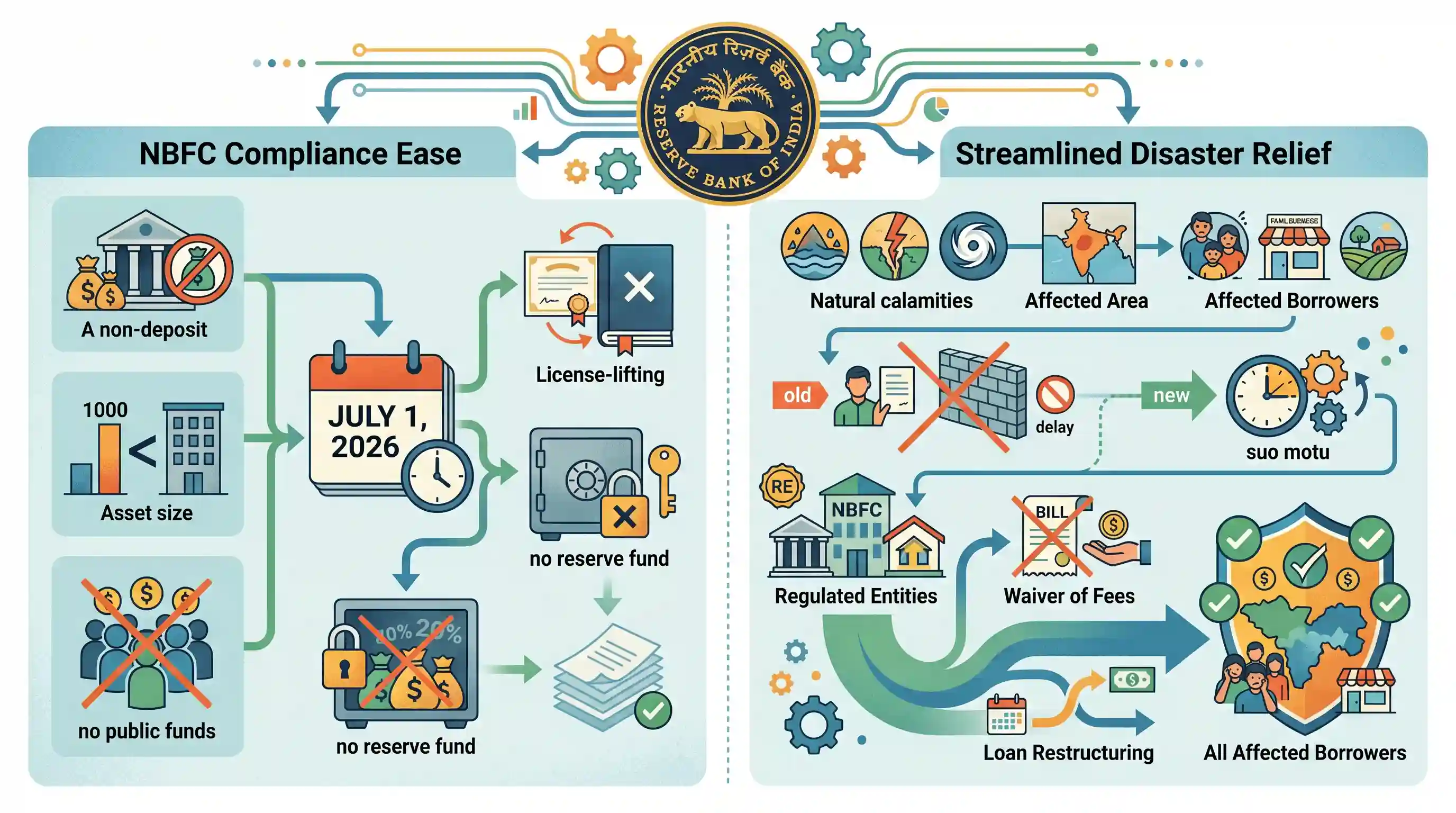
The Reserve Bank of India (RBI) has announced key regulatory updates affecting both the shadow banking sector and disaster relief protocols. To ease compliance, non-deposit-taking NBFCs with an asset size under ₹1,000 crore that do not rely on public funds will be exempt from RBI registration and reserve fund requirements starting July 1, 2026. Additionally, the RBI has streamlined financial disaster management by allowing banks and other Regulated Entities to proactively extend relief measures—such as waiving fees and restructuring loans—to borrowers in regions affected by natural calamities, removing the need for individuals to formally request such aid.
Key Points
- The RBI has exempted non-deposit-taking NBFCs with asset sizes below ₹1,000 crore from mandatory registration and reserve fund requirements, provided they do not access public funds.
- This regulatory relaxation, effective July 1, 2026, aims to ease the compliance burden on small financial entities that pose minimal systemic risk.
- In a separate move, the RBI issued revised directions enabling banks and other Regulated Entities (REs) to proactively extend financial relief in areas hit by natural calamities.
- Banks can now offer relief measures, including loan restructuring and a one-year waiver or reduction of fees and charges, without waiting for individual borrower requests in notified disaster zones.
Important Terms
Reserve Bank of India (RBI)

India’s central bank and regulatory authority for the financial system. It manages monetary policy, currency issuance, and supervises banks and non-banking financial institutions to ensure economic stability.
UPSC context
GS-III Indian Economy; essential for topics on monetary policy, inflation management, and financial sector regulation.
Non-Banking Finance Companies (NBFCs)
Companies registered under the Companies Act providing financial services like loans and advances without a banking license. They cannot accept demand deposits or issue cheques drawn on themselves.
UPSC context
GS-III Indian Economy; relevant to shadow banking, financial inclusion, and systemic credit market risks.
Regulated Entities (REs)
A collective term for all financial institutions supervised by the RBI, including commercial banks, cooperative banks, NBFCs, and payment system participants.
UPSC context
GS-III Economy; defines the scope of RBI’s supervisory powers and compliance frameworks.
Public Funds
Funds raised by an NBFC from external sources like bank borrowings, commercial papers, and debentures, but excluding promoter equity and shareholder capital.
UPSC context
GS-III Financial Sector; identifies risk-based classification for NBFCs and regulatory exemptions.
Reserve Fund
A statutory fund mandated under Section 45-IC of the RBI Act. NBFCs must transfer at least 20% of annual net profits to this fund before declaring dividends.
UPSC context
GS-III Economy; relates to prudential norms and ensuring the long-term solvency of financial intermediaries.
Asset Size
The total value of assets on a balance sheet. RBI uses thresholds like ₹1,000 crore to determine an entity's systemic importance and regulatory layer.
UPSC context
GS-III Economy; central to Scale-Based Regulation (SBR) and compliance tailoring for financial institutions.
Prelims Trap
"All NBFCs require mandatory RBI registration, and 'public funds' strictly refers to retail public deposits."
Small, non-public-fund NBFCs are now exempt. Crucially, "public funds" under RBI includes bank finance, commercial papers, and inter-corporate deposits, not just retail deposits.
Static Concepts Connected
What is the RBI's Scale Based Regulation (SBR) framework for NBFCs?
- Base Layer (NBFC-BL): Includes non-deposit taking NBFCs (< ₹1000 cr), P2P platforms, and Account Aggregators posing minimal systemic risk.
- Middle Layer (NBFC-ML): Includes all deposit-taking NBFCs, and non-deposit taking NBFCs with an asset size of ₹1000 crore and above.
- Upper/Top Layers: Comprises the top 10 eligible NBFCs and those specifically identified by RBI as having significant systemic risk.
How does the RBI classify "Standard" vs "Non-Performing" assets?
- Standard Asset: A performing account where payments are regular. For the new disaster relief eligibility, it must not be overdue by more than 30 days when the calamity hits.
- NPA: A loan or advance for which the principal or interest payment remains overdue for a period of more than 90 days.
Cross-Topic Patterns
Disaster Management + Banking Regulations
Links NDMA/State notifications of natural calamities directly to RBI's financial policies via proactive loan restructuring, bridging GS-3 Disaster Management with Economy.
Systemic Risk vs Ease of Doing Business
Reflects RBI's dual strategy: aggressively monitoring Upper Layer shadow banks for systemic risk while deregulating Base Layer non-public-fund entities to foster micro-lending and financial inclusion.

Expect a 2026 Prelims question testing the widened definition of "public funds" for NBFCs alongside the new SBR Base Layer exemptions.
Linked PYQs · 4
Linked PYQs · 4
- 2010PrelimsGS1
With reference to the Non-banking Financial Companies (NBFCs) in India, consider the following statements:
- 2024PrelimsGS1
Consider the following statements : 1. In India, Non-Banking Financial Companies can access the Liquidity Adjustment Facility window of the Reserve Bank of India. 2. In India, Foreign Institutional Investors can hold the Government Securities (G-Secs). 3. In India, Stock Exchanges can offer separate trading platforms for debts. Which of the statements given above is/are correct?
- 2020MainsGS3
Discuss the recent measures initiated in disaster management by the Government of India departing from the earlier reactive approach.
- 2024MainsGS3
What is disaster resilience? How is it determined? Describe various elements of a resilience framework. Also mention the global targets of Sendai Framework for Disaster Risk Reduction (2015–2030).
