RBI Draft Guidelines on Financial Mis-selling and Dark Patterns
Source:Indian Express ↗
Why It Matters
Highlights the evolving regulatory role of the RBI in addressing digital-era challenges like dark patterns and ensuring consumer protection in financial services, which is relevant for GS3 (Indian Economy).
Summary
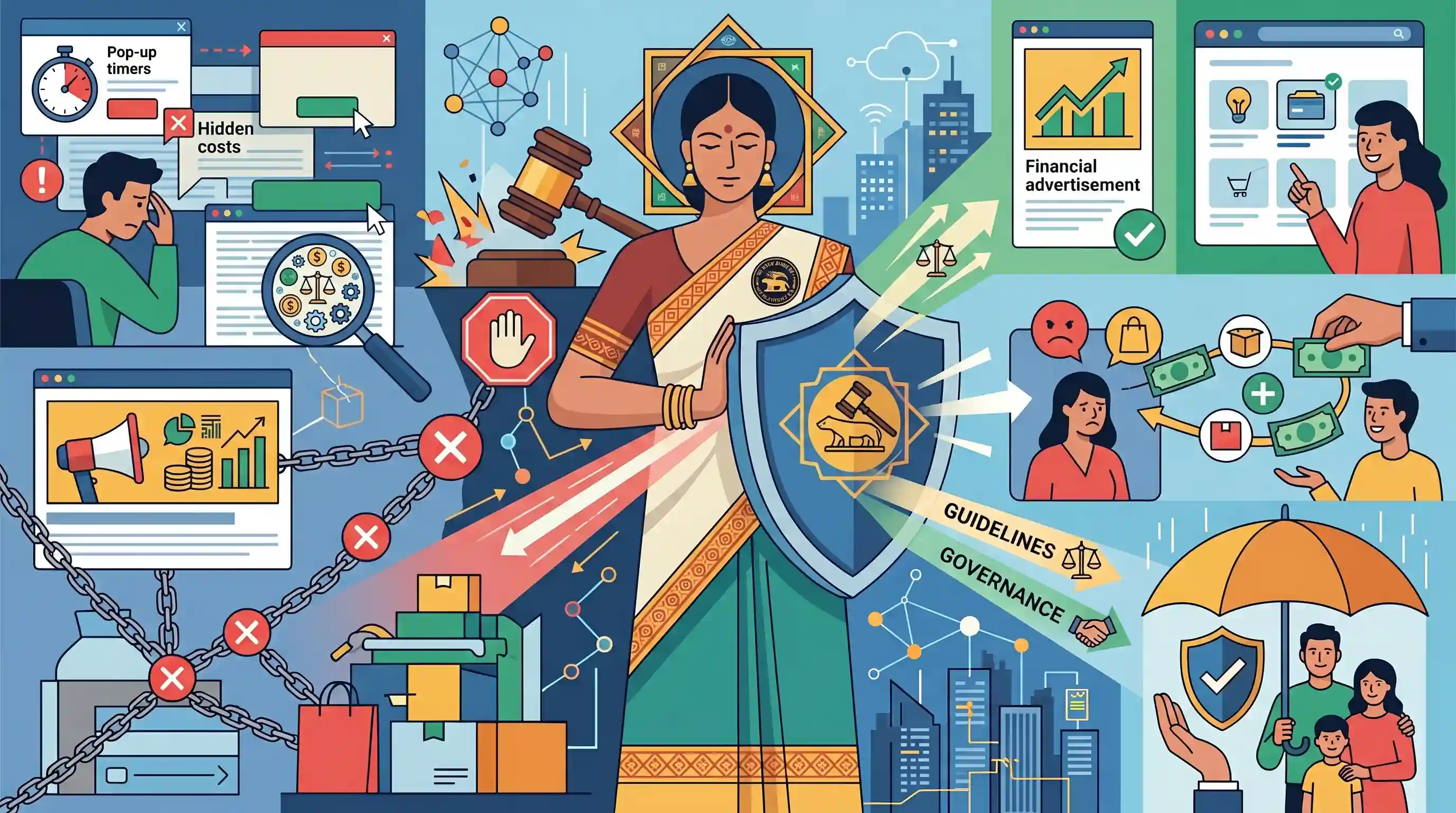
The Reserve Bank of India (RBI) has proposed draft guidelines targeting the mis-selling of financial products. Key measures include introducing refund mechanisms for consumers who are mis-sold products, establishing stricter frameworks for financial advertisements, and issuing warnings against the use of 'dark patterns'—deceptive user interfaces used to trick consumers into purchasing unwanted products or services. The move aims to enhance consumer protection and transparency in the rapidly digitizing financial sector.
Key Points
- The RBI has introduced draft guidelines aimed at curbing the mis-selling of financial products by banks and NBFCs.
- It proposes mandatory refund mechanisms to compensate consumers affected by mis-selling practices.
- The framework mandates clearer guidelines for financial advertisements to ensure transparency and prevent misleading claims.
- The central bank specifically warns against "dark patterns," which are deceptive digital user interface designs used to manipulate customer choices.
- These measures seek to bolster consumer protection and maintain trust in both digital and traditional banking ecosystems.
Important Terms
Mis-selling

The practice of selling financial products that are unsuitable for a customer's profile, poorly explained, or pushed without explicit consent and adequate risk disclosure.
UPSC context
GS Paper 3 (Banking/Economy); tests knowledge of consumer protection and regulatory measures to prevent unfair trade practices in the financial sector.
Dark Patterns
Deceptive user-interface designs (e.g., basket sneaking, drip pricing) used on digital platforms to manipulate users into making unintended financial decisions or purchases.
UPSC context
GS Paper 3 (Digital Economy) and GS Paper 4 (Ethics); focuses on ethical business conduct and the regulation of deceptive digital architectures.
Responsible Business Conduct (RBC) Directions
A draft RBI framework (2026) setting standards for banks to ensure fair treatment, transparency, and ethical conduct in advertising, marketing, and sales.
UPSC context
GS Paper 3 (Economy/Banking); significant for understanding the RBI’s shift toward conduct-of-business regulation and enhancing institutional accountability.
Product Bundling
The practice of making the purchase of one product (e.g., a loan) contingent upon buying a separate, often third-party product (e.g., insurance policy).
UPSC context
GS Paper 3 (Economy); relevant to discussions on bancassurance and the prevention of coercive selling practices by financial institutions.
Suitability Assessment
The regulatory requirement for banks to evaluate a product's risks and returns against a customer's age, income, financial literacy, and risk tolerance before selling it.
UPSC context
GS Paper 2 (Governance/Regulators); tests the concept of 'duty of care' and fiduciary responsibility in the delivery of public financial services.
Direct Selling Agents (DSAs)
Third-party intermediaries engaged by banks to market loans and other products. They are now subject to stricter RBI-mandated conduct and ethics codes.
UPSC context
GS Paper 3 (Banking); concerns the regulation of outsourced financial services and the protection of customers from aggressive recovery or marketing tactics.
Prelims Trap
The regulation of 'dark patterns' in India is the exclusive mandate of the Central Consumer Protection Authority (CCPA).
While CCPA broadly regulates e-commerce dark patterns under the Consumer Protection Act, RBI holds regulatory authority over deceptive digital UI/UX practices deployed by banks.
Static Concepts Connected
What are the key features of the Reserve Bank - Integrated Ombudsman Scheme (RB-IOS)?
- Integration: It merged three former ombudsman schemes (Banking, NBFCs, Digital Transactions) into one centralized system.
- One Nation One Ombudsman: Features a single portal, email, and address for lodging complaints against RBI-regulated entities.
- Cost & Appeal: It is a free-of-cost Alternate Grievance Redress (AGR) mechanism. The Appellate Authority is the RBI Executive Director.
When does a bank customer have 'zero liability' in unauthorized digital transactions?
- Bank Negligence: Zero liability if the unauthorized transaction occurs due to contributory fraud or negligence by the bank.
- Third-Party Breach: Zero liability if the breach is elsewhere in the system and the customer reports it to the bank within 3 working days.
- Customer Negligence: If the customer shares credentials, they bear the loss until reported; the bank bears any subsequent losses after reporting.
Cross-Topic Patterns
Digital consumer rights vs. Tech design
CCPA's 2023 guidelines on dark patterns in e-commerce (like 'basket sneaking') now parallel RBI's push to clean up digital banking interfaces, linking GS-2 (Governance) with GS-3 (Digital Economy).
Mis-selling as a barrier to inclusion
Forced bundling of third-party insurance with micro-loans undermines the trust required for true financial inclusion, making consumer protection a prerequisite for deepening rural credit access.

Expect a multi-statement Prelims question comparing the jurisdictions of RBI, CCPA, and SEBI on 'dark patterns' and digital mis-selling.
Linked PYQs · 1
Linked PYQs · 1
- 2013PrelimsGS1
The Reserve Bank of India regulates the commercial banks in matters of 1. liquidity of assets 2. branch expansion 3. merger of banks 4. winding-up of banks Select the correct answer using the codes given below.
