RBI Forex Reserves Management and Gold Reserve Adequacy
Source:The Hindu ↗
Why It Matters
The management and composition of India's foreign exchange reserves by the RBI are critical for cushioning the domestic economy against external geopolitical shocks. Understanding the components of forex reserves (such as gold, SDRs, and foreign currency assets) and the RBI's role in their administration is foundational for candidates studying macroeconomic stability and monetary policy.
Summary
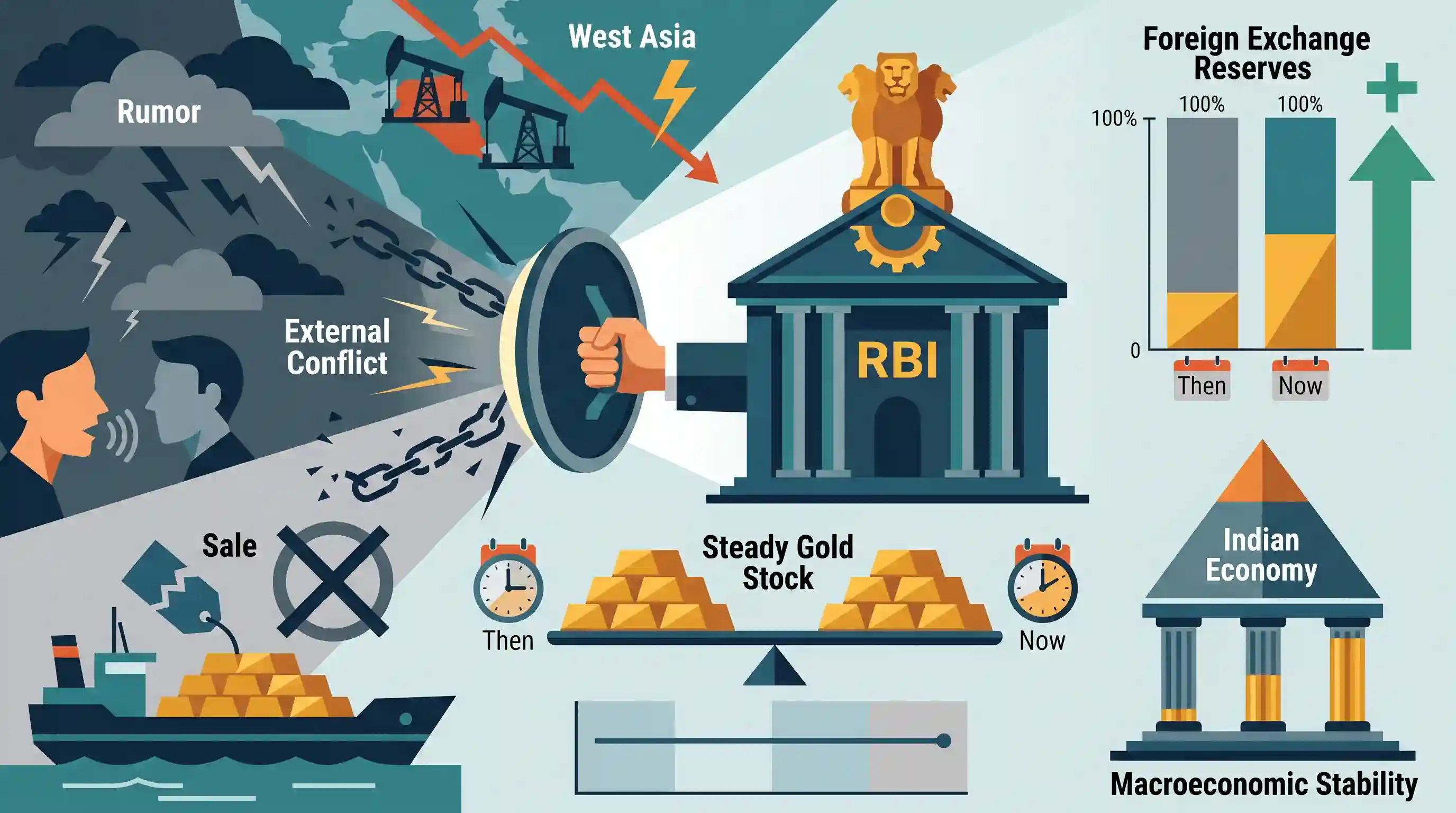
The Reserve Bank of India (RBI) has dismissed rumors suggesting it sold approximately $12 billion in gold to protect India's foreign currency reserves from the economic impact of the ongoing conflict in West Asia. The central bank clarified that its physical gold stock remains steady at 880.52 tonnes. Furthermore, official data reveals that rather than decreasing, the share of gold in India's total foreign exchange reserves has grown from 13.92% in September 2025 to 16.85% in May 2026.
Key Points
- The RBI refuted reports claiming it had sold approximately $12 billion in gold to shield its foreign currency reserves from the economic fallout of the West Asia conflict.
- India's physical gold reserves remain unchanged and steady at 880.52 tonnes.
- The proportion of gold in India's total foreign exchange reserves has increased from 13.92% in September 2025 to 16.85% as of May 2026.
- Both the RBI and the Press Information Bureau (PIB) issued official fact-checks advising the public not to rely on false rumors regarding gold sales.
Important Terms
Reserve Bank of India (RBI)

India's central bank and regulatory body responsible for monetary stability, currency issuance, and management of the country's foreign exchange reserves and credit system.
UPSC context
GS Paper III (Economy); core institution for monetary policy, banking regulation, and external sector stability.
Foreign Exchange (Forex) Reserves
External assets held by the central bank, comprising foreign currency assets (FCA), gold, Special Drawing Rights (SDRs), and the Reserve Tranche Position in the IMF.
UPSC context
GS Paper III; critical for maintaining macroeconomic stability, rupee value, and international trade credibility.
Gold Reserves
The portion of a country's foreign exchange reserves held in physical bullion, serving as a strategic hedge against inflation, currency volatility, and geopolitical risks.
UPSC context
GS Paper III; tested under external sector stability and diversification of reserve assets.
Press Information Bureau (PIB)
The nodal agency of the Government of India for disseminating official information to media regarding government policies, initiatives, and achievements.
UPSC context
General Studies; primary authentic source for government data and schemes; essential for current affairs preparation.
PIB Fact Check
A specialized wing within the PIB established to identify and debunk misinformation or fake news related to the Government of India and its departments.
UPSC context
GS Paper II/III; relevant for internal security (fake news) and governance transparency.
Prelims Trap
Gold constitutes the largest component of India's foreign exchange reserves.
Despite gold's share increasing to nearly 17%, Foreign Currency Assets (FCA) remain by far the largest component of India's forex reserves, usually constituting over 75% of the total.
Static Concepts Connected
What are the four components of India's Foreign Exchange Reserves?
- Foreign Currency Assets: The largest chunk of reserves, held in major global currencies like US dollars, euros, pounds, and yen.
- Physical Gold: Held by the RBI as a counter-cyclical safe-haven asset to hedge against inflation and geopolitical risks.
- Special Drawing Rights: An international reserve asset created by the IMF to supplement its member countries' official reserves.
- Reserve Tranche Position: The un-drawn portion of India's quota with the IMF that can be accessed without conditions.
What dictates the RBI's backing of domestic currency issuance?
- Minimum Reserve System: Since 1956, the RBI issues currency under this system, meaning currency must be backed by a statutory minimum of specific assets.
- Statutory Minimum: Under Section 33 of the RBI Act, 1934, RBI must maintain at least ₹200 crore in reserves.
- Gold Requirement: Out of the ₹200 crore, at least ₹115 crore must be explicitly held in gold coin or gold bullion.
- Foreign Securities: The remaining ₹85 crore is held in foreign securities to fulfill the mandated backing for issued currency.
Cross-Topic Patterns
De-dollarization and Central Bank Gold
Global central banks are aggressively buying gold to diversify reserves away from the US Dollar, a trend accelerated by recent geopolitical sanctions and fiat currency volatility.
West Asia Conflict and Imported Inflation
Geopolitical instability in West Asia impacts India's macroeconomic stability by spiking crude prices, which widens the Current Account Deficit and triggers imported inflation, prompting forex interventions.

A 2026 Prelims question will likely ask candidates to arrange forex components by size or identify the rationale for RBI's gold purchases.
Linked PYQs · 1
Linked PYQs · 1
- 2013PrelimsGS1
Which one of the following groups of items is included in India's foreign-exchange reserves?
