RBI Stance Against Stablecoins and Digital Assets
Source:The Hindu ↗
Why It Matters
Understanding the RBI's regulatory stance on private cryptocurrencies and stablecoins is crucial for analyzing India's evolving digital economy policies. It highlights the tension between technological innovation and macroeconomic stability, emphasizing the central bank's mandate to protect monetary policy transmission and sovereign currency sovereignty.
Summary
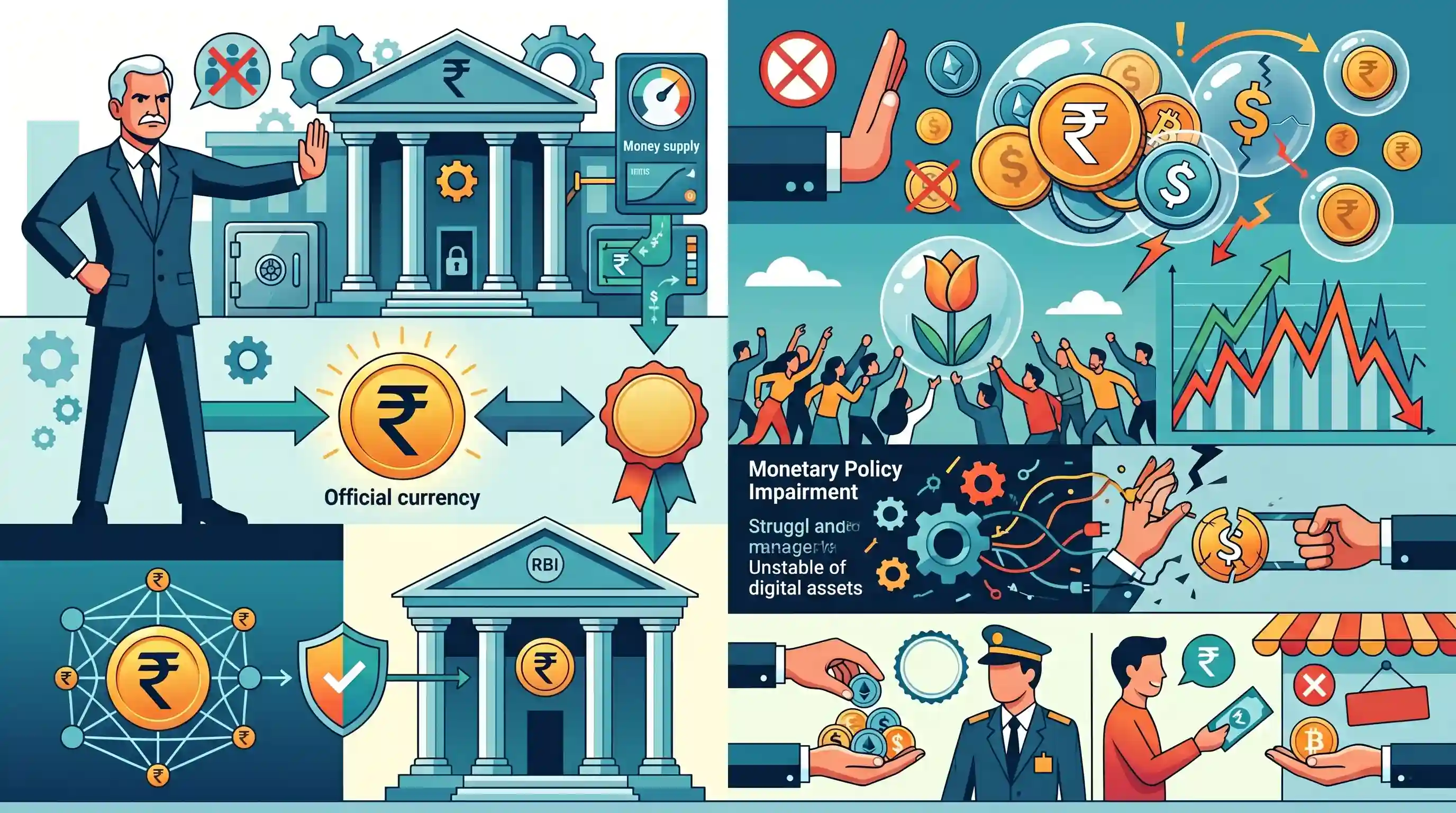
RBI Deputy Governor T. Rabi Sankar has firmly ruled out the need for stablecoins in India, arguing that they lack the fundamental "promise to pay" intrinsic to sovereign currency. He characterized cryptocurrencies, including Bitcoin, as speculative tools devoid of underlying cash flows or fundamental value, drawing comparisons to tulip mania. Sankar warned that the adoption of stablecoins could lead to price volatility and impair the RBI's ability to effectively conduct monetary policy. While the Finance Minister has suggested a need for countries to engage with stablecoins, the RBI maintains its strict stance against recognizing them as money. Currently, crypto transactions in India are subject to taxation, though cryptocurrencies are not legal tender.
Key Points
- RBI Deputy Governor T. Rabi Sankar ruled out the adoption of stablecoins in India, stating they lack the "promise to pay" that characterizes a sovereign fiat currency.
- Sankar argued that cryptocurrencies, including Bitcoin and stablecoins, lack underlying cash flows or fundamental value, comparing their speculative nature to the historical tulip mania.
- The RBI warns that recognizing stablecoins as money could induce price volatility and significantly undermine the central bank's capability to conduct effective monetary policy.
- Although the Finance Minister recently hinted at a need for global engagement with stablecoins, India currently taxes crypto transactions without granting them legal tender status.
- A clear distinction is drawn between the underlying blockchain technology, which may have utility, and the cryptocurrencies themselves, which are viewed merely as speculative tokens.
Important Terms
Stablecoins

Cryptocurrencies pegged to a reserve asset (like the US dollar or gold) to minimize price volatility; RBI warns they threaten sovereign monetary control.
UPSC context
GS-3 (Economy/S&T); tests understanding of fintech risks and the evolution of digital financial systems.
Virtual Digital Assets (VDA)
The legal classification under India's Income Tax Act for cryptocurrencies and NFTs; currently subject to 30% tax and 1% TDS.
UPSC context
GS-3 (Economy/Internal Security); relevant for taxation, digital market regulation, and money laundering prevention.
Central Bank Digital Currency (CBDC)
A digital form of sovereign currency (e.g., India's e-Rupee) issued by a central bank, functioning as a safe, regulated alternative to private cryptocurrencies.
UPSC context
GS-3 (Economy); core topic regarding digital economy, financial inclusion, and central bank innovation.
Monetary Policy
The RBI's framework for managing money supply and interest rates to maintain price stability while supporting economic growth.
UPSC context
GS-3 (Indian Economy); fundamental for understanding the RBI's role and inflation targeting.
Legal Tender
Currency mandated by law to be accepted for settling debts; in India, only sovereign-issued notes, coins, and CBDC hold this status.
UPSC context
GS-3 (Economy); tests knowledge of the legal definition of money versus private payment modes.
Dollarisation
When a foreign currency (typically USD) competes with or replaces domestic currency, undermining a nation's monetary independence.
UPSC context
GS-3 (Economy); highlights external risks to India's monetary sovereignty from global digital assets.
Fiat Money
Government-issued currency not backed by a physical commodity like gold, but by the "full faith and credit" of the issuing authority.
UPSC context
GS-3 (Economy); provides the conceptual basis for understanding modern currency and sovereign backing.
Prelims Trap
"Because cryptocurrency transactions are taxed in India, they have been granted legal tender status."
India taxes Virtual Digital Assets (VDAs) to capture revenue from speculation, but the RBI and government explicitly deny them legal tender status or recognition as fiat money.
Static Concepts Connected
What constitutes "fiat currency" and "legal tender" in India?
- Fiat Money: Issued by government decree, deriving value from regulation rather than being backed by a physical commodity like gold.
- Legal Tender: Recognized by law as a valid medium to settle financial debts and obligations (governed by the Coinage Act and RBI Act).
- Promise to Pay: Carries the RBI Governor's statutory promissory clause guaranteeing the value to the bearer (lacking in stablecoins).
How do private stablecoins threaten central bank Monetary Policy?
- Money Supply Control: If stablecoins replace the Rupee in daily transactions, the RBI loses its ability to control the domestic money supply.
- Interest Rate Transmission: Changes in the RBI's policy rates (like the repo rate) would fail to influence borrowing costs in a parallel crypto economy.
- Capital Flight Risk: Unregulated global stablecoins can easily bypass FEMA regulations, facilitating capital flight and straining India's forex reserves.
Cross-Topic Patterns
CBDC vs Private Stablecoins
While the RBI rejects stablecoins as a threat to independent monetary policy, it actively promotes the e-Rupee (CBDC) to provide digital efficiency backed by sovereign guarantee.
VDA Taxation vs Legal Tender Recognition
India's approach highlights a unique legal bifurcation: imposing a heavy 30% tax and 1% TDS on Virtual Digital Assets establishes a taxable asset class without conferring legal tender status.
Blockchain Utility vs Token Speculation
Government policy consistently separates the underlying distributed ledger technology (which it promotes for e-governance) from the speculative crypto tokens (which it restricts).

Expect a comparative Prelims question distinguishing CBDC, stablecoins, and fiat money based on intrinsic value and legal tender status.
Linked PYQs · 3
Linked PYQs · 3
- 2024PrelimsGS1
Consider the following statements in respect of the digital rupee : 1. It is a sovereign currency issued by the Reserve Bank of India (RBI) in alignment with its monetary policy. 2. It appears as a liability on the RBI's balance sheet. 3. It is insured against inflation by its very design. 4. It is freely convertible against commercial bank money and cash. Which of the statements given above are correct?
- 2023PrelimsGS1
With reference to Central Bank digital currencies, consider the following statements: 1. It is possible to make payments in a digital currency without using US dollar or SWIFT system. 2. A digital currency can be distributed with a condition programmed into it such as a time-frame for spending it. Which of the statements given above is/are correct?
- 2022PrelimsGS1
With reference to Non-Fungible Tokens (NFTs), consider the following statements : 1. They enable the digital representation of physical assets. 2. They are unique cryptographic tokens that exist on a blockchain. 3. They can be traded or exchanged at equivalency and therefore can be used as a medium of commercial transactions. Which of the statements given above are correct?
