RBI Defers Unique Transaction Identifier Rollout for Derivatives
Source:The Hindu ↗
Why It Matters
UPSC candidates must grasp the intricacies of India's money and financial markets, including the RBI's regulatory apparatus. Familiarity with terms like OTC derivatives, G-Secs, CCIL, and globally aligned frameworks (like UTI) is essential for Prelims (economy concepts) and GS3 Mains (financial stability and systemic risk management).
Summary
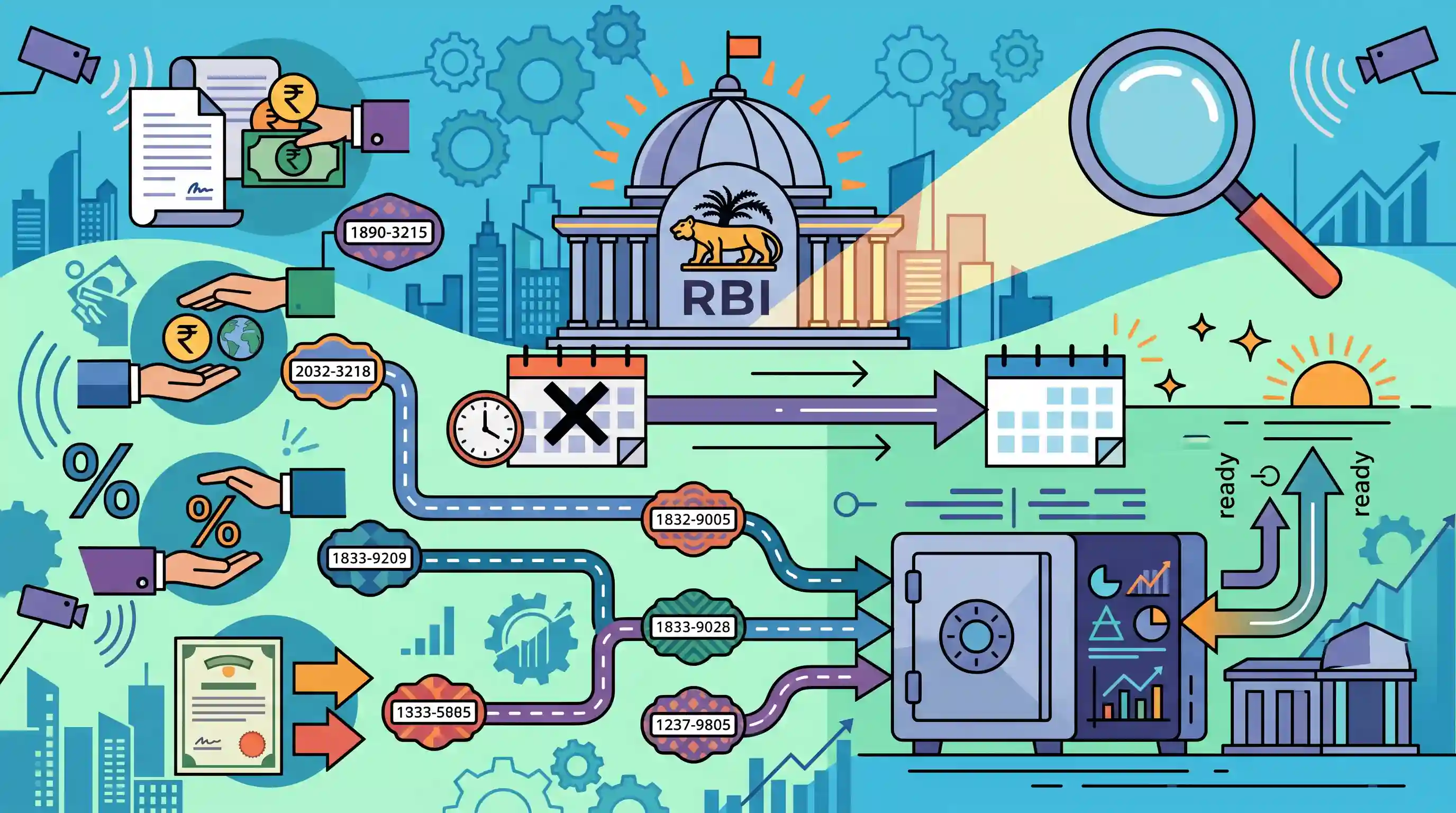
The Reserve Bank of India (RBI) has postponed the rollout of the Unique Transaction Identifier (UTI) for over-the-counter (OTC) derivative transactions to January 2027, revising its previous deadline of April 2026. The UTI will act as a globally standardized reference number for reporting trades—such as Rupee and foreign currency interest rate derivatives, credit derivatives, and forward contracts in G-Secs—to the Trade Repository managed by the Clearing Corporation of India Limited (CCIL-TR). This regulatory move aims to tighten systemic oversight and ensure comprehensive market surveillance.
Key Points
- The Reserve Bank of India (RBI) has deferred the mandatory implementation of the Unique Transaction Identifier (UTI) for all over-the-counter (OTC) derivative transactions from April 2026 to January 1, 2027.
- The UTI is designed to serve as a globally aligned, single unique reference code for every OTC derivative transaction to enhance market transparency.
- Instruments mandated for UTI reporting include Rupee interest rate derivatives, forward contracts in Government Securities, foreign currency derivatives, and credit derivatives.
- Transactions will be systematically reported to the Trade Repository managed by the Clearing Corporation of India Limited (CCIL-TR).
Important Terms
Unique Transaction Identifier (UTI)

A globally standardized 52-character alphanumeric code used to uniquely identify individual over-the-counter (OTC) derivative transactions. It ensures traceability across the trade lifecycle, facilitating better market surveillance and systemic risk assessment by regulators.
UPSC context
GS Paper III (Economy); tests knowledge of financial market transparency and global regulatory standards (CPMI-IOSCO) adopted by the RBI.
Clearing Corporation of India Limited (CCIL)
A specialized financial institution that acts as a central counterparty (CCP) for clearing and settling transactions in government securities, foreign exchange, and money markets. It manages the Trade Repository for OTC derivatives in India.
UPSC context
GS Paper III (Indian Economy); focuses on Financial Market Infrastructure (FMI) and institutions that mitigate systemic risk and ensure financial stability.
Over-the-Counter (OTC) Derivatives
Financial contracts (like swaps or forwards) negotiated and traded directly between two parties without the mediation of a formal stock exchange. While flexible, they carry higher counterparty risk compared to exchange-traded derivatives.
UPSC context
GS Paper III (Capital Markets); tests conceptual clarity on the distinction between organized exchanges and private bilateral financial contracts.
Trade Repository (TR)
A centralized registry that collects and maintains records of derivative transactions. It provides authorities with a comprehensive view of the market, helping to monitor concentration of risk and prevent market abuse.
UPSC context
GS Paper III (Regulatory Bodies); examines the mechanisms used by the RBI to enhance oversight in non-transparent financial segments.
Legal Entity Identifier (LEI)
A 20-character global reference code that uniquely identifies legal entities participating in financial transactions. It is a prerequisite for generating a UTI and is mandatory for various RBI-regulated reporting frameworks.
UPSC context
GS Paper III (Economy); relevant for questions on global financial integration and anti-money laundering (AML) tracking.
Central Counterparty (CCP)
An entity that interposes itself between counterparties in a trade, becoming the buyer to every seller and the seller to every buyer. This process, known as novation, reduces the risk of default.
UPSC context
GS Paper III (Economic Stability); tests understanding of risk mitigation strategies in high-volume financial markets.
Prelims Trap
"The Unique Transaction Identifier (UTI) is a SEBI-mandated code for all exchange-traded derivatives."
UTI is mandated specifically for Over-The-Counter (OTC) derivatives by the RBI, not for exchange-traded derivatives (which are primarily regulated by SEBI).
Static Concepts Connected
What differentiates OTC Derivatives from Exchange-Traded Derivatives?
- Customization: OTC contracts are custom-negotiated directly between private parties, whereas exchange-traded derivatives are standardized contracts traded on a formal platform.
- Counterparty Risk: OTC derivatives carry higher default risk due to the absence of a formal exchange, though institutions like CCIL help mitigate this in India.
- Regulatory Domain: RBI regulates OTC derivatives involving forex and interest rates, while SEBI oversees exchange-traded financial derivatives.
What is the role of the Clearing Corporation of India Limited (CCIL)?
- Settlement Guarantee: CCIL serves as a Qualified Central Counterparty (QCCP), guaranteeing the clearing and settlement for G-Secs, forex, and money market trades.
- Trade Repository: It functions as a centralized electronic database (Trade Repository) under RBI mandate to collect and maintain records of OTC derivative transactions.
Cross-Topic Patterns
G20 Post-2008 Crisis Reforms
The UTI and Trade Repository mandates fulfill G20 commitments made after the 2008 financial crisis to bring opaque, high-risk OTC derivatives under systemic regulatory surveillance globally.
LEI vs UTI in RBI surveillance
While the Legal Entity Identifier (LEI) identifies corporate parties in large cross-border or borrowing transactions, the UTI specifically tracks individual OTC derivative transactions.

Expect a Prelims statement confusing UTI with LEI, alongside a conceptual test of OTC vs Exchange-traded derivatives and CCIL's role.
Linked PYQs · 4
Linked PYQs · 4
- 2024PrelimsGS1
With reference to the Indian economy, "Collateral Borrowing and Lending Obligations" are the instruments of:
- 2024PrelimsGS1
Consider the following statements : 1. In India, Non-Banking Financial Companies can access the Liquidity Adjustment Facility window of the Reserve Bank of India. 2. In India, Foreign Institutional Investors can hold the Government Securities (G-Secs). 3. In India, Stock Exchanges can offer separate trading platforms for debts. Which of the statements given above is/are correct?
- 2022PrelimsGS1
With reference to the Indian economy, consider the following statements: 1. If the inflation is too high, Reserve Bank of India (RBI) is likely to buy government securities. 2. If the rupee is rapidly depreciating, RBI is likely to sell dollars in the market. 3. If interest rates in the USA or European Union were to fall, that is likely to induce RBI to buy dollars. Which of the statements given above are correct?
- 2024PrelimsGS1
In India, which of the following can trade in Corporate Bonds and Government Securities? 1. Insurance Companies 2. Pension Funds 3. Retail Investors Select the correct answer using the code given below:
