RBI Data Highlights Balance of Payments Deficit and Dollar Outflows
Source:The Hindu ↗
Why It Matters
The article provides a real-world case study of how external sector vulnerabilities—such as widening trade deficits and sudden capital flight (FPI withdrawals)—directly impact India's Balance of Payments and forex reserves. It highlights the macroeconomic triggers for government interventions like import duties and fuel price hikes, which are frequent topics in UPSC Prelims and Mains (GS3).
Summary
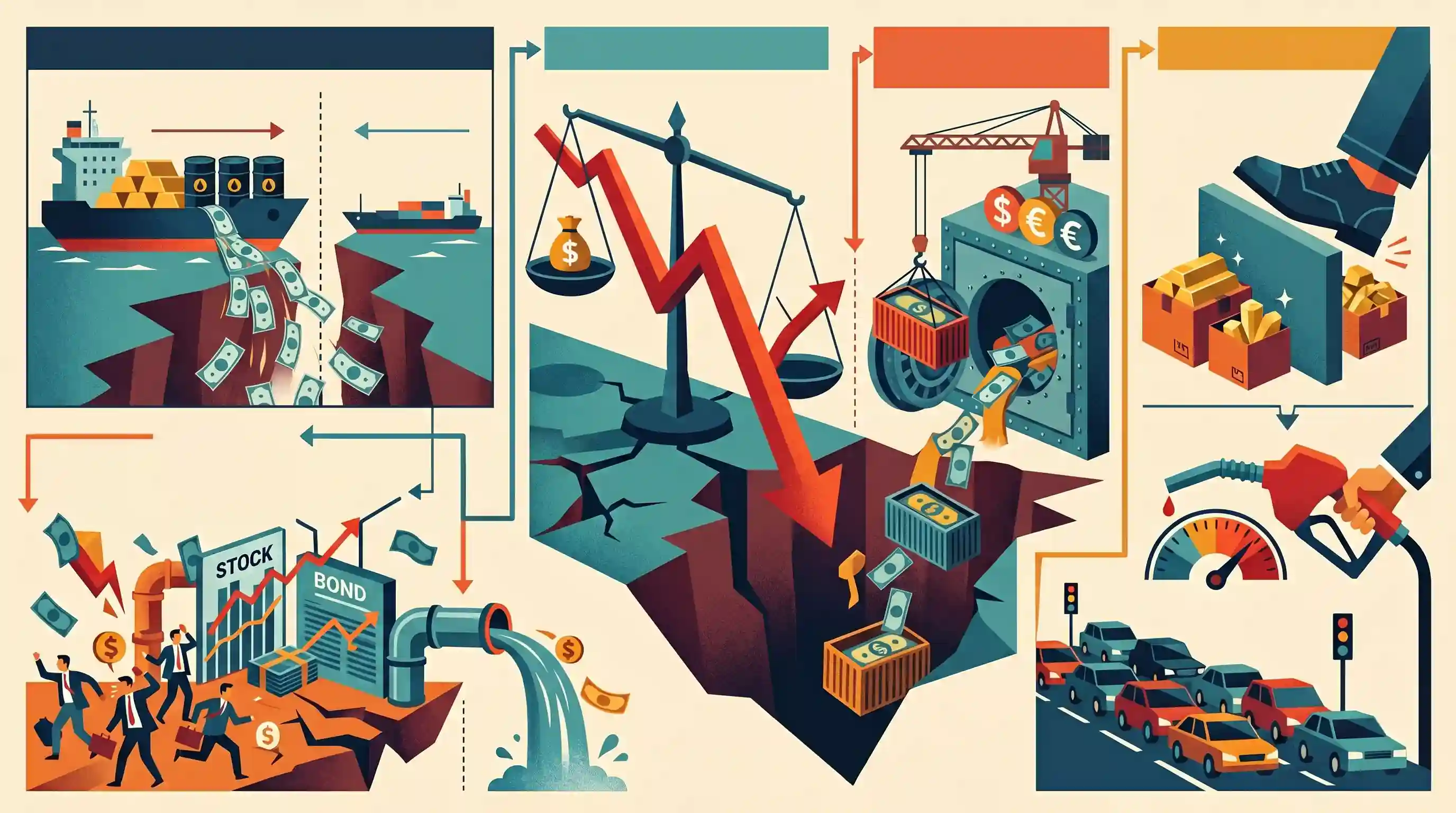
The Reserve Bank of India's (RBI) annual report for 2025-26 highlights a significant Balance of Payments (BoP) deficit of $30.8 billion, a drastic increase from the previous year. This deficit, indicating a net outflow of US dollars, was primarily caused by a widening Current Account Deficit (CAD) and a sharp decline in net foreign investments, resulting in capital flight. The shortfall had to be covered entirely by drawing down the RBI's foreign exchange reserves. In response to the massive dollar outflows—exacerbated by high imports of fuel and gold—the government has implemented remedial measures, including raising import duties on precious metals to 15% and increasing retail fuel prices to suppress domestic demand.
Key Points
- India's Balance of Payments (BoP) recorded a deficit of $30.8 billion in 2025-26, a six-fold increase from the previous year.
- The deficit was driven by a shrinking capital account surplus ($72 million) due to massive capital flight, with Foreign Portfolio Investors (FPIs) withdrawing $4.3 billion.
- The Current Account Deficit (CAD) reached a three-year high of $30.2 billion, as the surplus from services exports was insufficient to cover the $251.6 billion merchandise trade deficit.
- An additional $22.6 billion deficit emerged under the 'other capital' head, attributed to delayed export receipts, import advance payments, and funds parked abroad.
- The $30.8 billion BoP deficit was financed entirely by depleting the RBI's foreign exchange reserves.
- To curb dollar outflows, the government hiked import duties on gold and silver to 15%, restricted silver imports, and increased fuel prices.
Important Terms
Balance of Payments (BoP)

A systematic record of all economic and financial transactions between residents of a country and the rest of the world during a specific period.
UPSC context
GS III (Economy). Tests understanding of external sector stability and its components like the current and capital accounts.
Current Account Deficit (CAD)
A situation where the total value of goods, services, and transfers imported exceeds the total value of those exported.
UPSC context
GS III (Economy). Key indicator of economic health; tests knowledge of trade balance and currency depreciation.
Foreign Exchange Reserves
Assets held by the central bank in foreign currencies, gold, and Special Drawing Rights to manage exchange rates and meet external obligations.
UPSC context
GS III (Economy). Tests knowledge of RBI’s role as custodian and its intervention in currency markets.
Foreign Portfolio Investment (FPI)
Passive investment by foreign entities in financial assets like stocks and bonds without acquiring ownership or management control.
UPSC context
GS III (Economy). Relevant for understanding capital market volatility, "hot money," and foreign capital inflows.
Capital Flight
Rapid and large-scale outflow of financial assets from a country due to economic instability, policy changes, or better returns abroad.
UPSC context
GS III (Economy). Tests analysis of external shocks, investor confidence, and their impact on domestic currency and reserves.
Prelims Trap
"A BoP deficit implies India recorded a deficit in both its Current Account and Capital Account."
False. A BoP deficit occurs when the net combined balance is negative. A country can run a Capital Account surplus, but if the CAD is larger, the overall BoP is negative.
Static Concepts Connected
What are autonomous vs accommodating transactions in the Balance of Payments?
- Autonomous Transactions: These are transactions (like exports, imports, and FPI) undertaken for independent economic motives such as profit. They create the underlying BoP surplus or deficit.
- Accommodating Transactions: These are transactions undertaken specifically to bridge the BoP gap. The RBI drawing down foreign exchange reserves to cover a $30.8 billion deficit is an accommodating transaction.
How do import tariffs on gold impact India's macroeconomic balance?
- CAD Management: By raising duties (e.g., to 15%), the government artificially suppresses domestic demand for non-essential imports, helping to narrow a widening Current Account Deficit and preserve forex reserves.
- Smuggling Risk: While tariffs reduce formal dollar outflows, excessively high duties structurally incentivize illegal gold smuggling, which bypasses the official BoP recording systems.
Cross-Topic Patterns
Forex depletion and Imported Inflation
Depleting reserves limits RBI's ability to defend the rupee. A depreciating currency immediately inflates the import bill for inelastic goods like crude oil, transmitting global inflation into the domestic economy.
Global Interest Rates and FPI Flight
The sharp withdrawal of FPIs is tightly correlated with monetary policies in advanced economies. Rising yields in the US traditionally trigger immediate capital flight from emerging markets like India.

A multi-statement question testing the mechanics of BoP, specifically contrasting autonomous transactions with accommodating forex drawdowns.
Linked PYQs · 3
Linked PYQs · 3
- 2014PrelimsGS1
With reference to Balance of Payments, which of the following constitutes/constitute the Current Account? 1. Balance of trade 2. Foreign assets 3. Balance of invisibles 4. Special Drawing Rights Select the correct answer using the code given below.
- 2021PrelimsGS1
Consider the following : 1. Foreign currency convertible bonds 2. Foreign institutional investment with certain conditions 3. Global depository receipts 4. Non-resident external deposits Which of the above can be included in Foreign Direct Investments?
- 2022PrelimsGS1
With reference to the Indian economy, consider the following statements: 1. If the inflation is too high, Reserve Bank of India (RBI) is likely to buy government securities. 2. If the rupee is rapidly depreciating, RBI is likely to sell dollars in the market. 3. If interest rates in the USA or European Union were to fall, that is likely to induce RBI to buy dollars. Which of the statements given above are correct?
