Balance of Payments Deficit and Capital Outflow Concerns
Source:The Hindu ↗
Why It Matters
The structural vulnerabilities in India's Balance of Payments—driven by reliance on imported oil and gold, as well as volatile portfolio investments—are critical themes in GS3 (Indian Economy). Understanding how current account and capital account dynamics affect foreign exchange reserves and currency stability is a recurring focus in UPSC examinations.
Summary
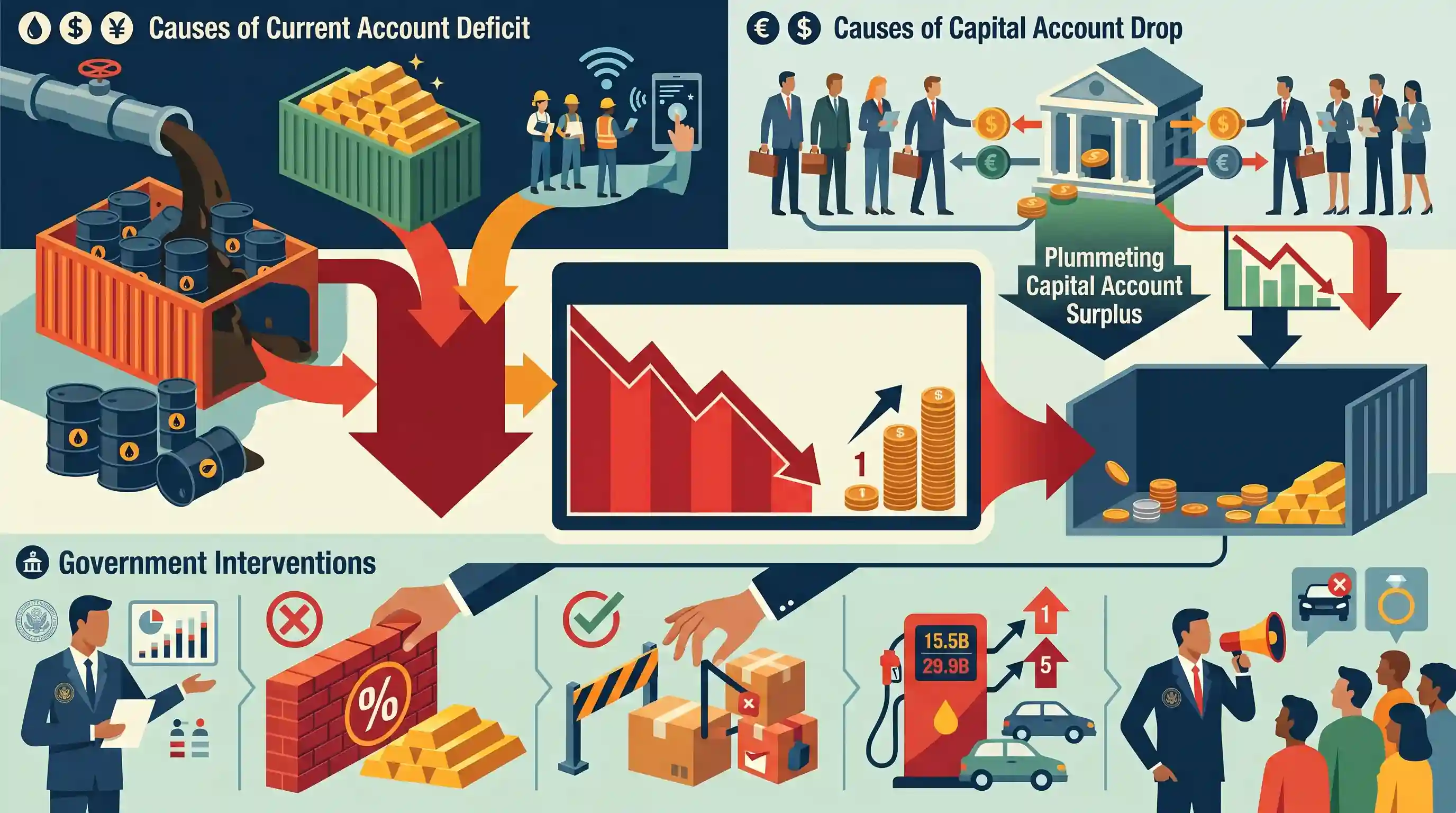
Reserve Bank of India (RBI) data has revealed a significant Balance of Payments (BoP) deficit of $30.8 billion for 2025-26, representing a six-fold increase in dollar outflows compared to the previous year. The outflow is attributed to a widening Current Account Deficit (CAD) driven by a stagnant services surplus, high oil import bills, and surging gold imports. Concurrently, the capital account surplus plummeted due to Foreign Portfolio Investors (FPIs) pulling out of the market and domestic capital flight. In response to the depleting foreign exchange reserves, the government has introduced policy interventions, including hiking import duties on precious metals to 15%, restricting certain imports, and increasing fuel prices, while urging citizens to limit non-essential consumption of oil and gold.
Key Points
- India recorded a massive Balance of Payments (BoP) deficit of $30.8 billion in 2025-26, nearly a six-fold increase from the previous year.
- The Current Account Deficit (CAD) widened as the services surplus shrank faster than the merchandise trade deficit, which remained high due to inelastic oil demand and surging gold imports.
- The capital account surplus saw a precipitous drop, driven by Foreign Portfolio Investors (FPIs) withdrawing capital and domestic residents moving funds abroad, resulting in significant capital flight.
- To stem dollar outflows, the government implemented policy measures such as raising import duties on gold and silver to 15%, restricting silver imports from Dubai, and hiking fuel prices.
Important Terms
Balance of Payments (BoP)

A systematic ledger recording all economic transactions between a country's residents and the rest of the world over a specified period, typically a year.
UPSC context
GS Paper III (Economy). Tests understanding of external sector stability and the impact of global transactions on the domestic economy.
Current Account Deficit (CAD)
A condition where the total value of imported goods, services, and transfers exceeds the value of exports. It signals that a nation is a net borrower.
UPSC context
GS Paper III (Economy). Tests ability to analyze trade imbalances, currency depreciation risks, and overall economic competitiveness.
Foreign Exchange Reserves
External assets including foreign currencies, gold, and Special Drawing Rights (SDRs) held by the central bank to manage BoP pressures and maintain currency stability.
UPSC context
GS Paper III (Economy). Tests understanding of macroeconomic buffers, import cover, and the RBI's role in economic shock absorption.
Foreign Portfolio Investment (FPI)
Passive investments by foreign entities in domestic financial assets like stocks and bonds without management control. These are highly liquid and sensitive to global market sentiment.
UPSC context
GS Paper III (Economy). Tests knowledge of volatile "hot money" flows and their impact on market stability.
Capital Account
A component of the BoP that records international transactions involving changes in the ownership of national assets and liabilities, including FDI, loans, and banking capital.
UPSC context
GS Paper III (Economy). Tests grasp of international finance and the financing of current account deficits through capital inflows.
Capital Flight
The rapid and large-scale outflow of financial assets from a country, typically triggered by economic instability, political uncertainty, or unfavorable domestic policy changes.
UPSC context
GS Paper III (Economy). Tests analysis of sudden outflows and their impact on currency value and reserve depletion.
Reserve Bank of India (RBI)
India's central bank and monetary authority responsible for regulating the banking system, managing foreign exchange, and controlling inflation through monetary policy.
UPSC context
GS Paper III (Economy). Tests knowledge of central banking functions and its role in maintaining macroeconomic stability.
Prelims Trap
A Current Account Deficit (CAD) always results in a Balance of Payments (BoP) deficit.
A CAD only causes a BoP deficit if it exceeds the Capital Account surplus. Often, strong FDI/FPI inflows (Capital surplus) completely offset the CAD.
Static Concepts Connected
What are the primary components of India's Current and Capital Accounts?
- Current Account: Includes merchandise trade (export/import of goods) and invisibles (services trade, net income, and private transfers/remittances).
- Capital Account: Captures financial flows including Foreign Direct Investment (FDI), Foreign Portfolio Investment (FPI), External Commercial Borrowings (ECBs), and NRI deposits.
How does 'Hot Money' differ from Foreign Direct Investment (FDI)?
- Hot Money (FPI): Short-term portfolio investments in stocks and bonds (FPI) that can be instantly liquidated and withdrawn, causing sudden capital flight during global shocks.
- FDI: Long-term investments involving physical assets or greater than 10% equity. It brings technology and is highly stable during economic crises.
Cross-Topic Patterns
Gold/Silver routing via UAE CEPA
Restricting Dubai silver imports connects macro-interventions to FTA loopholes, where traders use the India-UAE CEPA to bypass high domestic duties on precious metals.
Imported inflation via currency depreciation
As FPIs pull out, the Rupee depreciates. This makes inelastic imports like crude oil significantly more expensive, compounding domestic inflation pressures.

The interplay between capital flight, FPI withdrawals, and BoP deficit components is highly likely to feature in 2026 Economy Prelims.
Linked PYQs · 4
Linked PYQs · 4
- 2014PrelimsGS1
With reference to Balance of Payments, which of the following constitutes/constitute the Current Account? 1. Balance of trade 2. Foreign assets 3. Balance of invisibles 4. Special Drawing Rights Select the correct answer using the code given below.
- 2021PrelimsGS1
Consider the following : 1. Foreign currency convertible bonds 2. Foreign institutional investment with certain conditions 3. Global depository receipts 4. Non-resident external deposits Which of the above can be included in Foreign Direct Investments?
- 2022PrelimsGS1
Consider the following statements: 1. Tight monetary policy of US Federal Reserve could lead to capital flight. 2. Capital flight may increase the interest cost of firms with existing External Commercial Borrowings (ECBs). 3. Devaluation of domestic currency decreases the currency risk associated with ECBs. Which of the statements given above are correct?
- 2022PrelimsGS1
With reference to the Indian economy, consider the following statements: 1. If the inflation is too high, Reserve Bank of India (RBI) is likely to buy government securities. 2. If the rupee is rapidly depreciating, RBI is likely to sell dollars in the market. 3. If interest rates in the USA or European Union were to fall, that is likely to induce RBI to buy dollars. Which of the statements given above are correct?
