RBI Lowers Daily CRR Maintenance to Free Up Liquidity
Source:The Hindu ↗
Why It Matters
This article highlights operational changes in central banking instruments like the Cash Reserve Ratio (CRR), offering key insights into systemic liquidity management and monetary policy transmission mechanisms relevant for UPSC Civil Services GS Paper 3.
Summary
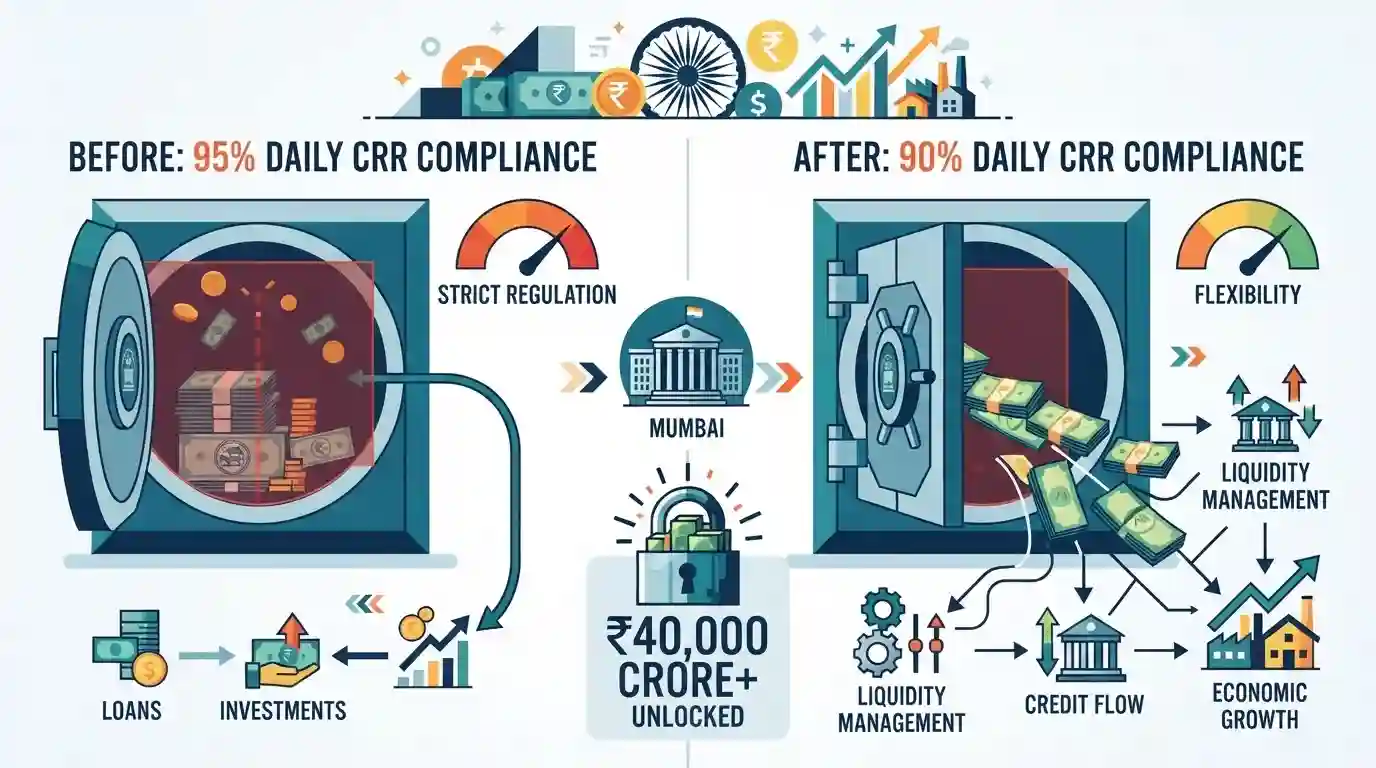
The Reserve Bank of India (RBI) lowered the minimum daily Cash Reserve Ratio (CRR) maintenance requirement for scheduled commercial banks from 95% to 90%. This policy tweak enables banks to optimize liquidity management and unlocks more than ₹40,000 crore in the financial system by granting greater flexibility in daily cash reserve compliance while keeping the overall CRR percentage unchanged.
Key Points
- The Reserve Bank of India reduced the daily Cash Reserve Ratio (CRR) maintenance requirement for scheduled commercial banks from 95% to 90%.
- This regulatory adjustment unlocks over ₹40,000 crore of liquidity in the banking system.
- The measure aims to provide banks with greater operational flexibility in managing their day-to-day cash flows and liquidity buffers without altering the overall monetary policy stance.
Important Terms
Cash Reserve Ratio

The minimum percentage of a bank's Net Demand and Time Liabilities (NDTL) that scheduled commercial banks must keep as liquid cash reserves with the RBI.
UPSC context
GS Paper III (Indian Economy - Monetary Policy and Banking System). Tests understanding of central bank instruments for liquidity management.
Reserve Bank of India
India's central banking institution, established under the RBI Act of 1934, responsible for regulating the monetary system, issuing currency, and managing foreign exchange reserves.
UPSC context
GS Paper II & III (Constitution, Polity & Governance / Indian Economy). Tests knowledge of apex regulatory institutions.
Scheduled Commercial Banks
Banks listed in the Second Schedule of the RBI Act, 1934, which meet statutory capital thresholds and qualify for specialized central bank borrowing and clearing facilities.
UPSC context
GS Paper III (Indian Economy - Banking Structure). Frequently tested in the context of institutional classifications and monetary policy transmission.
Static Concepts Connected
What is the distinction between CRR and SLR in India's banking system?
- CRR Definition: CRR requires banks to hold a specified percentage of their net demand and time liabilities (NDTL) as cash with the RBI.
- SLR Definition: SLR requires banks to maintain a specified percentage of NDTL in liquid assets like gold or approved government securities.
- No Interest Earned: Neither CRR nor SLR earns interest for the commercial banks, acting as both safety buffers and monetary policy instruments.
Cross-Topic Patterns
Monetary Policy Transmission vs Banking Liquidity
Changes in reserve ratios directly alter the marginal cost of funds and transmission speed of RBI rate cuts to commercial lending rates.
CRR Flexibility and Money Market Dynamics
Regulatory adjustments in CRR compliance thresholds impact short-term money market rates like the call money rate and collateralized borrowing.

Expect a statement-based question separating 'overall CRR rate changes' from 'daily maintenance compliance threshold adjustments'.
Linked PYQs · 4
Linked PYQs · 4
- 2023PrelimsGS1
Which one of the following activities of the Reserve Bank of India is considered to be part of 'sterilization'?
- 2021PrelimsGS1
The money multiplier in an economy increases with which one of the following?
- 2020PrelimsGS1
If the RBI decides to adopt an expansionist monetary policy, which of the following would it not do ? 1. Cut and optimize the Statutory Liquidity Ratio 2. Increase the Marginal Standing Facility Rate 3. Cut the Bank Rate and Repo Rate Select the correct answer using the code given below:
- 2024MainsGS3
What are the causes of persistent high food inflation in India? Comment on the effectiveness of the monetary policy of the RBI to control this type of inflation.
