RBI cash reserve ratio cut to inject banking system liquidity
Source:The Hindu ↗
Why It Matters
This is a major structural intervention by the RBI, representing a rare and steep 1% cut in the CRR. It is highly relevant for the UPSC GS3 syllabus on the Indian Economy, specifically regarding the central bank's tools for managing systemic liquidity, credit creation, and the money multiplier effect in the banking sector.
Summary
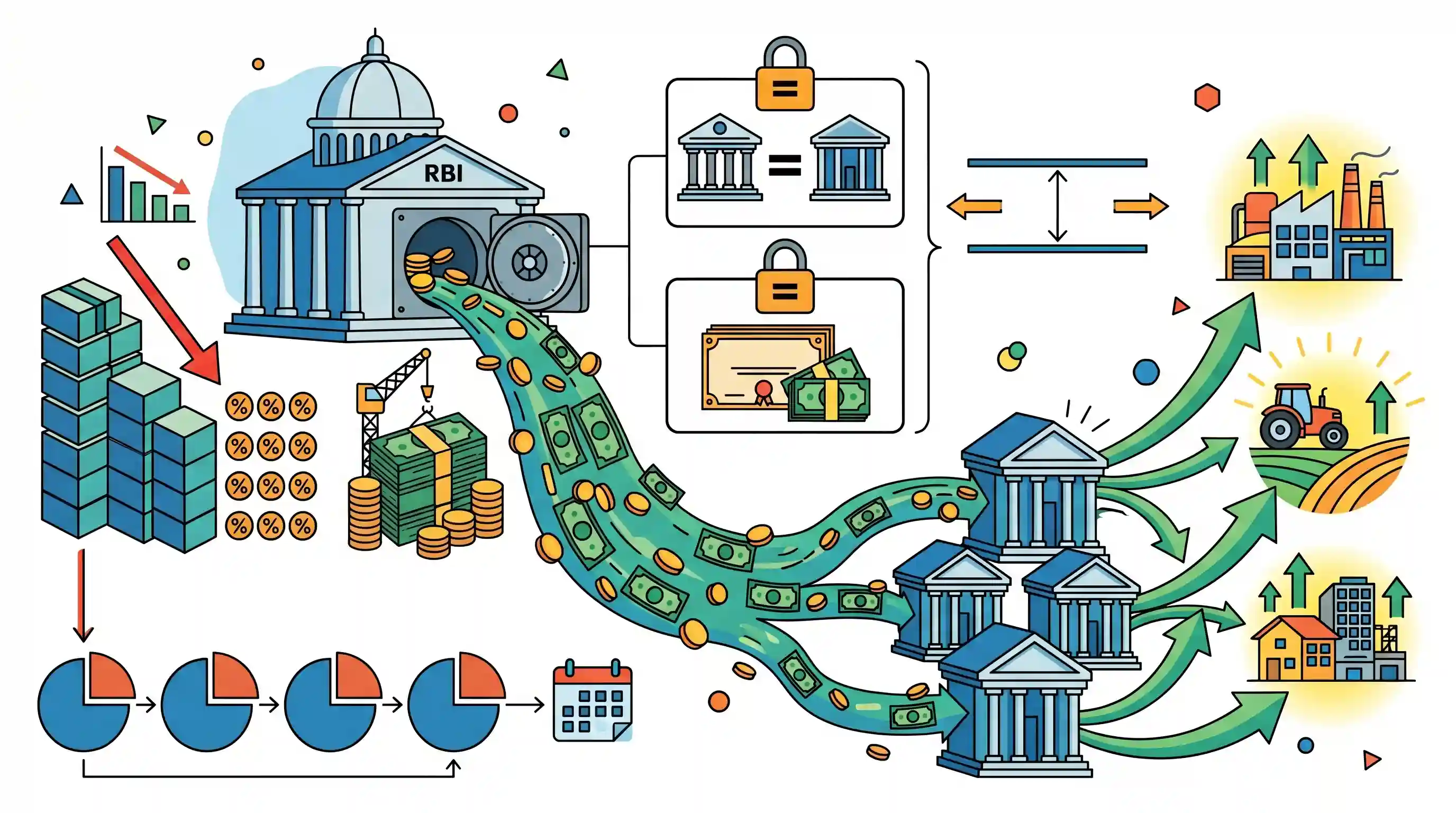
The Reserve Bank of India (RBI) has announced a significant reduction in the Cash Reserve Ratio (CRR) by 100 basis points (1%), aiming to inject around ₹2.5 lakh crore of primary liquidity into the banking system by the end of December 2025. The reduction will be carried out in four equal tranches of 25 basis points each. While the benchmark repo rate and the Statutory Liquidity Ratio (SLR) remain unchanged, the RBI has widened the Liquidity Adjustment Facility (LAF) corridor to 75 basis points. This structural shift in monetary policy is designed to address liquidity shortages, lower banks' cost of funds, and facilitate smoother credit flow to support broader economic growth.
Key Points
- The RBI announced a steep 100 basis points (1%) cut in the Cash Reserve Ratio (CRR), lowering it from 4.5% to 3.5% (effective down to 3% as detailed over four tranches).
- This policy action will inject approximately ₹2.5 lakh crore of primary liquidity into the banking system by late December 2025.
- The CRR cut will be implemented in four equal phases (Dec 14, Dec 28, Jan 11, and Jan 25) to smooth out liquidity absorption.
- The Statutory Liquidity Ratio (SLR) remains unchanged at 18%, and the benchmark repo rate is also maintained.
- The RBI widened the Liquidity Adjustment Facility (LAF) corridor to 75 basis points by modifying the SDF and MSF rates to allow greater flexibility in liquidity management.
- The move aims to address frictional liquidity shortages, reduce banks' cost of funds, and stimulate credit flow for economic growth.
Important Terms
Cash Reserve Ratio (CRR)

The share of a bank's total deposits (Net Demand and Time Liabilities) that must be maintained as cash with the RBI. It earns no interest and regulates economy-wide liquidity.
UPSC context
GS-3 Economy; critical quantitative tool for inflation control and managing the money multiplier effect.
Liquidity Adjustment Facility (LAF)
The primary framework used by the RBI to manage day-to-day liquidity mismatches through Repo and Reverse Repo operations, helping steer the overnight call money rate.
UPSC context
GS-3 Economy; tests understanding of monetary policy transmission and operational targets like the WACR.
Standing Deposit Facility (SDF)
A collateral-free liquidity absorption tool that serves as the floor of the LAF corridor. It allows banks to park surplus funds with the RBI at a specific rate.
UPSC context
GS-3 Economy; reflects recent shifts in monetary framework (Urjit Patel Committee) and collateral-free absorption.
Marginal Standing Facility (MSF)
A window for banks to borrow overnight from the RBI during emergency liquidity shortages by pledging SLR-eligible securities. It forms the ceiling of the LAF corridor.
UPSC context
GS-3 Economy; functions as a safety valve for the banking system and an interest rate cap.
Statutory Liquidity Ratio (SLR)
The minimum percentage of deposits that banks must maintain in liquid assets like gold, cash, or government securities. It ensures bank solvency and facilitates government borrowing.
UPSC context
GS-3 Economy; statutory requirement governing bank asset composition and credit flow to productive sectors.
Repo Rate
The benchmark interest rate at which the RBI lends money to commercial banks against government securities. It is the core signal of the central bank's monetary stance.
UPSC context
GS-3 Economy; primary instrument of the Monetary Policy Committee (MPC) for inflation targeting and growth.
Prelims Trap
Commercial banks earn interest from the RBI on the CRR balances maintained with it.
The RBI pays zero interest on CRR. Cutting CRR helps banks precisely because it frees up this unremunerated cash for profitable lending.
Static Concepts Connected
How do CRR and SLR differ in composition and returns?
- Composition: CRR must be maintained only as cash balances with the RBI. SLR can be maintained as cash, gold, or approved government securities (G-Secs).
- Returns: Banks earn absolutely no interest on CRR balances. Conversely, SLR assets like G-Secs generate regular interest income for the banks.
- Maintenance: CRR limits are maintained daily with the RBI, whereas SLR is maintained by the banks themselves in liquid form.
What constitutes the Liquidity Adjustment Facility (LAF) Corridor?
- The Corridor: It is the interest rate spread between the Marginal Standing Facility (MSF) rate (upper bound) and the Standing Deposit Facility (SDF) rate (lower bound).
- Policy Utility: A wider corridor gives the RBI greater flexibility to absorb or inject overnight liquidity without needing to alter the benchmark Repo Rate.
Cross-Topic Patterns
Monetary Transmission via CRR
Without cutting the repo rate, lowering CRR frees up unremunerated capital. This reduces banks' overall cost of funds, indirectly boosting lending and aiding monetary transmission.
The Money Multiplier Effect
A reduction in the reserve ratio (CRR) directly increases the money multiplier, mathematically expanding the broad money supply (M3) in the macroeconomic system.

Expect a 2026 prelims multi-statement question contrasting SDF vs MSF, and how widening the LAF corridor alters overnight liquidity.
Linked PYQs · 4
Linked PYQs · 4
- 2021PrelimsGS1
The money multiplier in an economy increases with which one of the following?
- 2020PrelimsGS1
If the RBI decides to adopt an expansionist monetary policy, which of the following would it not do ? 1. Cut and optimize the Statutory Liquidity Ratio 2. Increase the Marginal Standing Facility Rate 3. Cut the Bank Rate and Repo Rate Select the correct answer using the code given below:
- 2024PrelimsGS1
With reference to the Indian economy, "Collateral Borrowing and Lending Obligations" are the instruments of:
- 2024MainsGS3
What are the causes of persistent high food inflation in India? Comment on the effectiveness of the monetary policy of the RBI to control this type of inflation.
