RBI Outlines Priorities to Safeguard Financial System Stability
Source:The Hindu ↗
हे का महत्त्वाचे आहे
Understanding the central bank's evolving regulatory approach to financial stability is crucial for GS3 aspirants studying banking sector reforms, systemic risks, and monetary policy management in India.
सारांश
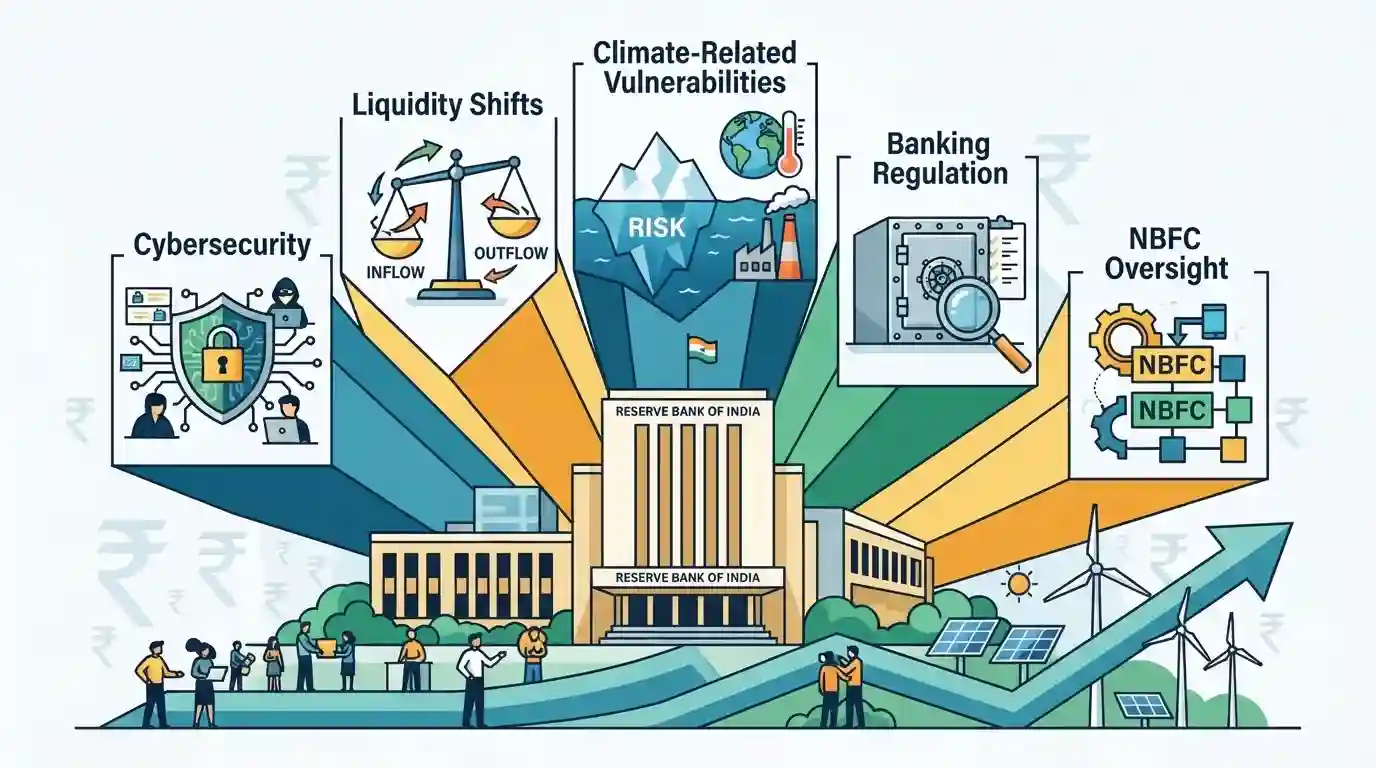
The RBI chief outlined five key strategic priorities focused on preserving financial stability in the face of emerging modern risks like cybersecurity, liquidity shifts, and climate-related vulnerabilities, reinforcing the regulatory framework for banks and non-banking financial companies (NBFCs).
मुख्य मुद्दे
- The RBI chief outlined 5 key priorities to maintain financial stability amid emerging macroeconomic and systemic risks.
- Focus areas include addressing cybersecurity threats, managing liquidity risks, strengthening governance and credit underwriting standards, monitoring interconnectedness in the financial ecosystem, and safeguarding against climate-related financial vulnerabilities.
- Emphasized proactive risk management by banks and NBFCs to insulate the domestic economy from external shocks.
महत्त्वाच्या संज्ञा
Reserve Bank of India

India's central banking institution, established under the RBI Act of 1934, responsible for regulating monetary policy, issuing currency, and maintaining financial stability.
UPSC context
UPSC GS Paper III (Indian Economy - Banking and Financial Stability). Tests knowledge of central bank mandates, regulatory mechanisms, and systemic risk management.
Non-Banking Financial Companies (NBFCs)
Financial institutions registered under the Companies Act that provide banking services without holding a full banking license, regulated stringently by the RBI to mitigate systemic contagion risks.
UPSC context
UPSC GS Paper III (Growth, Development, and Banking Sector Reforms). Evaluates understanding of shadow banking regulation and non-bank financial intermediation risks.
Financial Stability
The condition in which the financial system—comprising intermediaries, markets, and payment infrastructures—is resilient to economic shocks and capable of smoothly facilitating financial intermediation.
UPSC context
UPSC GS Paper III (Mobilization of Resources and Economic Stability). Tests comprehension of macroprudential policy, systemic resilience, and emerging financial risks.
Cybersecurity Risks
Measures taken by financial institutions and regulators to protect digital assets, networks, and IT infrastructure from emerging cyber threats, including AI-driven attacks and third-party tech dependencies.
UPSC context
UPSC GS Paper III (Internal Security and Financial Sector Regulation). Essential for questions on modern digital threats to critical national financial infrastructure.
पूर्वपरीक्षा सापळा
RBI's regulatory framework and macroprudential mandates extend uniformly across all financial market intermediaries and capital market participants.
Aspirants often confuse RBI's direct regulatory jurisdiction over cooperative banks (extended recently) with non-banking entities or financial markets regulated by SEBI/IRDAI.
संबंधित स्थिर संकल्पना
What are the core instruments of monetary policy and macroprudential regulation used by the RBI?
- Rate Tools: Policy rates including Repo, Reverse Repo, and MSF used to manage system-wide liquidity and signal stance.
- Reserve Ratios: Statutory liquidity ratios (SLR) and Cash Reserve Ratio (CRR) serving as structural liquidity cushions.
- Macroprudential Buffers: Countercyclical capital buffers and risk-weight adjustments deployed to curb excessive credit growth in specific vulnerable sectors.
आंतर-विषय नमुने
Green Finance & Prudential Regulation
Climate risk disclosures intersect with RBI's green taxonomy and SEBI's Business Responsibility and Sustainability Reporting (BRSR) mandate.
Cybersecurity & Critical Infrastructure Protection
Cybersecurity resilience protocols tie regulatory mandates to national critical information infrastructure protection and CERT-In guidelines.

RBI's multi-layered supervisory framework (NBFCs + climate risk + liquidity) is a hot favourite for Prelims statement-based MCQs.
संबंधित PYQ · 2
संबंधित PYQ · 2
- 2022PrelimsGS1
In India, which one of the following is responsible for maintaining price stability by controlling inflation?
- 2023PrelimsGS1
Which one of the following activities of the Reserve Bank of India is considered to be part of 'sterilization'?
